

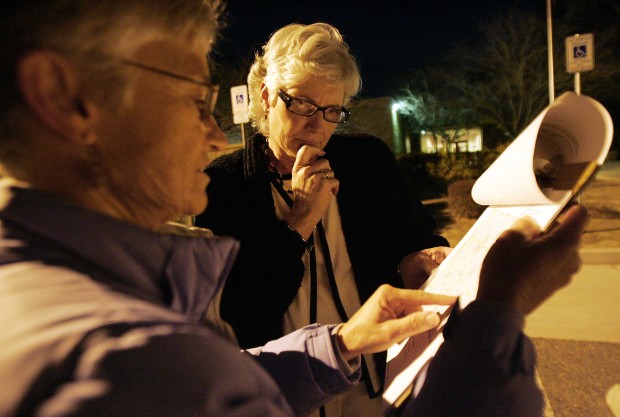
Leslie Carlson spent part of Tuesday night driving around Tucson's south side searching for those who live on the streets.
She is a volunteer in the 2010 Annual Homeless Street Count, which took place across Arizona on Tuesday. The goal is to come up with an accurate count of an area's homeless population.
Volunteers spread out through the metro area, checking in washes, parks, under overpasses and in other areas where homeless people are likely to camp. Working in teams, they record the number of homeless people they encounter or get information from another person.
"It's our best effort at getting a feeling of how many homeless people are in Tucson," Carlson said.
Though numbers weren't immediately available, local officials had no doubt the continuing economic slump has left more people on the street, especially considering the jumps reported in the past two years.
People are also reading…
Organized locally by the Tucson Planning Council for the Homeless, this year's count also could have increased significance as agencies providing services to the homeless population are beset with budget woes.
According to a report released in December by the Arizona Department of Economic Security, during a comprehensive survey in 2009 nearly 15,000 people were reported as homeless in Arizona. Of those, about 25 percent were in Pima County.
During last year's street count, nearly 1,400 people in Pima County were counted as unsheltered or living on the street - a 25 percent increase compared with the 2007 total.
While these figures serve to paint a picture of homelessness in Tucson, officials say, it's far from the reality because the count fails to identify those who are staying with friends and family or living out of their vehicles.
"We know that we are grossly underestimating our homeless population," said Laurie Mazerbo, street count co-chair and manager of Our Family's Teens in Transition program.
In an effort to increase accuracy, this year's local count was scheduled for 6:30 p.m. rather than the traditional 4:30 a.m. launch. Not only did an evening count attract more volunteers and better coincide with an annual shelter survey conducted statewide, it will hopefully allow for more precision because those staying in shelters will have turned in for the night.
The results of the count, which is required by Department of Housing and Urban Development, help to bring in more than $7 million to local agencies that serve the homeless population.
Though there are close to 13,000 year-round beds in Arizona, HUD estimates an unmet need of about 17,000 individual and family beds. This includes 5,900 emergency shelter beds. And the situation has worsened in the last year.
"The numbers keep going up, and the funding keeps going down," Mazerbo said. "We are stretching our dollars farther and farther, and that goes for all organizations."
At Our Family, the annual budget has decreased from $5 million for the fiscal year 2008-09 to $3.7 million in 2009-0. The cuts have resulted in several layoffs, and the agency has had to reduce the size of some programs. All the while, more people have been coming through the door.
"I have stopped taking a waiting list for housing because when you say 'waiting list,' people think they might get into housing, and I don't want to give them any false hope," Mazerbo said.
According to HUD, families experiencing homelessness continue to be the fastest growing segment of homeless people - a trend Mazerbo said is all-too-evident.
"There is definitely a new face of homelessness," she said.
At the Primavera Foundation, budget cuts have resulted in the scaling down of the relief and referral program, and Executive Director Peggy Hutchison said the Foreclosure Prevention and Mitigation Program has been "overwhelmed by families in economic crisis struggling to keep their home."
At Open Inn, Executive Director Nancy Panico said the budget has been reduced by 10 percent, or roughly $300,000.
"In March and April we had to eliminate eight positions out of about 55," Panico said. "We had to shut down one of our facilities in Flagstaff, which essentially cut our number of shelter beds for youth in half."
Though its emergency facility, the Center for Juvenile Alternatives, is no longer open 24 hours a day, the agency is seeing more youth than ever before. She added that its independent living facility is operating at full capacity.
"This is unprecedented what we are seeing now," Panico said. "If somebody handed us 20 apartments tomorrow, we could probably fill them."
When numbers for this year's street count are released, Mazerbo hopes they will reflect the severity of the situation. With more than 130 volunteers, she said, they have a lot of ground to cover.
Bethany Conway is a University of Arizona journalism student who is apprenticing at the Star. Contact her at 573-4198 or at starapprentice@azstarnet.com.

 Lake Mead's drops raise prospect of unaffordable Hoover Dam electricity


