

The Kensington and Scajaquada expressways could be big beneficiaries after a decision Monday by Rep. Brian Higgins and State Sen. Tim Kennedy to back away from a New York State study on the Skyway's removal.
The two expressway projects were already expected to vie for an anticipated windfall of federal dollars for infrastructure improvements.
"Certainly, without a doubt, the 33 is the big beneficiary of Higgins and Kennedy's decision," Assemblyman Pat Burke said of the Kensington. "I think it's pretty widely accepted."
Gov. Andrew M. Cuomo recently urged Western New York leaders to reach a consensus on which big-ticket projects they want to prioritize as the state prepares for what could be a once-in-a-generation opportunity for major projects under President Biden's proposed $2.3 trillion infrastructure plan.
Higgins has long championed the removal of the Skyway, a position Cuomo shares. But community-driven efforts are calling for a section of Humboldt Parkway to be restored by building a deck over part of the Kensington, while another effort seeks to downgrade or remove the Scajaquada Expressway.
People are also reading…
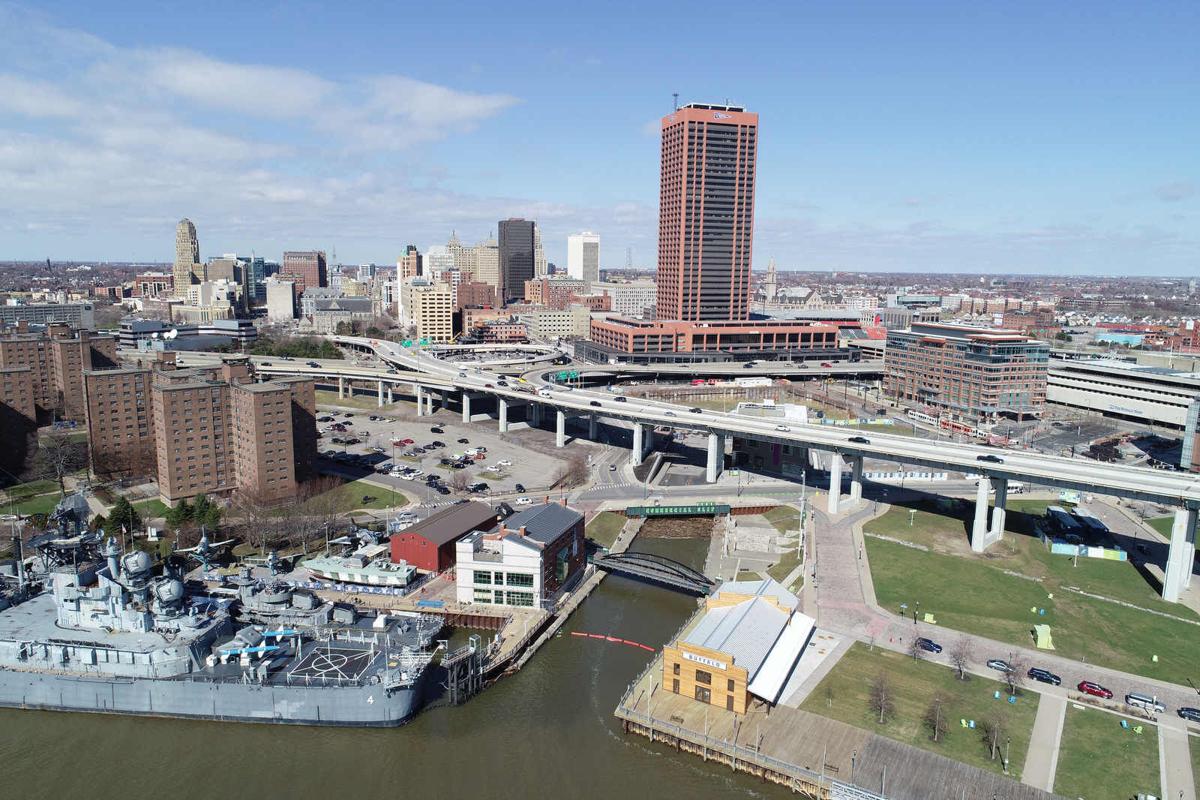
The #BNdrone provides a unique view of the Skyway, built in 1955, a 110-foot-tall highway connecting downtown Buffalo to the Outer Harbor on Route 5. Its height was to accommodate the massive lake freighters that pass beneath to reach grain elevators in the Buffalo River and Shipping Channel. Loathed by many for the way it cuts off access to the waterfront, there is increasing talk of plans to demolish the highway.
The surprising announcement by Higgins and Kennedy to distance themselves from the Skyway study came after a lack of success in convincing the state Department of Transportation to create an at-grade alternate route with an accompanying park, along with other commuter enhancements.
"The bottom line is, they are getting ready to issue an environmental impact statement that I can't support in terms of the alternatives," Higgins said. "I don't want to replace one elevated highway for another."
The state Department of Transportation said the project's study will continue.
"We are disappointed with today's announcement," said DOT spokesman Joe Morrissey. "New York has worked to accelerate the draft environmental impact statement in record time and remains committed to delivering a project that has strong community support."
Morrissey said the additions to the project that Higgins and Kennedy proposed lacked community support and would not have been compliant with the Federal Highway Administration's standards for roadway safety and level of service.
The additions would have also significantly increased the project's cost and timeline, he said.
Higgins' decision to pull back on his pressure to remove the Skyway was a turnabout. He has long wanted the Skyway to come down, and his position on the influential House Ways and Means Committee puts him in a position to help deliver a once-in-a-generation amount of federal infrastructure money to Western New York.
Higgins and Kennedy are instead calling for a number of projects they say will better prepare Buffalo and the Southtowns for the eventual removal of the Skyway, including the removal of the Hamburg tolls. But that price tag is expected to be far less than the $600 million projected by the state Department of Transportation for removing the Skyway, replacing it with an alternate route and other construction costs.
Burke applauded Higgins and Kennedy's decision.
"It's great that they have seen the writing on the wall and changed course," said Burke, whose district represents several Southtown communities.
Kennedy was the only person among the six Democrats in the Western New York Assembly and two state senators to support the Skyway's removal.
In February, five of the Assembly members wrote a letter to Transportation Secretary Pete Buttigieg, urging that the Kensington Expressway and the reestablishment of an electrified streetcar system in Buffalo take priority over the Skyway.
State Sen. Sean Ryan, a backer of the Scajaquada and Kensington expressway projects, believes the Skyway announcement moves both projects to the front of the line. Ryan sees both projects as connected since they would restore a section of Humboldt Parkway that was destroyed to make way for the highway, shattering neighborhoods in the process.
"Restoring Olmsted's parkways will reunite neighborhoods and right historic wrongs, and fits squarely within President Biden's infrastructure priorities," Ryan said. "Now we can really talk about how to reconnect Delaware Park with Martin Luther King Park."
Kennedy, who chairs the State Senate Transportation Committee, said he will work to make those projects a reality.
"While the Skyway's future may be on hold for now, we will continue to drive an aggressive agenda forward to secure a substantial federal investment that will fuel other big-ticket projects that are long overdue," Kennedy said.
While the Skyway and Scajaquada projects are further along with federally required environmental impact statements than the Kensington, the Biden administration has made removing highway projects that devastated neighborhoods a priority even, it appears, if they are behind in being reviewed.
Higgins and Kennedy are calling for the removal of the Hamburg tolls; more efficient stoplight patterns to ease travel for commuters through city streets on the East Side and in South Buffalo; and a new parkway, park and bike path at Tifft Street that would connect South Buffalo and Buffalo Harbor State Park.
They also want to see a new Louisiana Street bridge that would cross the Buffalo River at the I-190; an on-ramp at Lake Avenue to take Southtowns residents to the 90 to connect to the 190; and a Thruway turning lane at Milestrip Road, which they say is also necessary for commuters.
"All of this other stuff would have to be done before the Skyway came down, anyway," Higgins said.
The congressman said the state DOT has a framework and culture that makes it unable to look at projects beyond their impact on traffic, which he said had been a continual source of frustration. He also faulted the DOT for not preparing renderings to show the public the changes he proposed.
But Morrissey said the renderings Higgins requested would have been for an alternate proposal not included in the draft environmental impact statement, and for which the federal government and community displayed no support.
Cuomo has fast-tracked the federally required Skyway study, with a target completion date by the end of the year, and Higgins acknowledged it was disappointing to conclude the changes he envisioned won't happen.
"There is an opportunity for the governor's office and the DOT to do a reset," Higgins said.
Higgins said the recent $34 million spent on maintaining the Skyway may now need to run its course.
"We may have to get a life cycle on that investment," he said.
Mark Sommer covers preservation, development, the waterfront, culture and more. He's also a former arts editor at The News.


