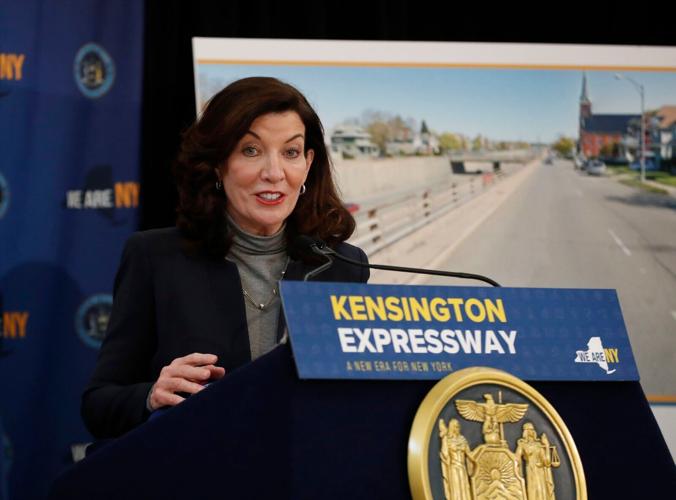
Gov. Kathy Hochul reinforced her commitment to converting a section of the Kensington Expressway that runs through the East Side into a below-ground tunnel while speaking Saturday morning at the Buffalo Museum of Science.
The governor announced the required federal environmental review of the project "begins immediately."
"It's really important to me to start putting the resources behind this," Hochul said. "This community has literally been splintered apart. Righting the wrongs of the past is so smart for countless reasons, and they all tie into my philosophy of connecting communities once again and also stimulating the economic development and affordable housing opportunities."

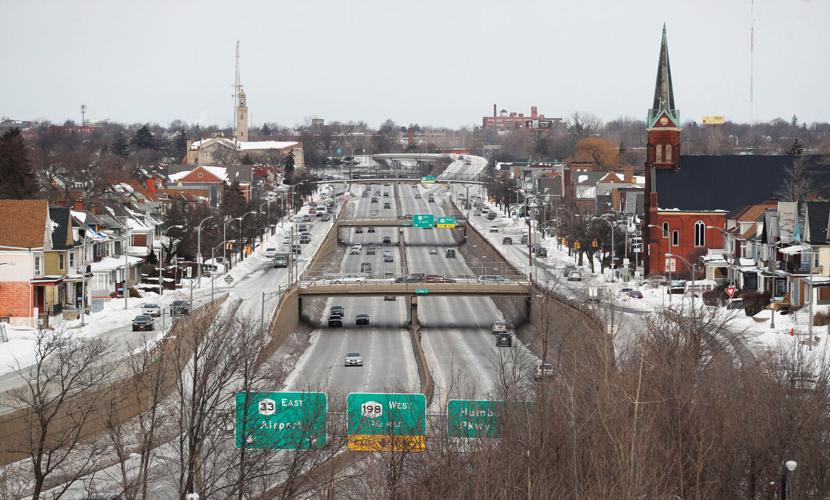
Gov. Kathy Hochul announced Saturday at the Buffalo Museum of Science that New York State is beginning an environmental study of the Kensington Expressway. A leading plan would see the highway capped and made into a tunnel from Best to Easy Ferry streets, a portion of which is seen here.
Hochul made her comments, similar to ones made during her State of the State address earlier this month, as part of a broader commitment to reconnecting neighborhoods torn apart more than a half century ago by highway projects. She has also prioritized the removal of portions of the I-81 in Syracuse, the Inner Loop in Rochester and the Cross Bronx Expressway.
People are also reading…
"It's been done before with great success," Hochul said in reference to the removal of the East Inner Loop highway in Rochester in 2017, which enhanced walkability and jump-started 6 acres of economic development.
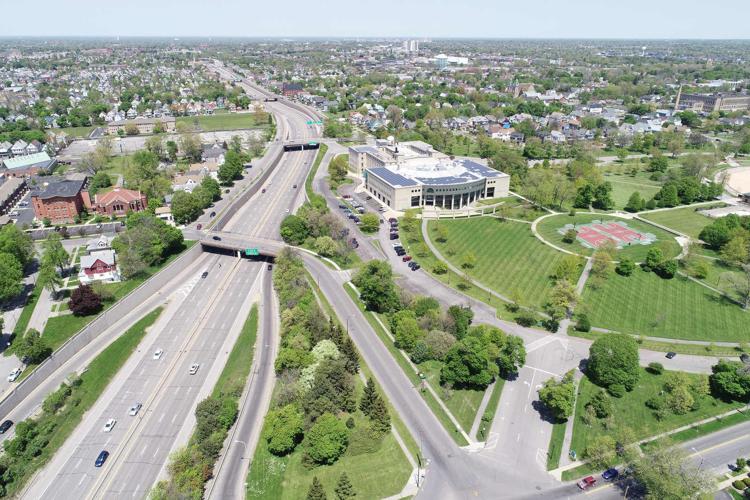
The once tree-lined Humboldt Parkway on the East Side, which connected to Delaware Park and was designed by Frederick Law Olmsted, was destroyed to make way for the Kensington Expressway. A leading plan would deck the portion of the highway between Best and East Ferry streets, creating a tunnel for traffic.
Proponents see it as the first phase of a long-term plan to reconnect a tree-lined Humboldt Parkway to Delaware Park.

Restoring a stretch of Humboldt Parkway with a deck over the Kensington Expressway is no longer a long shot. Now, it is a New York State priority.
State Department of Transportation Commissioner Marie Therese Dominguez, who accompanied Hochul to Buffalo on Saturday, said the possibility of the Federal Highway Administration expediting the project is similar to what Gov. Andrew Cuomo was on track to do with the Skyway. That reduced what would have been a three- to four-year timetable to two years.
"We are working with our federal partners right now to see exactly how we can move the environmental review process forward as soon as possible," Dominguez said. "Obviously the governor's announcement will go a long way toward helping us do that."
The State Department of Transportation did studies on the Kensington Expressway in 2012 and 2019. The new assessment will consider environmental, community, economic and other impacts of such a project and lead to a final plan, state DOT spokesman Joseph Morrissey said recently.
The scoping report, expected to include a public meeting in the spring, will also evaluate different decking scenarios and their respective costs. It is expected to be completed by the end of the summer.
Proponents say burying the Kensington would allow multiple streets to be reconnected, the health of those who live near the highway would improve by reducing air pollution and a beautiful parkway would serve as an impetus for residential and commercial development.
"We're ecstatic. I'm pinching myself," said Richard A. Cummings, vice chairman of the Restore Our Community Coalition. "It took us a long time to get here, but we're here, finally."
Assembly Majority Leader Crystal Peoples-Stokes, who introduced the governor, was also elated at seeing the Kensington project move to the head of the table.
"Our governor, Kathy Hochul, has decided to move this from a conversation to action," Peoples-Stokes said.
She also wondered aloud how East Side neighborhoods could have been allowed to be torn apart decades ago to make way for the highway.
"Why do we have to go backwards to rectify things that were torn down?" Peoples-Stokes said. "Why do people make decisions that, maybe not intentionally, but ultimately destroyed people's lives? Why?"
Rep. Brian Higgins, State Sens. Tim Kennedy and Sean Ryan and County Executive Mark Poloncarz also expressed their enthusiasm for the Kensington project.
"This will create a better Buffalo. This will create a better Erie County," Poloncarz said. "Sometimes you look back on a career and you think what did I do that had a greater impact on the greater community, a legacy project? This will be a legacy project for everyone in our community."
The project's cost and where the money will come from is still to be determined.
A federal fund for such projects that local leaders hope to tap is smaller than originally planned. President Biden proposed $20 billion to replace highways that destroyed mostly Black neighborhoods, but funding dropped to $1 billion in the $1.2 trillion infrastructure bill Congress passed in the fall.
Other federal infrastructure dollars will be available, but with a typical price tag of $500 million and up for highway removal projects and a long list of them hoping to move forward, competition for federal funding is expected to be steep.
Mark Sommer covers preservation, development, the waterfront, culture and more. He's also a former arts editor at The News.