

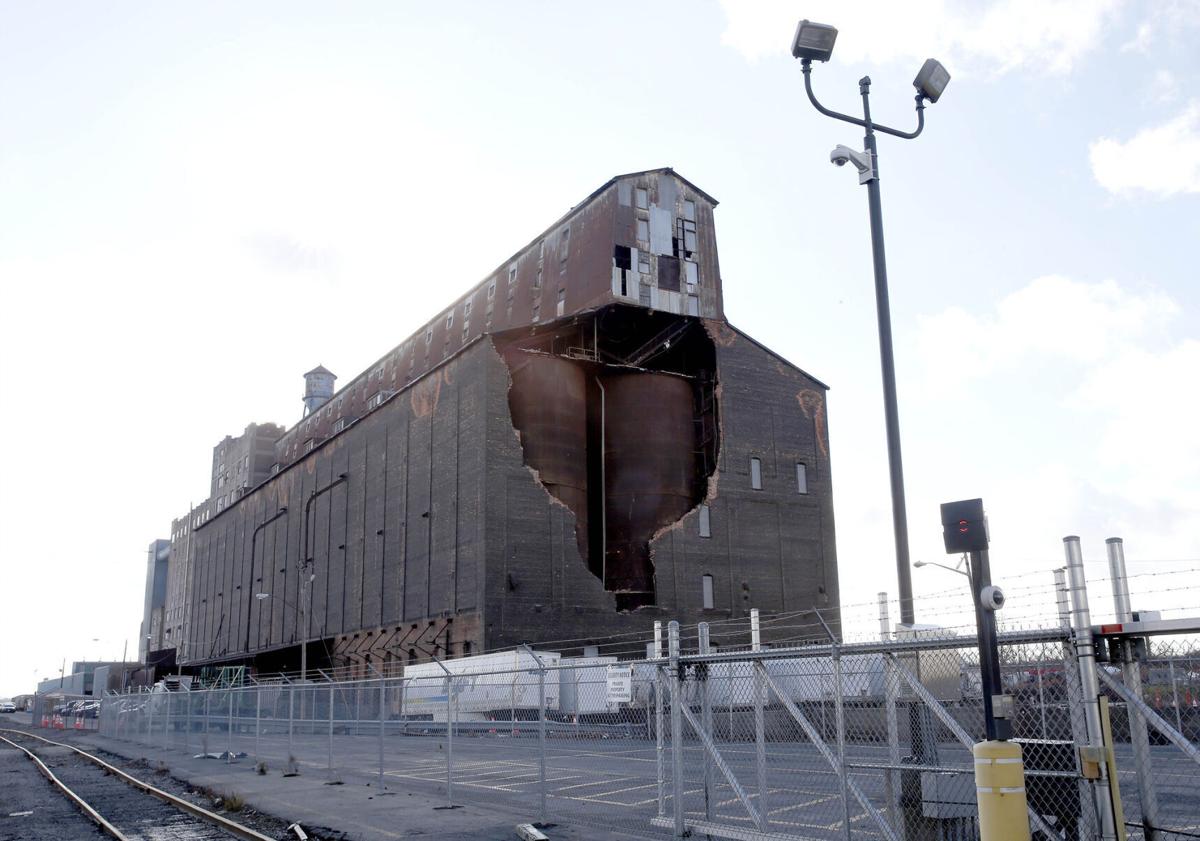
The fate of the historic Great Northern grain elevator will remain undecided for at least another week.
State Supreme Court Justice Emilio Colaiacovo on Monday urged a settlement between those seeking to tear down the 1897 structure, the City of Buffalo and Archer Daniels Midland, and a preservation organization seeking to save it, the Campaign for Greater Buffalo History, Architecture & Culture.
Colaiacovo, who continued the stay to an emergency demolition order, said he wants a mediated settlement over the next week. If the parties can't agree on one he will quickly render a decision.
"Because of the significance of this matter, the court is going to reserve its decision and will issue a written decision shortly," Colaiacovo said.
The judge asked Barbara Howe, a former State Supreme Court Judge and certified mediator, to immediately begin trying to reach a settlement.
People are also reading…
The two sides began meeting with Howe shortly after the court proceeding.
"I told (Howe) I want this to be mediated within a week and if it can, great," the judge said. "If not, the court will issue its decision. But I think we need to leave everything out on the field before the court reaches its determination."
The Great Northern was damaged on Dec. 11 by a windstorm, revealing some of the steel bins long encased inside. The city granted ADM, which owns the building, an emergency demolition order that has been challenged by the preservation organization.
It's the fourth time that the Chicago-based commodities giant has sought to tear the structure down.
During the 67-minute session, Colaiacovo said the case will hinge on whether James Comerford, the city's commissioner of permit and inspection services, acted in "an arbitrary and capricious manner" in issuing the emergency demolition.
The judge acknowledged the public attention the Great Northern has received.
"It is difficult to ignore the public outcry to save this building," Colaiacovo said. "There is a significant interest in certain sections of the public to save this important historical building."
The judge added any ruling would be driven by the law and not emotion.
Richard Lippes, attorney for the Campaign for Greater Buffalo, contended Comerford rushed to judgment without exploring other remedies that could safely preserve the local landmark, the last standing brickbox grain elevator in North America.
Lippes cited the written testimony of structural engineers and architects, who said they were certain the structure could be repaired, along with suggestions on how to do so. One of the engineers works closely with Douglas Jemal, a developer who has offered to buy the building and repurpose it.
Based on that, a normal order of demolition, which would send the matter to the Buffalo Preservation Board for review, should have occurred instead of the issuing of an emergency demolition, Lippes said. Or the city could have instructed ADM to make the necessary repairs, he said.
But ADM attorney Brian Melber said there is no time for that. He cited debris falling from the building which, he said, posed an immediate safety risk to passersby, motorists and customers at the Wonder Coffeehouse across the street.
"There is no way to protect those areas from debris flying off this building and striking someone," Melber said.
That risk, Melber said, trumped aesthetic and historic concerns.
The judge asked Lippes how he explained away warnings about the building's condition contained in an engineer's report prepared for ADM, and by the city's fire commissioner. Lippes said they were rebutted by testimony from experts submitted to the court, including assertions that the damage to the north wall did not affect the integrity of the rest of the structure.
"How can you say that this is not a hazard?" Colaiacovo asked. "This is a gaping hole on the side of the elevator."
"The hole doesn't have anything to do with the structure itself – it's like a facade," Lippes said. "Even if those bricks fell, it doesn't present a further danger."
The judge asked ADM why the company wouldn't want to preserve the building.
"It's not a question of desire, judge," Melber said. "It's a question of the paramount importance of safety."
Melber, citing engineers, said "the walls are too high and too thin, are not supported by metal bracing and were never built to withstand the wind at that location. The events of the past couple of weeks have demonstrated those engineers are right."
The judge expressed skepticism.
"It has withstood inclement weather for the past 125 years," he said. "This is nothing new for Western New York."
He asked city attorney Rashied McDuffy how he reconciled a Dec. 23 letter from the mayor to ADM calling on the company to preserve some or all of the structure at the same time his commissioner was ordering an emergency demolition.
"Your Honor, I don't believe you need to," McDuffie said. "In this instance the statute put the authority to make a decision clearly with the commissioner of permits and inspections."
"But if it's an emergency that requires demolition, how can the mayor say, wait a minute, we think this can be saved," the judge asked. "It's either one or another."
Mark Sommer covers preservation, development, the waterfront, culture and more. He's also a former arts editor at The News.


