
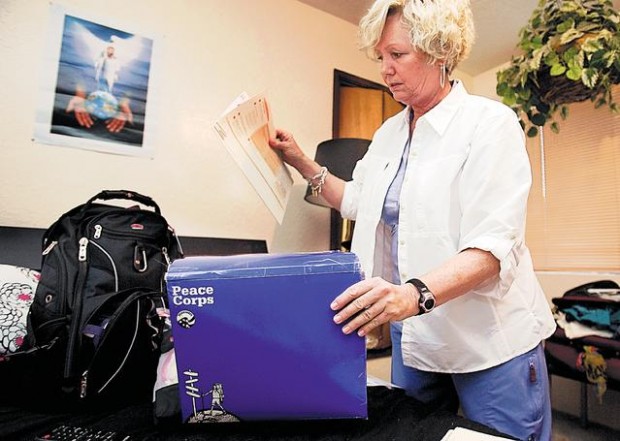
PHOENIX — After a lifetime of work, 62-year-old Hazel Powell decided to leave her comfortable Scottsdale home and family behind for 27 months of deprivation and a hard job in Eastern Europe.
The recently retired teacher left for Bulgaria, where donkey carts outnumber automobiles. She hopes to make a difference in the lives of the poor villagers she will live with.
She's among an increasing number of older adults — many from Arizona — who have joined the Peace Corps.
"My whole life, all I've ever done is pay bills," Powell said. "I've worked 45 years and raised two girls by myself. They're happy. This is the perfect time for me to give back. This is what I'm supposed to be doing."
Two years ago the Peace Corps sought volunteers who could bring more skills and experience. Those recruiting efforts resulted in a 44 percent increase in applications from people older than 50.
People are also reading…
The international program continues to attract older Americans. Although leaving behind their responsibilities at home for months of cultural isolation and stark accommodations abroad can prove difficult, the personal rewards and sense of accomplishment are profound.
"You feel like a pioneer," said Rita Ruks, 69, who served in Kyrgyzstan from 2005 to 2007. "How many times in your life can you say, 'I made a difference?'"
Peace Corps officials are happy to see the rise in interest from older adults.
"People over 50 tend to be much more qualified and better rounded because they bring more skills and experience, not only in the workplace but life experience as well," said Kate Kuykendall, public-affairs specialist.
Applications also are on the rise in Arizona, with 32 older adults applying in 2008, compared with 20 each in 2007 and 2006. Nationally, 1,197 over-50 adults applied in 2008, compared with 864 in 2007 and 932 in 2006. Still, older adult volunteers make up just 5 percent of the total, with the average age of volunteers at 27.
The Peace Corps was launched in 1961 and serves in 79 countries. Those who join get an orientation before being sent overseas to live with a host family. Then volunteers find their own housing for a two-year stint.
About a third of volunteers work in education, most of them teaching English — a particularly valued skill in areas where the dominant industry is tourism. Some volunteers work in health care.
Kuykendall said no one is exactly sure why there is a spike in older volunteers, except that there are more people in the over-50 age group now. She said the economy, with careers ending early, may be one reason, but that usually the decision is something a volunteer has considered over time.
Responsibilities accrued over decades can make the leap into Peace Corps difficult.
Phoenix native Kathryn Bethards had volunteered several times for Habitat for Humanity in Africa, as well as at a Romanian orphanage. Those had been enriching times.
Her dream was that upon retirement, she would serve in the Peace Corps. She mapped out what she would need financially to attain that dream.
Then the recession hit. She lost her job and lived off the savings that was supposed to enable her retirement.
Bethards, 61, stuck to her plan, waiting out the monthslong application process and visiting doctors to complete the medical evaluation.
All the while she dreamed of returning to Africa and was happy upon discovering she'd been assigned to Ghana.
In the spring, her father died. Her decision to leave was made more difficult knowing she would have to leave her newly widowed mother alone.
"I talked to my mother about my being gone while she was adjusting to him being gone," Bethards said. "And she was so supportive."
Dealing with family can be difficult for older volunteers. Besides concerns for their parents, their own children may worry. Fears rise about the risks of working in poor villages.
Powell, the retired teacher from Scottsdale, had a hard time convincing her adult daughters that the Peace Corps was right for her.
"They were in shock for quite a few months," she said. "They said, 'Mom, all you've done is give.' But once they understood the reasons, both my daughters and my friends have been supportive."

 New Tucson lounge to embrace dark and cozy