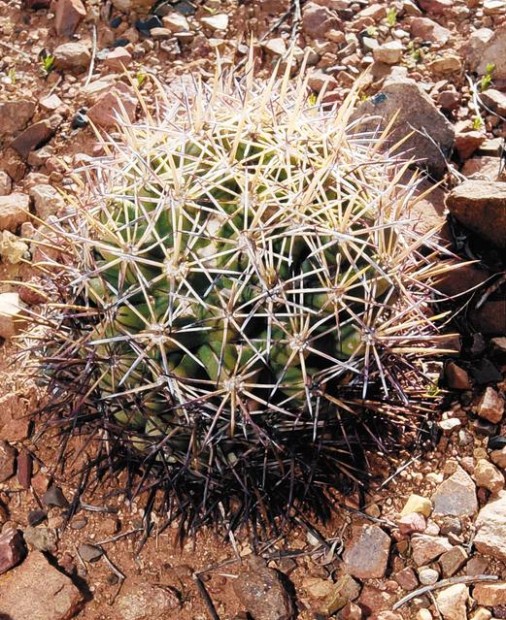
The endangered Pima pineapple cactus will stay federally protected, meaning that new developments will have to save open space for it in Tucson's fast-growing southern and southeastern suburbs.
The U.S. Fish and Wildlife Service decided last week to keep the plant on the endangered list, despite arguments from some private biologists that it is far more common than previously estimated and should be lumped with other, more common pineapple cacti varieties.
The decision, made after a review of the species' status, comes nearly 14 years after it made the endangered list.
Wildlife Service officials said two studies from a private consulting firm questioning the listing were faulted by the federal agency's scientists and all but one of 14 outside scientists.
For one, the consultants used cactus survey methods that would tend to "bias" the survey data toward making the population seem more abundant than it is, the service said.
People are also reading…
Bob Schmalzel, a biologist for the private firm, defended both WestLand Resources' studies. The population data they provided "constitutes the best scientific and commercial data currently available," Schmalzel said. It provides substantially more information than what was available at the time of the listing in September 1993, Schmalzel told the Star in an e-mailed statement.
The cactus has since been a thorn in the side of developers, although not nearly as controversial as Tucson's other major endangered species — the pygmy owl that the Wildlife Service pulled from the list last year.
Since 1993, developers of homes, shopping centers, schools, prisons, mine tailings piles and other projects have set aside about 4,058 acres of cactus habitat in the Tucson area and bladed 4,481 acres, service records show.
Numerous pineapple cacti have been transplanted by builders from bulldozers' paths.
The species lives only in Southern and Southeastern Arizona, at elevations below 4,000 feet, in desert scrub and in transition areas between scrubland and grassland, and in north-central Sonora.
Development and the associated habitat losses remain primary threats to the cactus, the service report said. The cactus has at most recovered to 25 percent of what's needed to ensure survival, the service's review said.
Invasive species such as Boer's and Lehman's lovegrass may also threaten the cactus, as they occupy 1.47 million acres today and will continue to invade native grasslands in the future, the service said.
The cacti's total population remains unknown, because the service doesn't have enough money or access to all possible locations to conduct comprehensive surveys, said Sherry Barrett, a service official in Tucson.
"We get most of our information from surveys made before development," Barrett said. "Most plants we find out about are about to be bladed."
In its decision, the service said 1,340 of 5,553 known cacti have been destroyed or have otherwise disappeared. But some records of the 5,553 cacti are quite old, so the service said it doesn't know if those cacti are still alive.
From 1997 to 2003, about 1,168 cacti were destroyed, removed or transplanted through development, the service said.
Pinpointing the total habitat loss is also difficult, because the service reviews only projects that are built or approved by the federal government, the service said. About 1.5 million acres lie within the cacti's range.
Pima County-commissioned studies have identified about 140,000 acres of high-priority cactus habitat. About 13 percent of it was developed as of September 2006, and 39 percent will be developed in 30 years, the service said.
WestLand concluded in 2004 that the cacti's population was actually 100,000 to 150,000. Using 99 surveys, Schmalzel and other WestLand scientists concluded that less than 5 percent of the plants had been lost for development.
But the company didn't select its survey plots at random to ensure the plots represent the entire pineapple cactus population, the service's review said. The service and five outside reviewers faulted the WestLand report for sampling less than 2.5 percent of the cacti's entire range.
In 2004, Schmalzel and other WestLand scientists published a paper asserting the Pima pineapple cactus isn't different enough from two pineapple cactus varieties in New Mexico and Texas to be a separate subspecies. A second study at about the same time from an Arizona State University scientist disagreed with Schmalzel. The service's new review said Schmalzel's conclusions weren't supported by data.
A Tucson environmental group applauded the service's decision. The cactus is clearly a case in which threats to its survival are increasing and the science supports its uniqueness as a species, said a Center for Biological Diversity official.
But the center's Greta Anderson pointed out that the cactus still lacks a recovery plan to chart its future course. So much of the plant's habitat is disappearing that she can't be optimistic about it, Anderson said.
If there is any good news, it's that a lot of people love this plant, and Pima County's proposed habitat conservation plan recognizes it as a priority species, Anderson said.
The service's Barrett said a lack of funds has stalled preparation of a recovery plan. A federal team of scientists for the cactus hasn't met in four years because of a heavy workload.
Pima pineapple cactus
• Hemispherical-shaped, ranges from 4 to 18 inches tall and 2 to 7 inches wide.
• Spines are in clusters, with one stout, straw-colored, hooked spine surrounded by six to 15 smaller, straight spines.
• Sparsely distributed, with densities lower than one per four acres.
• Silky yellow flowers bloom for a few days in July, after as little as 0.12 of an inch of rain.
• Oval, green and sweet fruit.
Sources: Pima County government and the U.S. Fish and Wildlife Service

 Lake Mead's drops raise prospect of unaffordable Hoover Dam electricity