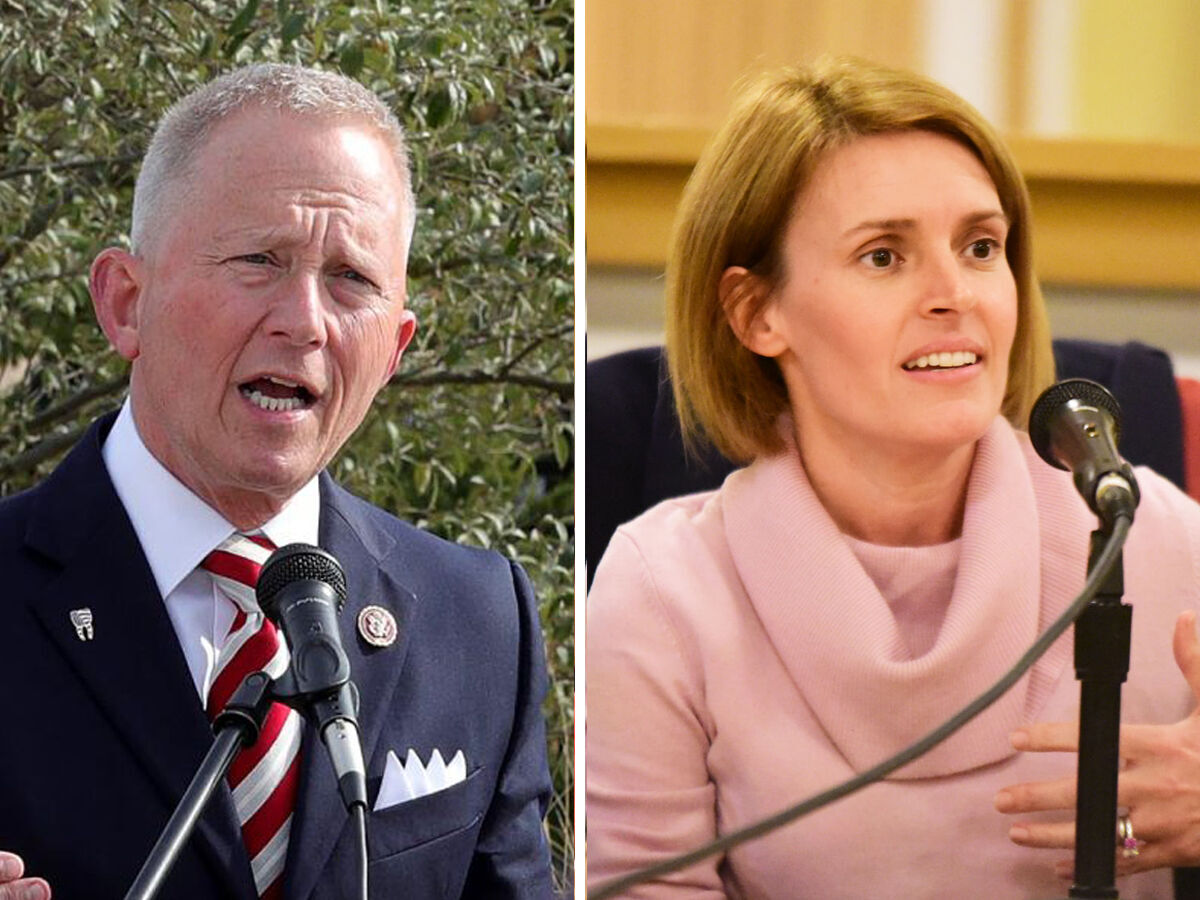
Recent polls show the Congressional race is tight in New Jersey’s 2nd District, and the Cook Political Report has changed the district’s rating from “leans Republican” to “Republican toss-up.”
An RMG Research poll of 500 registered voters in the 2nd District, conducted from July 30-Aug. 5, found that incumbent Congressman Jeff Van Drew (R-2nd) narrowly leads Democratic challenger Amy Kennedy 42% to 39%, which is within the 4.5% margin of error.
Another poll of 400 likely 2nd District voters, funded by the Democratic Congressional Campaign Committee, found Kennedy, of Brigantine, with a slight lead over Van Drew, but the lead is within the poll’s 5% margin of error. Kennedy was supported by 51% of respondents, and Van Drew by 46%.
“Four hundred (people) in early stage polls is big enough” said John Froonjian, executive director of the William J. Hughes Center for Public Policy at Stockton University, of the sample size. “When I do districts like this, I like to do 600, but it’s harder and harder to get people to take polls.”
People are also reading…
Froonjian’s Hughes Center also conducts polls.
The RMG poll also found that Kennedy could increase her support from 3% to 9% of Republican voters if she supported term limits.
The DCCC poll found President Donald Trump and former Vice President Joe Biden in a statistical tie, with support from 46% of respondents to 47% for Trump.
The DCCC added Kennedy to its Red to Blue Program in July, for having surpassed aggressive goals for grassroots engagement, local support, campaign organization and fundraising.
Another poll by Global Strategy Group for the House Majority PAC, another Democratic organization, found Kennedy leading Van Drew 47% to 46%.
Kennedy celebrated the polls and the Cook Report change, while Van Drew dismissed two as funded by Democrats.
Froonjian cautioned against making too much of the results, particularly of the DCCC poll.
“Don’t read too much into it, with a 5% margin of error,” Froonjian said. All had similar margins of error.
Froonjian said the voters in the 2nd District often split their votes between candidates of different parties, for various offices.
“They really do look at different candidates. They don’t just go the party line. That’s why it is a swing district,” Froonjian said.
But if Trump really is stronger in the district than Van Drew, it may be because of Van Drew’s party switch at the end of 2019.
“It may say there are some Republicans who never liked Van Drew and can’t bring themselves to vote for him,” Froonjian said. “That is, if the numbers are accurate.”