

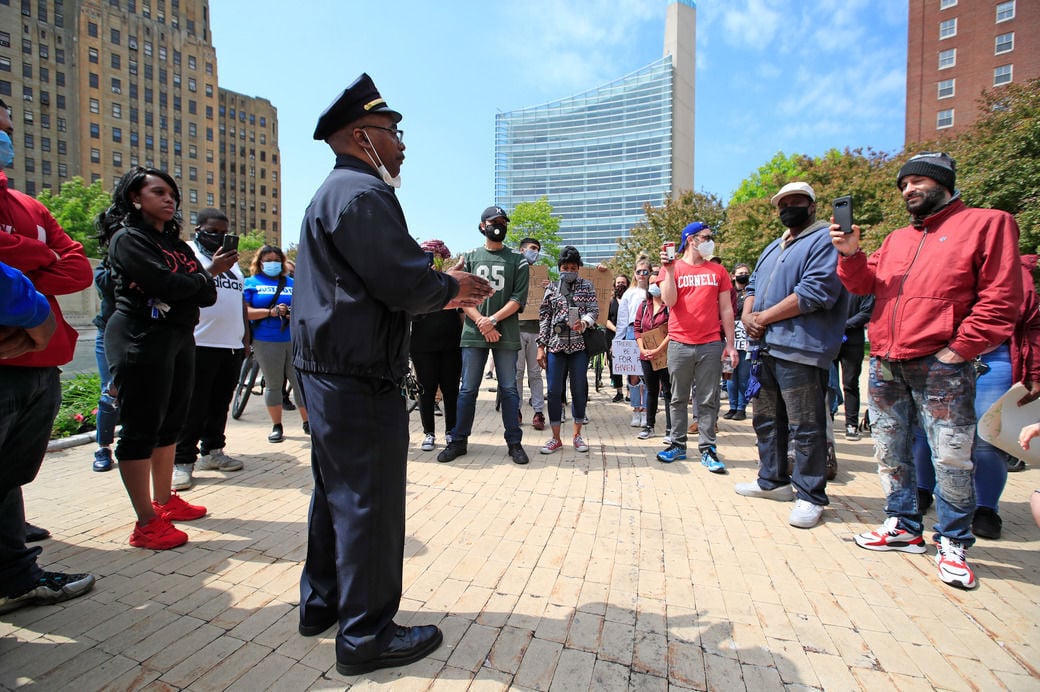
The Buffalo Common Council Police Oversight Committee normally meets only twice a year.
But following a month in Buffalo that included national notoriety over the department's handling of a City Hall protest, members of the committee decided they didn't have time to wait.
In a nearly three-hour long emergency meeting Thursday conducted via Zoom and posted to Facebook Live because of Covid-19 safety concerns, committee members grilled Police Commissioner Byron Lockwood and his command staff about how the Buffalo Police Department operates.
With Lockwood, his deputy commissioners and chief of staff seated around a conference table and each wearing a mask, they asked questions about the inner workings of the department.
They asked about how the Internal Affairs unit investigates complaints against a police officer.
People are also reading…
They asked about the role the police union has in instituting new policies.
They asked about who gives the orders to clear a crowd during a protest.
They asked why only 120 police officers out of about 700 have received crisis intervention training.
They asked about the possibility of starting a separate non-police agency to handle mental health emergencies.
"Our city has been cast in a not-so-favorable light," Councilmember Christopher P. Scanlon said. "I have a great many questions. I truly hope you are able to provide us with some answers."
The emergency meeting was prompted by national outrage over the department's handling of protests sparked by the death of George Floyd in Minneapolis. It also was in response to long-simmering anger over police treatment of the city's black and brown residents.
More than 350 logged on to watch, with well over 2,000 comments posted. Members of the public weren't given a chance to speak during the video conference as they would have during a regular session, but Councilmember David Rivera said the committee received more than 90 statements that would be included in the public record.
Councilmember Rasheed Wyatt said Buffalo likes to think of itself as the City of Good Neighbors.
But now, Wyatt said, "they say we're a city of racist people."
Now is the time to act and make serious changes to the way Buffalo approaches policing, Wyatt added.
"We have one shot at this," he said.
It was a sense of urgency that Common Council President Darius Pridgen said he shared.
"Real reform is going to take real hard work," Pridgen said. "... This is real hard work that people pay us to do."
Lockwood said he supports making changes to the department but he has to balance that with protecting its residents.
"I'm not taking nothing away from Black Lives Matter. I believe in it and I get what they're saying," said Lockwood, the city's second black police commissioner.
But, he said, there have been 30 shootings in Buffalo in June. The victims include five black men who died and 16 more who were wounded.
Councilmembers were especially interested in hearing about two incidents: when 75-year-old Martin Gugino was pushed as members of the Buffalo riot police unit were clearing the front of City Hall and, more recently, when police arrested 13 protesters who were "occupying" Niagara Square early Wednesday morning.
The city's corporation counsel repeatedly warned the councilmembers and police officials to refrain from getting into specifics because of the possibility of future lawsuits.
Scanlon asked the police officials questions about the ERT – Emergency Response Team – who were involved in the Gugino incident. Two officers were immediately suspended without pay and have been charged with felony counts of assault.
The unit was formed in 2014 under the previous commissioner, Daniel Derenda, through a federal grant, Lockwood said. Their role is to control crowds when they become unruly.
Scanlon raised questions about how police officers can be suspended or even charged for their actions, whether they're following orders or refusing to follow orders.
"Don't you see there's a Catch-22 there? They're damned if they do, damned if they don't," Scanlon said.
"I don't," replied Lockwood.
Pridgen asked about the arrests of protesters early Wednesday, hours before a new policy went into effect that people arrested on minor nonviolent charges would be ticketed on the spot and no longer handcuffed and taken to Central Booking to be processed. The 13 protesters were all booked before being released.
Again, corporation counsel asked the participants not to speak specifically about the arrests.
Capt. Jeff Rinaldo explained that if a person is in a park after hours they can be issued a citation. But if they refuse to leave, that's considered obstruction of governmental administration and in such cases, the person can be detained and subject to having their mug shot and fingerprints taken.
Wyatt asked why Buffalo police officers aren't given performance evaluations.
Lockwood explained that would require an agreement with the Buffalo Police Benevolent Association. The department had to get a waiver from the state for not requiring performance evaluations when it went up for accreditation, which is received last year.
"What everything boils down to is collective bargaining agreement," Lockwood said.
Maki Becker


