

Buffalo's push for changes in police policies comes at the same time the city is negotiating a new contract with the Buffalo Police Benevolent Association, giving the Common Council an item in its toolbox to leverage the kind of changes it wants.
If changes such as additional training for police are not included in the collective bargaining agreement with the police union when it comes to the Council for approval, city lawmakers can send it back to the parties to negotiate further. Negotiations are now under mediation through New York State.
The contract "is not fully ratified until the Council makes a move,” Council President Darius G. Pridgen said . “We still have the authority to say no, and then it goes back for renegotiation.”
“I’m putting them on notice that if they give us a contract that does not include some of the things that we, the Common Council, have been asking for on behalf of our constituency regarding the BPD and their contract, then yes, they will be heavily scrutinized," Masten Council Member Ulysees O. Wingo Sr. warned during Tuesday’s Council meeting.
People are also reading…
If the negotiated contract does not reflect what the Common Council has asked for, Wingo said, "they need to understand that the leverage and the power that we have, it will be used and exercised moving forward.”
Changes that constituents have told Council members they would like to see in a new police contract include additional training and a career residency requirement, Council Member Ulysees Wingo later said in an interview.
A residency requirement for the first seven years of employment as a police officer ended under a sunset clause when the current contract expired June 30, 2019, said PBA President John T. Evans.
"There's been two classes of (recruits) that do not have to live in the city," he said.
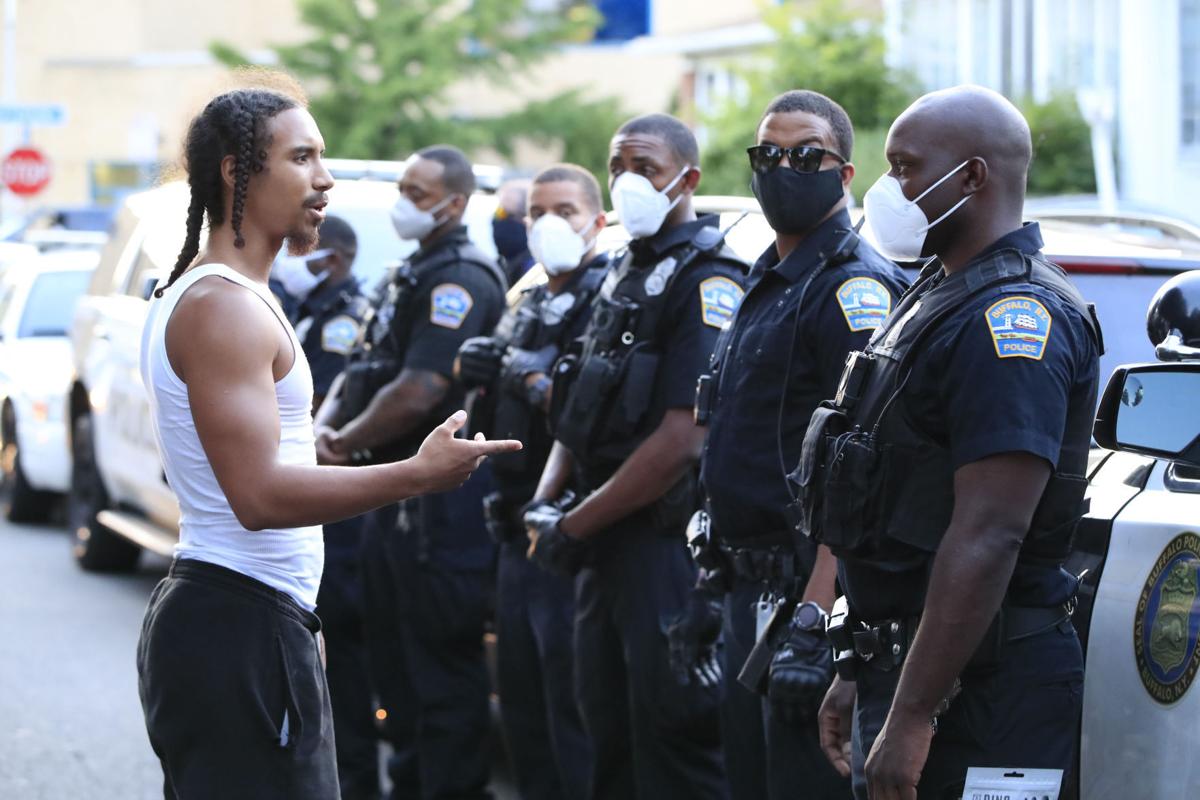
The PBA contract took center stage following recent protests in the city sparked by the death of George Floyd in Minneapolis, local resentment about the way police treat Black and brown residents, and national notoriety over the department’s handling of a City Hall protest in which video showed a 75-year-old man being pushed by officers, resulting in head injuries and hospitalization when he fell.
Mayor Byron W. Brown then proposed changes last month that involve a shift to a policing model that promotes stronger community bonds.
Some of the changes already have been implemented through executive order. Buffalo police officers now issue “stop receipts” for all traffic stops to provide written explanations of what the officer observed that prompted the stop and appearance tickets instead of handcuffing and transporting suspects for low-level offenses to a police station to be booked.
Other changes – such as additional training that includes de-escalation techniques, and performance evaluations for officers – must be agreed upon by the police union.
After the PBA declared an impasse in contract negotiations with the city, the process moved into a mediation phase with the state Public Employment Relations Board, said Evans. The PBA has continued to negotiate with the city in front of the mediator, he said.
Citing labor law, Evans said he could not comment specifically on negotiations, but he did say that under the state’s Taylor Law, police continue working under the current terms and conditions of the expired deal, including health care, longevity and work schedules, but “overall percentage raises” ceased when the contract expired.
If the mediation process fails, “then we’ll end up in binding arbitration, and whatever the arbitrator says, goes,” Evans said.
That means all parties would have to abide by what the arbitrator decides and the Council would not get a vote.
So now is the time for the city to include some of the police changes they want, said Niagara Council Member David A. Rivera in a telephone interview. Rivera is a retired Buffalo police officer, Council majority leader and chairman of its Police Oversight Committee.
“As far as the city wanting to see some reforms, this is the time to do it. Put it in the negotiations, put those things on the table,” he said.
In its effort to use its leverage to press for changes in police policies, the nine-member Council unanimously approved a resolution Tuesday that calls on the Brown administration to file entire contracts – not just summaries – when the administration recommends approval by the Council.
The resolution – which does not change the fact the administration and the unions negotiate contracts in private – includes all contracts that come before the Council for approval, but the focus is on the police contract.
And the Council wants to be briefed by the city’s Law Department and whoever else negotiates on behalf of the city.
“When they send us the contract, we want to know what was discussed, the details, the sticking points. Where is there room for compromise? What is the other side willing to negotiate on? Was there any movement on the issues that are important to our constituents,” Rivera said.
Having the entire contract and discussions with the city’s negotiator at approval time is very important in terms of transparency, said University Council Member Rasheed N.C. Wyatt, during Tuesday’s meeting. It’s something the public and the Council have called for in terms of reforms.
“I think this is very helpful to the public being apprised, as well as the Council, of what has been agreed upon,” Wyatt said.


