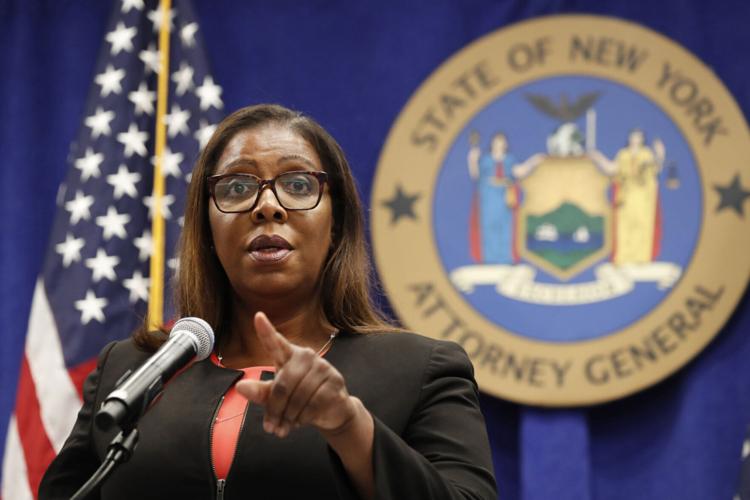
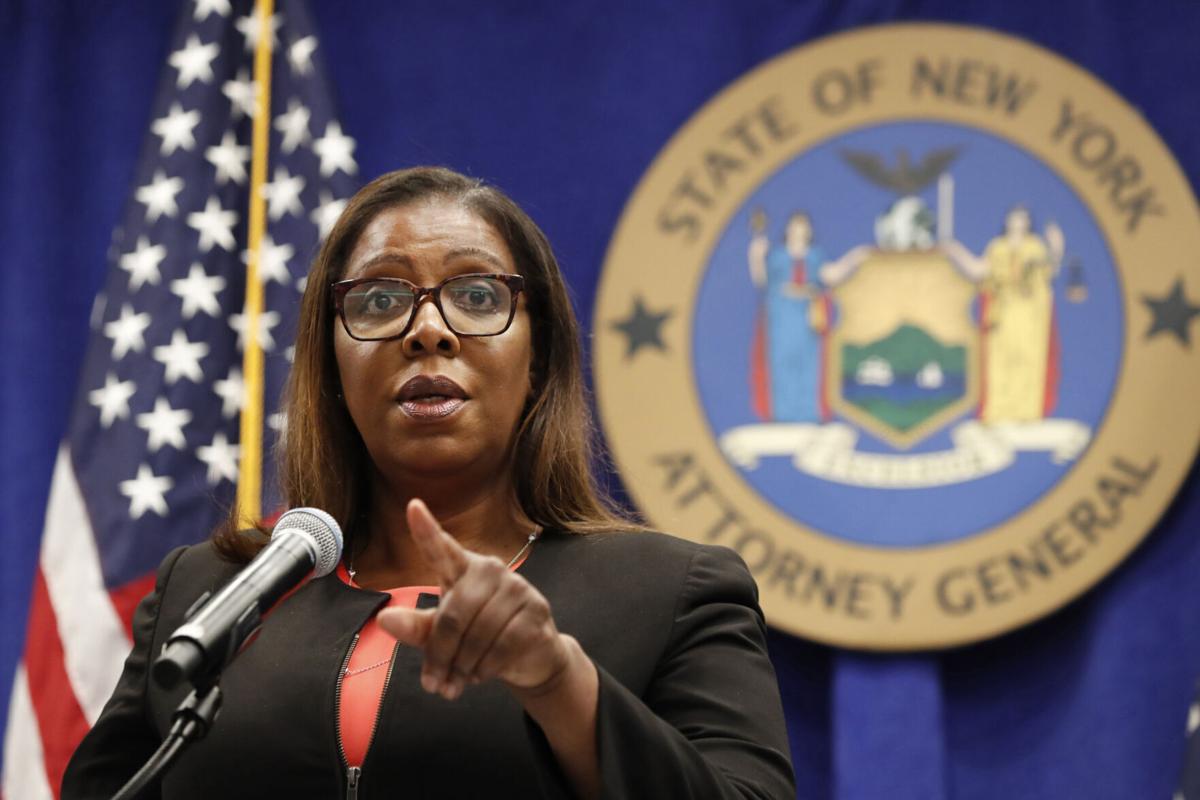
New York State's statistics on nursing home resident deaths from Covid-19 could be too low by as much as 50%, according to the state attorney general.
Attorney General Letitia James said the undercounting was caused by the State Health Department not counting infected nursing home residents who died after they were transferred to hospitals and inaccurate reporting of Covid-19 deaths by some nursing homes.
“In fact, the OAG found that nursing home resident deaths appear to be undercounted by DOH by approximately 50%,” James said Thursday in releasing an investigative report.
The attorney general based her assertion on her office's examination of fatalities at 62 of the state's more than 600 nursing homes.
People are also reading…
But questions raised about the correct number of Covid-19 deaths in nursing homes only scratches the surface of what the attorney general’s 76-page report found in examining how the pandemic was handled by the state.
James also took aim at understaffing by nursing homes, lack of compliance with infection control protocols, exempting health care providers from civil liability for pandemic-related decisions and payment of public dollars to for-profit nursing homes in the report.
And as findings from the report became known Thursday, Republicans went on the attack, calling for the resignation of State Health Commissioner Howard Zucker. They also said it took James, a Democrat, to reveal the disturbing findings on how the Democratic administration of Gov. Andrew M. Cuomo has handled the pandemic.
“Instead of working with us, Gov. Cuomo’s only response has been to ruthlessly attack anyone who questioned the state’s disastrous policies, including those from his party, deny any wrongdoing, and hide damning nursing home fatalities data that would implicate his administration,” Rep. Tom Reed, R-Corning said. “Now, the state’s incompetence and gross negligence have been confirmed by its own attorney general.”
In calling for Zucker’s resignation, State Senate GOP Minority Leader Rob Ortt of North Tonawanda told reporters that the commissioner’s behavior represented an “unbelievable level of duplicity.” Ortt thanked James for uncovering “a lie” to the state residents and “for having the courage to do this report.”
“He is the face of the vaccine. He has no credibility,” Ortt said of Zucker. “The governor has no credibility. There needs to be a broader investigation.”
When Sen. Kirsten E. Gillibrand, D-N.Y., was asked about the report during an earlier conference call Thursday, she said it was “deeply disturbing and gravely worrisome.” She said she plans to ask the Senate Special Committee on Aging to hold hearings on senior living facilities amid the pandemic.
"I don't think New York was isolated," Gillibrand said. "I think this disease went like wildfire through assisted living facilities across the country and across the globe. And so, I would like to have hearings on how we can improve the care that older Americans are getting, especially during a pandemic."
State Sen. Sean Ryan, a Buffalo Democrat, demanded answers from Zucker.
“It should not take an investigation by the attorney general to receive accurate information regarding nursing home fatalities during the pandemic. We need answers immediately from the Department of Health. I am calling on Dr. Zucker to appear before the Senate Health Committee and provide full and complete answers," Ryan said.

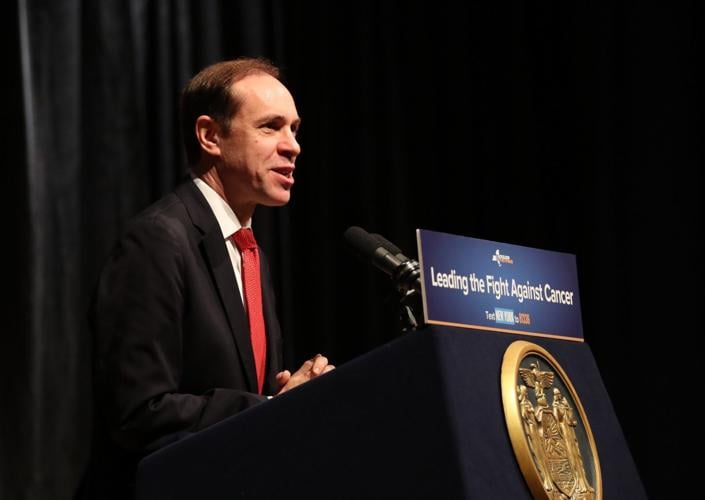
State Health Commissioner Howard Zucker.
Zucker responds
In responding to the Attorney General’s investigation, Zucker said that there was no undercount of nursing home deaths.
“DOH has consistently made clear that our numbers are reported based on the place of death. DOH does not disagree that the number of people transferred from a nursing home to a hospital is an important data point, and is in the midst of auditing this data from nursing homes,” Zucker said.
He said that the state has accurately reported the total number of Covid-19 deaths, whether they occurred in nursing homes or elsewhere.
The word "undercount," he said, “implies there are more total fatalities than have been reported” and that “is factually wrong.”
At a joint hearing of the State Senate and Assembly in August, Zucker defended the Health Department for not including in its nursing home resident Covid-19 death statistics the deaths of nursing home residents infected with Covid-19 who died at hospitals. He said he did not want to count the deaths twice, an explanation that was received with skepticism from lawmakers.
The Health Department’s most recent statewide Covid-19 fatality statistics for nursing home residents is 5,928 confirmed cases and 2,783 presumed cases for a total of 8,711. Erie County has a total of 621 nursing home fatalities, with all but nine of them confirmed Covid-19 cases. In Niagara County, there are 119 fatalities, including seven that are presumed cases.
There are about 86,500 residents in the state’s 613 nursing homes, according to the Health Department.
Addressing infection control, Zucker said that Health Department inspectors have issued 140 infection control citations and more than a dozen immediate jeopardy citations at nursing homes.
AG's investigation continues
As a result of her office’s investigation, James said, 20 nursing homes remain under investigation. The report does not identify any facilities by name, but there was no shortage of concerns and findings, including:
• There were a higher number of Covid-19 deaths at nursing homes that had poor staffing level ratings from the U.S. Centers for Medicare and Medicaid Services prior to the pandemic.
• A Health Department guidance in March requiring the admission of Covid-19 patients into nursing homes "may have contributed to increased risk of nursing home resident infection, and subsequent fatalities."
• Some nursing homes required workers who were ill to report to work “or face retaliation or termination.”
• Insufficient personal protective equipment and testing of residents and staff for Covid-19, particularly in the early stages of the pandemic.
In addressing the guidance on Covid-19 admissions at nursing homes, Zucker said, “The OAG report also affirmed the fact that DOH's March 25 memo was not a directive that nursing homes accept Covid patients from hospitals even if they couldn't care for them. The OAG report also found no evidence that DOH's March 25 advisory memo resulted in additional fatalities in nursing homes.”
In citing understaffing at an unnamed Western New York nursing home with the lowest rankings for staffing levels and overall performance, the attorney general's investigators put together statements from registered nurses and certified nursing assistants that showed huge gaps and irregularity in care:
“One CNA (certified nursing assistant) reported that on a day in late March, for at least a few hours, there was only one CNA in the entire building of approximately 120 residents. She also reported that on a day in mid-April, there was one CNA on each hall, one RN to cover the rehabilitation and dementia units, and one supervisor performing double duty by dispensing medication from two medicine carts.
“Another employee alleged that the staffing levels at the facility were so low that CNAs, rather than nurses licensed to do so, were dispensing medications to residents."
In offering an overall assessment on understaffing, the report stated: “OAG’s preliminary investigations reflect many examples where for-profit nursing homes’ pre-pandemic low staffing model simply snapped under the stress of the pandemic.”
To fix this situation, the report recommends “direct care and supervision staffing levels that are expressed in ratios of residents to registered nurses, licensed practical nurses, and certified nursing assistants.”
For at least a decade, state lawmakers have considered a safe staffing bill that would require hospitals and nursing homes to meet minimum nurse to patient ratios. The Safe Staffing For Quality Care Act was introduced again this month in both the Senate and Assembly.
But the hospital and nursing home industries have strongly opposed the measures in the past, saying the potential costs could force some facilities to close.
The Assembly passed the safe staffing bill in 2016, but it has never been voted upon by the Senate.
In August, the State Health Department issued a report on safe staffing that concluded that the proposed legislation would result in significant labor costs for hospitals and nursing homes. The Health Department report estimated that the required extra workers would cost the state’s hospitals an additional $1.8 billion to $2.4 billion and would cost nursing homes between $1.9 billion and $2.3 billion.
In defense of the nursing home industry, Stephen B. Hanse, an industry spokesman, provided this statement:
“The fundamental issue underlying the findings of the attorney general’s report is that policymakers uniformly failed to treat nursing homes with equal priority as hospitals throughout the pandemic. At the onset of the Covid-19 virus, policymakers implemented a ‘hospital centric’ approach to combatting the virus, while failing to provide equal focus to the essential testing, PPE and staffing needs of long-term care providers."