


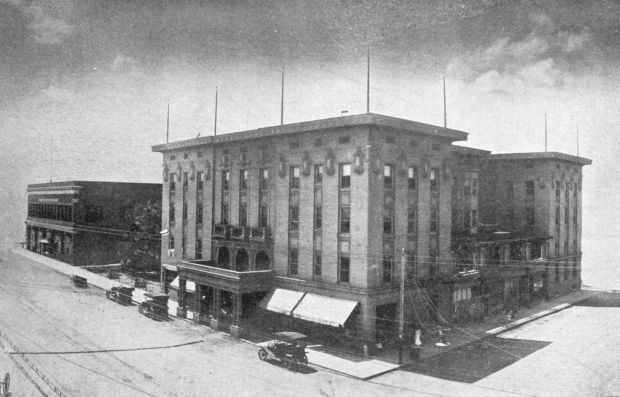
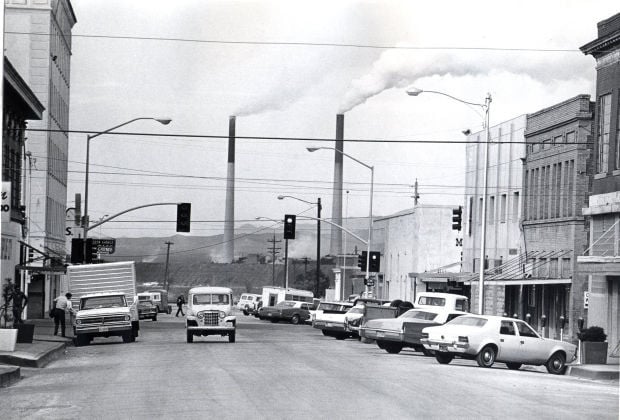
Located in the Sulphur Springs Valley in Southeastern Arizona at an elevation averaging 4,000 feet, the border town of Douglas was created by the Phelps Dodge company to accommodate its nearby smelter.
The abundance of water and cheap land were factors in the selection of the townsite by Dr. James Douglas, president and general manager of the Copper Queen Consolidated Mining Co. and the town’s namesake.
The site was originally called “black water” because of the rank smell of the water. The town Agua Prieta, a mile south of Douglas across the international border, was named for the Spanish word meaning “black water.”
Established in 1901 and incorporated four years later, Douglas was on the main line of the El Paso & Southwestern Railway with branch lines running to Nacozari, Sonora, 80 miles south and also lines north through the Sulphur Springs Valley into Courtland.
People are also reading…
The town accommodated ores mined from Bisbee, Courtland and Nacozari, with its two principal smelters operated by Phelps Dodge and the Calumet and Arizona Mining Co.
The Calumet and Arizona Mining Co., chief rival of Phelps Dodge in the early 1900s, acquired 160 acres of mining property and erected a smelter near Douglas to accommodate the ores from its Irish Mag mine at Bisbee. The company operated the smelter until it was taken over by the Phelps Dodge Corp. in 1931, eventually turning into the Douglas Reduction Works.
Phelps Dodge invested $2.5 million in its early smelting operations consisting of more than 300 acres and including five blast furnaces, a foundry, machine shops and powerhouses. It also included more than 12 miles of standard-gauge railroad track. The smelter was built to process more than 100 million pounds of copper a year.
By the second decade of operation, the Douglas smelters were producing 200 million pounds of copper a year. By 1914, the town had a population of 5,000. The operation became so big that the smelter was turning out nearly 12 percent of the copper in the United States and 7 percent of the copper used in the world.
During its lifetime, the Douglas Reduction Works witnessed many upgrades, beginning as a blast-furnace smelter and upgradedwith reverbertory furnaces in 1912, followed by a new, 350-foot smelter stack built in 1927.
A 572-foot-tall stack — one of the tallest at the time — was built at the site in 1940. At completion, workers topped it with an American flag to salute their achievement.
Douglas flourished, reaching a population of 11,925 in 1960 while achieving the status of commercial center for both southern Cochise County and northern Sonora, Mexico.
Western operations for Phelps Dodge were headquartered at Douglas until 1982. The Phelps Dodge Corp.’s Douglas Reduction Works, which encompassed 2,000 acres at the time, poured its last anodes in January 1987 before being shut down because of environmental regulations.
As a result, Douglas lost $9 million of annual income. The symbolic stacks were taken down four years later, forever altering the landscape of the former smelter town.
Sources: “History of Mining in Arizona, Vol. I,” Tucson: Mining Club of the Southwest Foundation, 1987-1999, Michael J. Canty and Michael N. Greeley, eds.; “Vision & Enterprise: Exploring the History of the Phelps Dodge Corporation,” Carlos A. Schwantes; “Roadside History of Arizona,” Marshall Trimble; Guidebook 1-Highways of Arizona U.S. Highway 666, Arizona Bureau of Mines Bulletin 174, Eldred D. Wilson, “Who’s Who in Arizona,” Vol. I, compiled and published by Jo Conners. Press of the Arizona Daily Star Tucson.
William Ascarza is an archivist, historian and author of five books, including “Southeastern Arizona Mining Towns” and “Arizona-Sonora Desert Museum.” The books are available at Antigone Books, Cat Mountain Emporium and the Arizona-Sonora Desert Museum. Email him at mining@azstarnet.com


 Tucson's having a big fast-food reshuffle


