

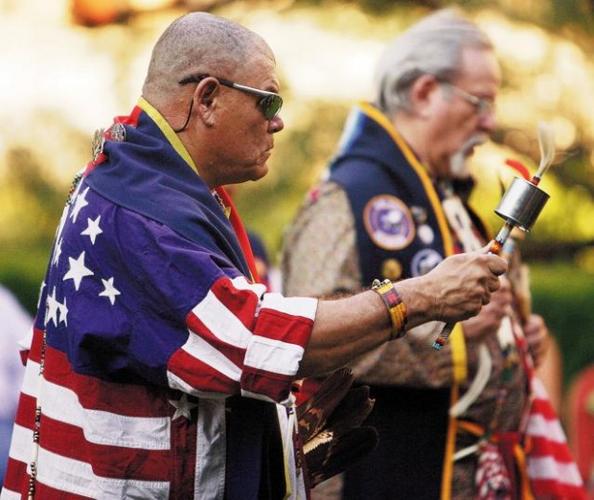
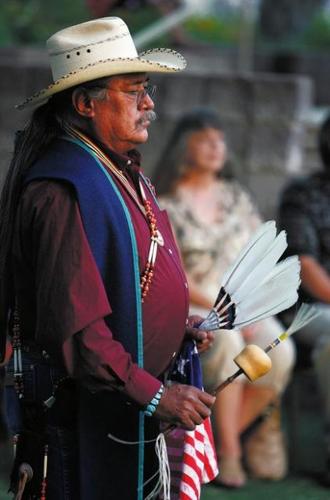
Strangers to each other, the two young men came together in an ancient American Indian dance ceremony that honors warriors past and present.
Eric Isaac, who is Tohono O'odham, moved his feet in unision with other war veterans to the beat of a drum that Michael Peru pounded at a recent gourd dance recognizing Isaac's military service.
"Thank you, brave soldiers," sang Peru in Apache as Isaac and other war veterans danced around a circle of men beating on a single large drum of steer-hide and cottonwood. The dance was featured during last week's annual conference of the Society of American Indian Government Employees at Ventana Canyon Resort.
The ritual held special meaning for both Isaac, who participated for the first time in a gourd dance, and Peru, who presented his original song to the Southwest Gourd Society, which hosted the two-hour event.
People are also reading…
"This has been a unique experience," said Isaac, who did two tours in Iraq during his four years with the Marine Corps. Isaac, 26, said he was discharged in late 2004.
Peru, who said he is Cherokee, Chiricahua Apache and Yaqui, became involved in the gourd dance ceremony to help preserve his ancestors' traditions. Through it, Peru said he honors his grandfather, Filemon Chacon, a World War II veteran.
"Third-generation males can dance for their grandfathers if they're unable to do it," said Peru, 27. "My grandpa is almost 93 years old. He lives up in Bullhead City, but he knows what I'm doing."
Like Isaac's family, Peru's relatives watched the ceremony from the sidelines. "It's not good to be proud; we're supposed to be a humble people," said his mother, Carol Peru. "But it's very rewarding to see this because it keeps the culture alive within us."
The gourd dance originated with the Kiowa tribe in the Southern Plains. Other tribes later adopted it.
Once banned by the U.S. government, the ritual has been resurrected. Nowadays, it is often featured at such events as powwows.
Tom Holm, a professor of American Indian Studies at the University of Arizona, told spectators at the ceremony of the various stories surrounding the origins of the gourd dance.
The story Holm said he has heard the most is the one about a young Kiowa warrior who, en route to his village, encountered a singing red wolf. The wolf gave the warrior songs to take back to his people, Holm said.
The "howl" at the end of each gourd dance song continues "to honor the wolf for giving these people these wonderful songs," said Holm, a member of the Southwest Gourd Society.
Kathleen Bergeron, a 55-year-old Louisiana resident attending the conference, said the gourd dance is one of her favorite Indian ceremonies.
"I've been watching gourd dancing since I was a little girl," said Bergeron, who is Houma. "I have a daughter in the National Guard, and she also likes this dance because of what it represents."
"It's not good to be proud; we're supposed to be a humble people. But it's very rewarding to see this because it keeps the culture alive within us."
Carol Peru,
mother of Michael Peru, a participant in the gourd dance ceremony


