

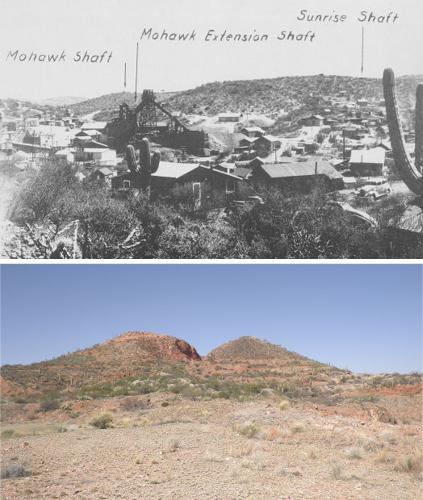
Located three miles southwest of the town of Mammoth in Pinal County, the townsite that would become known as Tiger began with the Hackney claim discovered in 1879 by Charles Dyke and T.C. Weed.
Several years later, Frank Schultz discovered the ore body that became the Mammoth-St. Anthony Mine. It was the mammoth proportions of gold believed to be located at the site that contributed to the name of the mine and the nearby town.
Because of the challenges of working the ore at the mine site, a stamp mill was erected on the banks of the San Pedro River to enhance water accessibility. By the early 1900s, an aerial tramway was established to supply the mill with ore from the mine.
The mines around Tiger produced a variety of metals from the 1880s to the 1950s. Gold was the dominant mineral mined at the locality from the 1880s until World War I.
People are also reading…
Molybdenum became the primary mineral mined at the site because of the necessity of steel manufacture for wartime purpose. After the war, gold, molybdenum and vanadium were mined, along with lead, silver and zinc, all of which held strategic wartime significance during World War II.
Originally known as Schultz, the surrounding area did not get the name Tiger until March 15, 1939, when a post office was established. Tiger may have originated from mining engineer and promoter Sam Houghton's attribution of the name in favor of the mascot of his alma mater. The local population voted for naming the post office Tiger instead of the other option, St. Anthony.
The population of Tiger fluctuated according to the mines, peaking at 1,800 in 1939. A company store, barbershop, gas station and movie theater were some of the buildings found in the community.
The townsite and surrounding mines were taken over in 1953 by the Magma Copper Co. The town and post office were closed the following year after prices for lead and zinc plummeted and the mines flooded.
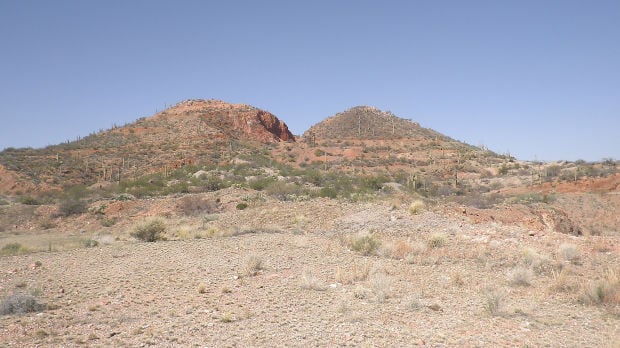
Nothing remains of Tiger today. Magma Copper Co. obliterated it years ago in its attempts to acquire gold and silver bearing silica flux rock at the Tiger site for the San Manuel smelter.
Today, the site is owned by BHP Billiton and is undergoing reclamation.
During the history of mining around Tiger, production included 400,000 ounces of gold, 1 million ounces of silver, 3.5 million pounds of copper, 75 million pounds of lead, 50 million pounds of zinc, 6 million pounds of molybdenum oxide and 2.5 million pounds of vanadium oxide.
Principal mines in the area included the Mohawk Mine, Collins Mine and Mammoth Mine, with workings averaging 500 to 700 feet. The Collins vein reached a depth in excess of 1,100 feet.
Because of the rare and spectacular specimens discovered at this site, the mines around Tiger are of interest to mineral collectors. More than 100 minerals have been discovered, including ultra-rare minerals that are specific to the Tiger locality, such as white acicular needles of Bobmeyerite, reddish-orange crystals of Georgerobinsonite, pale purple prismatic crystals of Yedlinite, transparent crystals of Bideauxite and yellowish-brown pseudohexagonal crystals of Macquartite.
Writer William Ascarza is an archivist, historian and author of five books, including two self-published volumes: "Sentinel to the North: Exploring the Tortolita Mountain Range" and "Zenith on the Horizon: An Encyclopedic Look at the Tucson Mountains from A to Z." The books are available at Antigone Books, Cat Mountain Emporium and the Arizona-Sonora Desert Museum. Email him at mining@azstarnet.com Sources: Anthony, J.W., Williams, S.A., Bideaux, R.A., and Grant, R.W., "Mineralogy of Arizona," third edition, University of Arizona Press; Bideaux, Richard A., "Famous Mineral Localities: Tiger, Arizona," The Mineralogical Record, May-June, 1980; Canty, J. Michael, and Greeley, Michael N., eds. "History of Mining in Arizona," Vol. II. Tucson, Mining Club of the Southwest Foundation; Creasey, S.C., "Geology of the St. Anthony (Mammoth) Area, Pinal County, Arizona"; Sherman, James E., and Barbara H., "Ghost Towns of Arizona," University of Oklahoma Press.


 Analysis: These 9 TUSD schools are at highest risk of merging or closing


