

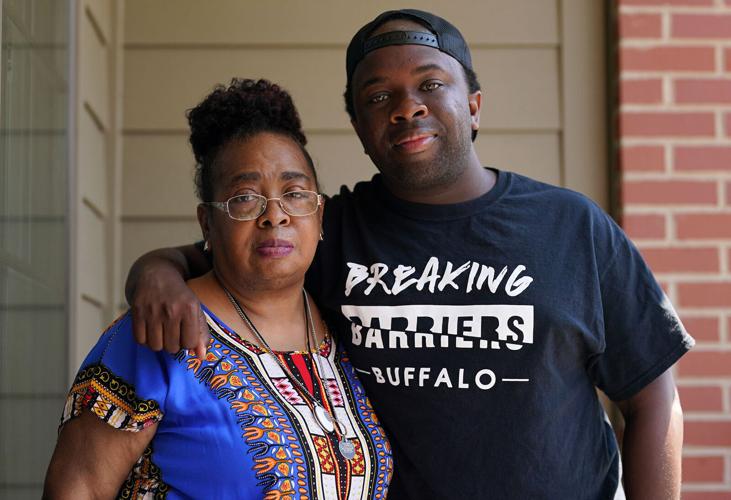
Two years ago, Anna Smith moved to the People Inc. Jefferson Avenue Apartments, a residential complex so new it still has that crisp just-built smell. The place was designed to make life easier for those with disabilities, but one of the benefits Smith loved was coincidental.
She was only a few short city blocks from a Tops Markets store, the first time in memory that Smith – who has spent her life in predominantly African-American neighborhoods in Buffalo – had such easy access to a supermarket.
Smith, 61, was always grateful for that Tops, yet she did not go Friday, when the store finally reopened in a neighborhood still staggered by raw and unbearable trauma.
People are also reading…
To understand why Smith waited requires knowing a little of her history and why the store is intertwined with her well-being, which her oldest son, Malik Stubbs, sees as emblematic of thousands of others for whom Jefferson Avenue is a centerpiece of daily life.
“I try to eat healthy,” Smith said, which is an imperative. She received a kidney transplant three years ago that freed her from years of dialysis, but it causes her to follow a strict dietary discipline.
Smith copes with occasional seizures and uses a cane. Tops was close enough for her to take a regular walk to the store. She looked forward to seeing Aaron Salter Jr., the warm security guard whose greeting would begin a Saturday shopping routine centered around the convenience of paying a few bills inside, just before her joyous, casual journey toward what she needed most:
Cantaloupe, blackberries, strawberries and other fresh vegetables and fruits for her salads, exactly what had been so difficult to find when a grocery store was far away. Often she would pick out a rotisserie chicken, and she soon learned of her best way to make it home while that chicken was still warm.
She would take a ride from a jitney driver named Heyward Patterson. Everyone called him “The Deacon” because he was so active in his church, which forged a swift natural friendship for Smith.
“If someone needed a dollar,” she said, “he was the kind of man who’d reach into his pocket and give them two.”
A little more than two months ago, Smith was ready to head to Tops on a quiet Saturday when she locked into an old episode of “Bonanza” on TV. It was good enough to postpone her departure by just a bit, until the sound of what seemed to be 100 sirens poured through her windows.
She went to her balcony to see a line of police cars and ambulances sweeping past, then picked up her phone when she saw her sister Niecy was calling.
“Do not go to Tops,” Niecy said. “Do not go down there.”
Within minutes, Smith joined some residents who had spilled into the corridor to begin praying together.
"They were shaken," Smith said. "They're still shaken."
Other neighbors returned later, friends who had been forced to hide in the back of the store, and they saw first-hand what investigators soon would say occurred:
A white supremacist in body armor had entered their Tops and committed mass murder. He killed 10 women and men, including Patterson and Salter, and wounded three others – a group of neighbors Smith recognized simply from the familiar kinship of walking the aisles.
“You know, you laugh over the vegetables and you talk about your kids or you just say, ‘How're you doing?’ ” Smith said.
Friday, when the store reopened, she did not go to Tops.
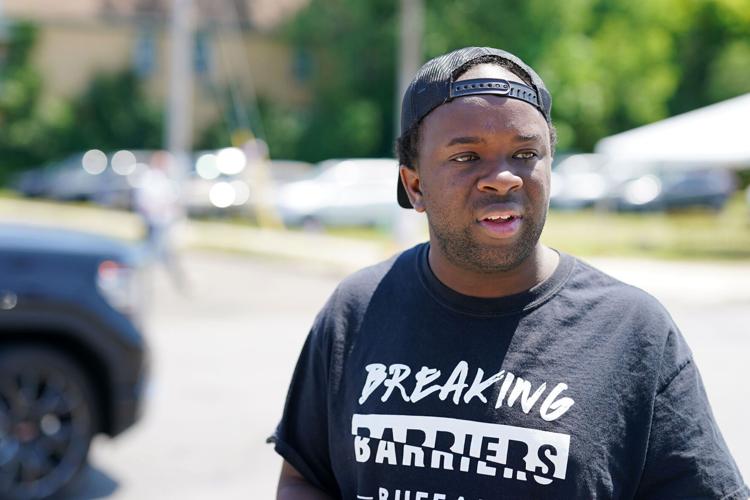
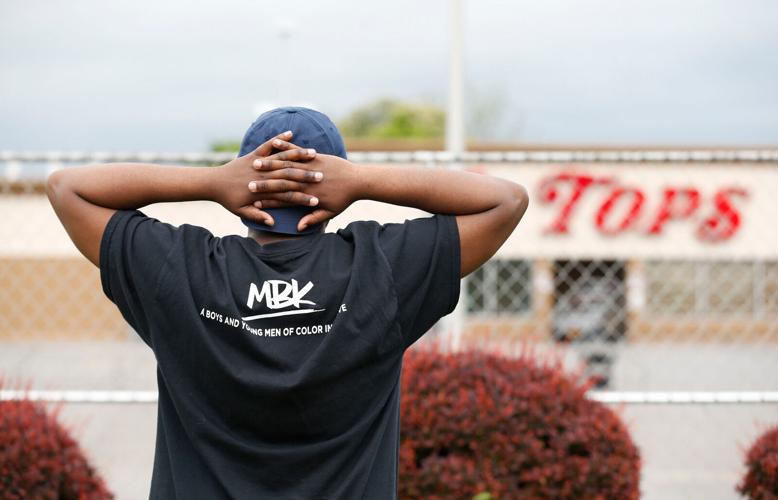
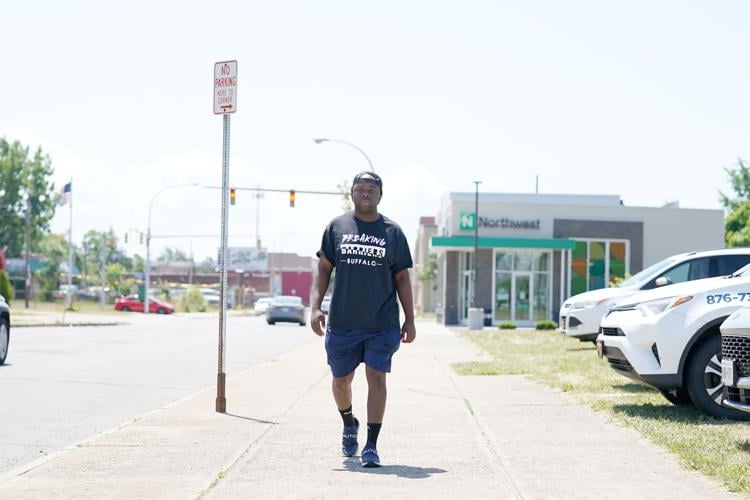
She thought about it, but instead allowed Stubbs to make that short walk on her behalf. Her son, 27, a graduate student at Medaille College, is teaching science and math this summer to city teens while speaking to neighborhood children about social justice, part of the “Breaking Barriers” program coordinated by Say Yes Buffalo.
The Say Yes sessions begin next week. Stubbs realizes the kids, trying to sort out the impossible, will ask him almost immediately about Tops, and he wants to be able to tell them he walked safely through the store.
“They know,” he said. “You can’t pretend it didn’t happen.”
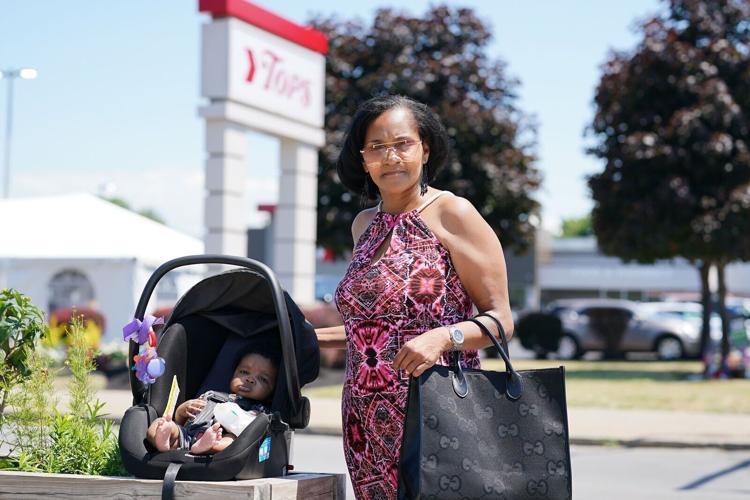
We joined Stubbs on Friday on his walk to Tops, passing an empty lot where a lone butterfly fluttered between wildflowers, passing a circle of memorial candles at Riley Street, and finally crossing paths with a nurse named Judy Thomas, who recalled how Salter – not so long ago – stopped at her place, out of sheer courtesy, to use electrical tape and an extension cord to fix her broken fridge.
Thomas went to Tops for the reopening with her 3-month-old grandson, John Wesley, a pensive infant whose presence she offered as a gift.
“I think,” she said, “we all can use this little bit of light.”
Stubbs, seeking the same thing, hesitated for just a moment by Jefferson Avenue.
“I know I need to be brave,” he said, remembering the friends his mother made at the store and intensely conscious of everything lost there, and then he braced himself to cross the parking lot and enter the store.
Before long, he was in and out. He returned to speak with reverence of a new indoor memorial of flowing water for the 10 who died, and he described an expanse of gleaming fruits and vegetables that he knows his mother will appreciate.
He was particularly moved by seeing the diverse nature of the staff, taking it as proof that many workers from throughout the region were there because they wanted to be part of larger healing.
All of it is meaningful, Stubbs said, and his voice cracked when observing how “the whole world is showing support for us” in neighborhoods that for too long could seem utterly forgotten.
Still, it also points him toward an obvious and overwhelming truth that he said has to be a guidepost, moving forward:
“It shouldn’t take a terrible incident like we just had,” Stubbs said, “for all of this to come to be.”
Back at the apartment, his mother listened intently to his description, but still was not quite ready to go to Tops herself. For two months, she has been forced to leave the neighborhood to shop, using a shuttle or traveling by Uber to another store.
After thinking about it, she asked Stubbs if he minded taking a second walk to Tops on Friday, this time for some groceries.
He cheerfully agreed. Stubbs picked up some “fruits and veggies,” as well as macaroni salad and the first rotisserie chicken they have shared in more than two months.
Smith recalled being a child in the Fruit Belt, more than a half-century ago, and how her own mom used to do all her grocery shopping on Broadway. It was before city neighborhoods that are home to communities of color turned into “food deserts,” where those on foot can struggle to find a fresh tomato.
Stubbs said his mother is "a biblical scholar," a person of deep faith. She keeps Bibles in almost every room in the house, and she often turns to Psalm 23, with its familiar passage about fearing no evil in the valley of the shadow of death.
That reading was really the blueprint for Smith's plan about again walking to the store.
Saturday afternoon is when she always went to Tops, and Saturday afternoon is when she decided to return. She said that once she arrives, “I think I might just stand there for a minute,” remembering the fate of 10 people who should be at her side, but this 5-foot-something transplant survivor with a cane intends to steel herself against such horror with this thought.
She will fear no evil. It is her prayer of community, her prayer of faith that all of us will help to bring her home.


