

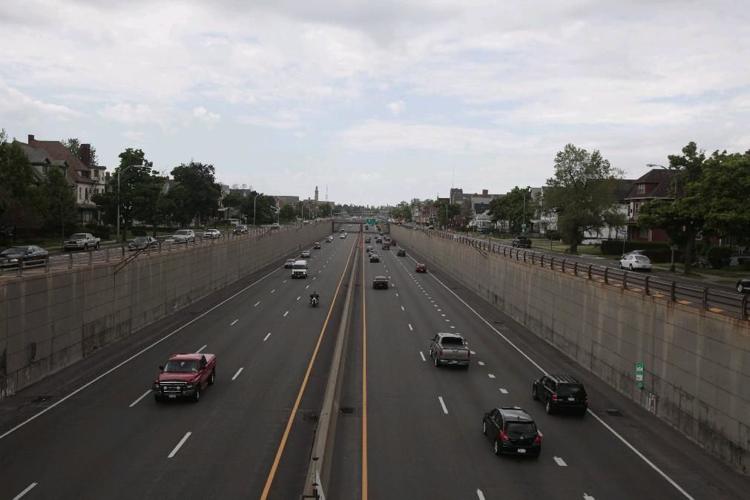
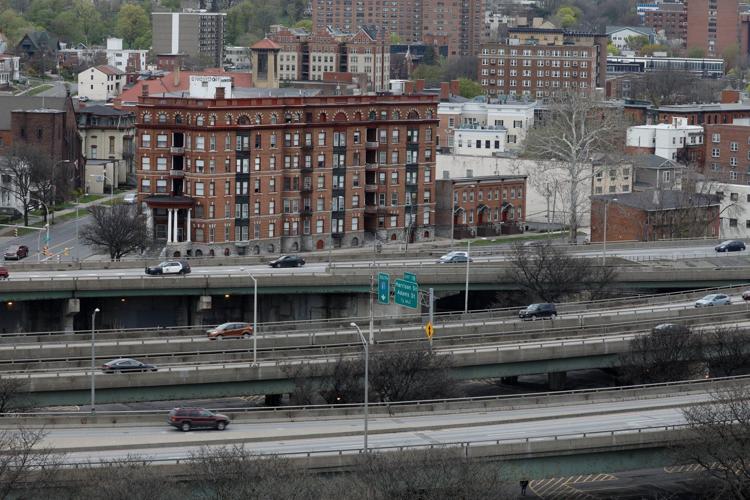
WASHINGTON – Decades after providing the funding to build highways like Buffalo's Kensington Expressway, Congress now seems increasingly likely to spend infrastructure dollars reinventing them – or even tearing them down.
That's because the Democrats in the White House and Congress now see highway construction not just in terms of how fast it will get people from here to there, but also in terms of the damage it can do to communities like Buffalo's East Side.
Proof of that fact came Tuesday, when Senate Majority Leader Charles E. Schumer and Sen. Kirsten E. Gillibrand teamed up to propose spending $15 billion to fix what they see as highway mistakes of the past.
"Infrastructure should build up communities, not divide them," said Schumer, a New York Democrat who, upon introducing his Reconnecting Communities Act, specifically mentioned the Kensington as the kind of highway that damaged urban neighborhoods. "This legislation will ensure local communities have the federal resources needed to revitalize and reconnect communities that have been neglected for far too long.”
People are also reading…
That effort comes in the wake of – and will likely be merged with – President Biden's American Jobs Plan, which would set aside $20 billion for the same purpose. Meanwhile, Rep. Brian Higgins, a Buffalo Democrat, is pushing for $500 million out of that Biden effort to restore Humboldt Parkway, the historic tree-lined thoroughfare that united the East Side until the Kensington divided it in the 1960s.
"This is a once -in-a-lifetime opportunity, given the size and scope of the infrastructure bill and a specific categorical emphasis on the importance of projects like returning Humboldt to a parkway and returning the Scajaquada to a parkway," Higgins said.
The size and scope of Biden's infrastructure plan is an unprecedented $2.3 trillion, and equally unprecedented is its emphasis on environmental justice.
"Too often, past transportation investments divided communities – like the Claiborne Expressway in New Orleans or I-81 in Syracuse – or it left out the people most in need of affordable transportation options," the Biden administration said in a fact sheet detailing the infrastructure effort. "The president’s plan includes $20 billion for a new program that will reconnect neighborhoods cut off by historic investments and ensure new projects increase opportunity, advance racial equity and environmental justice and promote affordable access."
Schumer and Gillibrand, both New York Democrats, have the same thing in mind.
“Historically, the building of highways in upstate New York and across the country has disadvantaged low-income neighborhoods and communities of color by displacing residents, contributing to poor air quality and dividing the heart of communities," Gillibrand said. "This is more than a transportation issue, it is a social justice and economic issue that we must address as our nation rebuilds."
To hear Higgins and others in the Buffalo political community, reimagining the Kensington fits in perfectly with the Biden plan and the parallel Schumer-Gillibrand proposal.
Built in the 1950s and 1960s, the Kensington – also known as the 33 – replaced Humboldt Parkway, a tree-lined thoroughfare designed by Frederick Law Olmsted that served as a green oasis on the city's East Side, much like Lincoln Parkway and Bidwell Parkway serve the West Side.
The Kensington "divided and isolated Buffalo’s East Side, home to a large and growing African American community," said Mayor Byron W. Brown.
The question, though, is what should be done about the Kensington now. A few years ago, local officials floated a $300 million plan that would cover and landscape much of the Kensington for about a mile-long stretch between Ferry and Best streets, but neighborhood activists have been pushing for something more ambitious: replacing the Kensington with an at-grade tree-lined boulevard running from downtown to the I-190.
Higgins leans in that more ambitious direction. Noting that the Kensington was built to serve a city of 580,000, which is more than twice Buffalo's size today, he questions the need for the expressway. He also noted that the Scajaquada – which would be rebuilt as a parkway as part of his plan – has been operating for years now as a low-speed thoroughfare, thereby proving that such roadways don't have to be expressways.
What's more, he said turning the Kensington into a new, at-grade Humboldt Parkway would likely encourage traffic to move to east-west streets such as Broadway and Sycamore Street, which are now underutilized. With synchronized lights installed on those streets, they could become major commercial thoroughfares where new businesses would be more likely to spring up, Higgins said.
Higgins, a House co-sponsor of the Schumer-Gillibrand bill, said the reinvention of the Kensington would fit in nicely with both Biden's infrastructure plan and that of the two senators.
"This is supposed to be stunning and transformational," Higgins said.
Then again, it won't be easy.
There is no guarantee that the Biden plan or the Schumer-Gillibrand proposal will become law. Republicans have resisted a multi-trillion-dollar infrastructure bill, with Senate Minority Leader Mitch McConnell this week indicating that the GOP doesn't think the nation should spend more than $800 billion on such a rebuilding effort.
That means Biden will either have to dramatically scale back his infrastructure ambitions to win Republican votes in the evenly divided Senate or persuade moderate Democrats to unite on a bill and force it through over GOP objections. And that latter option may be difficult because the most conservative Senate Democrat, Sen. Joe Manchin, is negotiating with Republicans to try to reach a lower-cost alternative to the Biden plan.
Then there's the fact that reinventing the Kensington will be hugely expensive. Higgins' $500 million request to bring back Humboldt Parkway dwarfs all his other infrastructure requests. The second largest – fully restoring auto traffic on Buffalo's Main Street – would cost only $40 million.
But Higgins isn't letting such potential obstacles stand in the way of his vision of a new tree-lined parkway and bustling broad business thoroughfares on Buffalo's East Side. And he noted that sometimes, ambitious dreams become reality.
"Nobody thought that the Robert Moses expressway was going to be removed and replaced with a parkway," he said of the former Niagara Falls highway. "That's occurring today."


