

In football, it is one of the most difficult decisions a team can face: Go for it or punt.
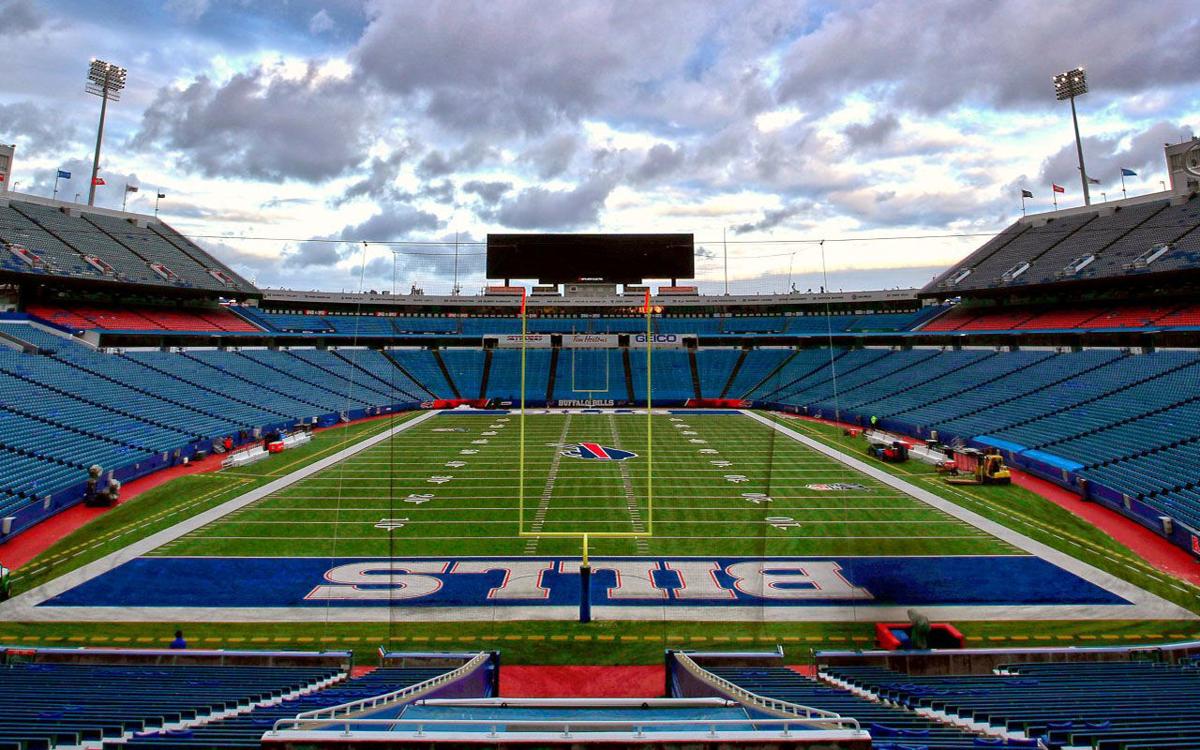
In 2012, when the Buffalo Bills and government officials were negotiating the lease that is still in place for Highmark Stadium in Orchard Park, the sides managed to do both.
The result was a deal that kept the Bills in Western New York while deferring on the more difficult, expensive and controversial decision on building a new stadium.
But it now leaves Erie County, New York State and Bills owners Terry and Kim Pegula grappling over the construction of a new facility.
The current lease, which became official in 2013, expires in 2023. But in the world of lease negotiations, the two years between now and when the lease expires is a moment.
“My goal is to get a deal done that’s fair for all parties: Bills fans, to ensure that the Bills are playing in Buffalo, but also the citizens of Erie County,” said Erie County Executive Mark Poloncarz, responding to a question during an Aug. 4 press briefing.
People are also reading…
Read the full story here.
The status of the stadium negotiations was top of mind for media and fans regionally and nationally after an Aug. 1 report in The Buffalo News revealed that Pegula Sports and Entertainment, the team owners’ management company, is looking for a new stadium to be built in Orchard Park to be funded by taxpayers. The project’s cost is $1.4 billion, according to a source familiar with negotiations that are happening among the team, the state – which, for practical purposes, will drive most of the public funding behind any deal – and the county, which owns Highmark Stadium.

What has become increasingly unclear this week is whether Gov. Andrew Cuomo will play any role in what the team eventually gets in a stadium negotiation.
“There is no blank check,” said Poloncarz, who didn’t address specifics on the details of the negotiations. “There will hopefully be a compromise in which we all come together, one way or another, and do what’s best for this community and ensure the integrity of the football team as the Buffalo Bills for decades to come.”
Poloncarz acknowledged that Gov. Andrew Cuomo – who is facing widespread calls for his resignation, possible impeachment and possible criminal charges in the wake of a damning report from the state attorney general detailing allegations of his sexually harassing women – has not been personally involved in lease meetings so far. If Cuomo resigns or is removed from office, Lt. Gov. Kathy Hochul – a longtime Western New Yorker – will become governor. It’s likely that she will show a personal interest in securing the team’s future. “We expect the Bills to be here a very long time,” Hochul told reporters on Aug. 2.
Save the team first, save the stadium for later
The 2012 lease negotiations had the same core goal – keeping the Bills in Buffalo – but happened on a different playing field.
The idea of building a new stadium was broached a decade ago, when the current lease was being negotiated. Built in the early 1970s, the facility was 40 years old even then. But the team’s founder and then-owner, Ralph C. Wilson Jr., didn’t want a new stadium. He was in his 90s, wished the team to be sold upon his death, and his goal was to keep the team in Buffalo following that sale. That meant creating a lease that minimized debt. Hence the renovations rather than an overhaul of the existing stadium or building a new one.

The Buffalo Bills have enthralled and enraged fans on this playing field for 53 years, first when it was called Rich Stadium, then from 1998 t…
It also meant agreeing to a non-relocation agreement and locked the club into Western New York during the likely term of a sale and the years immediately thereafter. If a future Bills owner wanted to move the team, they would have to pay a $400 million penalty – a staggering amount even for most billionaires. That penalty is separate from the NFL's own nine-figure relocation fees. The Raiders, for example, paid $378 million for their 2020 move from Oakland to Las Vegas.
Poloncarz provided a glimpse into the negotiations behind the current lease in his 2019 book, “Beyond the Xs and Os: Keeping the Bills in Buffalo.” He wrote, “By agreeing to the ironclad non-relocation terms demanded by the county and state to be included as part of the lease, Mr. Wilson knew he was setting the stage for the next owner to keep the team in Buffalo.”
It worked.
Ultimately, there were three bidders: The Pegulas; a Toronto group that included Larry Tanenbaum of Maple Leaf Sports and Entertainment, Edward Rogers of Rogers Communications and musician Jon Bon Jovi; and Donald Trump, then still a New York developer and reality TV star and who, in a twist of what-if history, has since acknowledged that if he purchased the Bills, he would have likely not run for president.
The Pegulas, who already owned hockey’s Sabres, purchased the team in 2014 and stated their excitement about keeping the Bills in Buffalo. Poloncarz noted that Russ Brandon, then the Bills’ president, told him that other prospective bidders “ ‘kicked the tires of the team’ but did not come close to placing a bid ‘because of the non-relocation agreement.’ ”
That positioned the Pegulas to buy the team, and the relatively short lifespan of the lease also ensured that at some point, they would have to deal with a bigger commitment – such as a new stadium – and with it, likely a longer-term lease.
The 2012 negotiations were focused on the near-term: how to keep the team in Buffalo, and connected to that objective, how to renovate the then-four-decade-old stadium to reach its 50th birthday. In his book, Poloncarz writes that Bills treasurer Jeff Littmann, Wilson’s chief negotiator and one of his most trusted confidantes, said the franchise “doesn’t want a new stadium,” nor were they seeking “a complete rehab like Green Bay or Kansas City.”
Only three NFL stadiums are older than Highmark: Kansas City’s Arrowhead Stadium (1972), Green Bay’s Lambeau Field (1957) and Chicago’s Soldier Field (1924). All three have undergone extensive overhauls; most of Soldier Field was demolished and rebuilt.
Measuring viability
According to Poloncarz’s book about the 2012 lease talks, Littmann described the team’s ongoing viability in Buffalo by using an algebraic equation: Viability = D x P-cubed – C.
The “D” is demographics of the fan base that the Bills can draw across upstate, Western New York and Southern Ontario.
“P” – to the third exponent – represents the passion of the fans.
The “C” that subtracts from those two elements is the debt that comes with capital improvements.
Then and now, the “P” is the Bills’ strongest factor. The passion of Bills fans endured a 17-year playoff drought that ended in 2017, and a gap between postseason wins that spanned a quarter century. That devotion earned the team’s fan base a nationally recognized reputation that conjures images of people body slamming themselves through tailgating tables and is recognized by a memorable moniker: Bills Mafia.
The “D” has long been a challenge. Buffalo is a blue-collar city with less corporate presence – and thus fewer sponsorships and less ability for the team to sell premium seats. That’s why the debt that comes with capital projects (“C”) was a concern then, and now.
This was the Wilson-era model for describing the team’s viability. Pegula Sports and Entertainment officials, who declined to comment for this story, likely consider similar factors and could point to Western New York’s relatively limited economic capacity to make a case for significant – and even complete – governmental support in building a new stadium. Asking politicians for a fully funded facility is a dicey proposition anytime, but especially in the throes of a pandemic, with a governor whose political future is in peril, and with a contingent of voters and politicians on the left who recoil at what they would view as a billionaire handout.
But the NFL has to approve any new lease, and its 31 other teams have a vested interest in seeing the Bills build a new stadium or, potentially, move to a larger market because of the league’s revenue-sharing agreement. Buffalo is among the smallest markets not only in the NFL but all of big-league sports. In Nielsen TV market rankings, for example, Buffalo is No. 53 — smaller than every other locale except Green Bay-Appleton, Wis. (No. 69) that has a team in one of the four major sports leagues.
In some ways, that ranking is deceiving. The Bills also pull fans from at least three other markets, two of which are smaller (Rochester, No. 77; Syracuse, No. 87) and one that isn’t ranked, because it is in Canada: Toronto, with a metro population of about 6 million people.
But tapping into Toronto and monetizing it in a significant way has been difficult for the Bills, much as the team has tried. Under Wilson’s ownership, the team played a series of preseason and regular season games in Toronto from 2008 to 2013, and ultimately had trouble selling enough seats to justify pulling events from Orchard Park. Shortly after the Pegulas purchased the franchise in 2014, they canceled the series.
While the Bills still maintain a fan base in southern Ontario that presumably helps bolster the team’s bottom line, Toronto also stands as one of the first cities mentioned when the topic of moving the team is broached by media and politicians. Another oft-mentioned possibility is London, should the league wish to expand overseas.
The stateside list of untapped markets is lengthy, too: Orlando (No. 17), Portland (No. 21), St. Louis (No. 23), San Diego (No. 27), Salt Lake City (No. 30), San Antonio (No. 31, and located only an hour from the vibrant Texas capital, Austin, which ranks 38th – although that market may be too close for the Dallas Cowboys’ liking), Birmingham (No. 45) and Louisville (No. 49).
Neither the NFL nor the Bills make detailed financial information available. But team revenue is split into two primary categories – national and local. National revenue, which is split by all 32 teams, includes the NFL’s television deals, merchandise and licensing agreements and a portion of each organization’s gross ticket sales. The Bills’ average ticket price entering last season ($75.95) was the lowest in the league and nearly $30 cheaper than the NFL average ($104.73), according to Statista, a market and consumer data firm.
According to a Forbes report released Aug. 6, the Bills are the least valuable team in the NFL, with an estimated worth of $2.27 billion. That is an 11% increase to the Bills' value from one year earlier, but well below the $3.5 billion average worth. The most valuable team – Dallas – is valued at $6.5 billion, and the second-highest club – New England – is valued at $5 billion.
While the pandemic season broadly dampened stadium revenues leaguewide, a glimpse at pre-Covid numbers illustrates Buffalo’s steady place in the basement of NFL finances. According to Forbes, the Bills generated $104 million in total stadium revenue in 2018, which ranked 29th out of 32 teams, ahead of only the Cincinnati Bengals, Los Angeles Chargers and then-Oakland Raiders.
The Bengals’ lease at Paul Brown Stadium expires in 2026, and the team and local county officials are reportedly expected to begin negotiations on extending the agreement in 2024. Any deal will require significant stadium upgrades. The average cost of NFL stadium renovations since the Bengals’ venue opened in 2000 was pegged at $214 million, according to the Cincinnati Enquirer. That’s considerably higher than the $130 million invested in Highmark Stadium as part of the 2013 lease agreement. (The Bills contributed $35.455 million; the county, $40.654 million; and the state, $53.891 million.)
The Chargers were playing home games in a 27,000-seat soccer stadium from 2017-19, after leaving San Diego, their home for 56 seasons, when a ballot measure to fund a new downtown stadium failed. Last year, they moved into a new $5.5 billion, privately financed stadium in Inglewood, Calif., which they share with the L.A. Rams.
Similar stadium financing issues were the catalyst for the Rams leaving St. Louis in 2016 and the Raiders leaving Oakland for Las Vegas in 2020, a move approved by the league in 2017. The Raiders' average ticket price ($153.47) entering last season was the highest in the NFL, per Statista.
The bottom line: Buffalo’s economics make it difficult at best for the region to sustain an NFL franchise, even with strong fan support. The prices the Bills can charge per seat, coupled with a comparatively smaller or less lucrative list of corporate sponsors than most NFL cities, are daunting obstacles. It's clear they need to be overcome. What's unclear – and what negotiations will have to resolve – is how prominent a role tax dollars should play in fixing that problem.


