

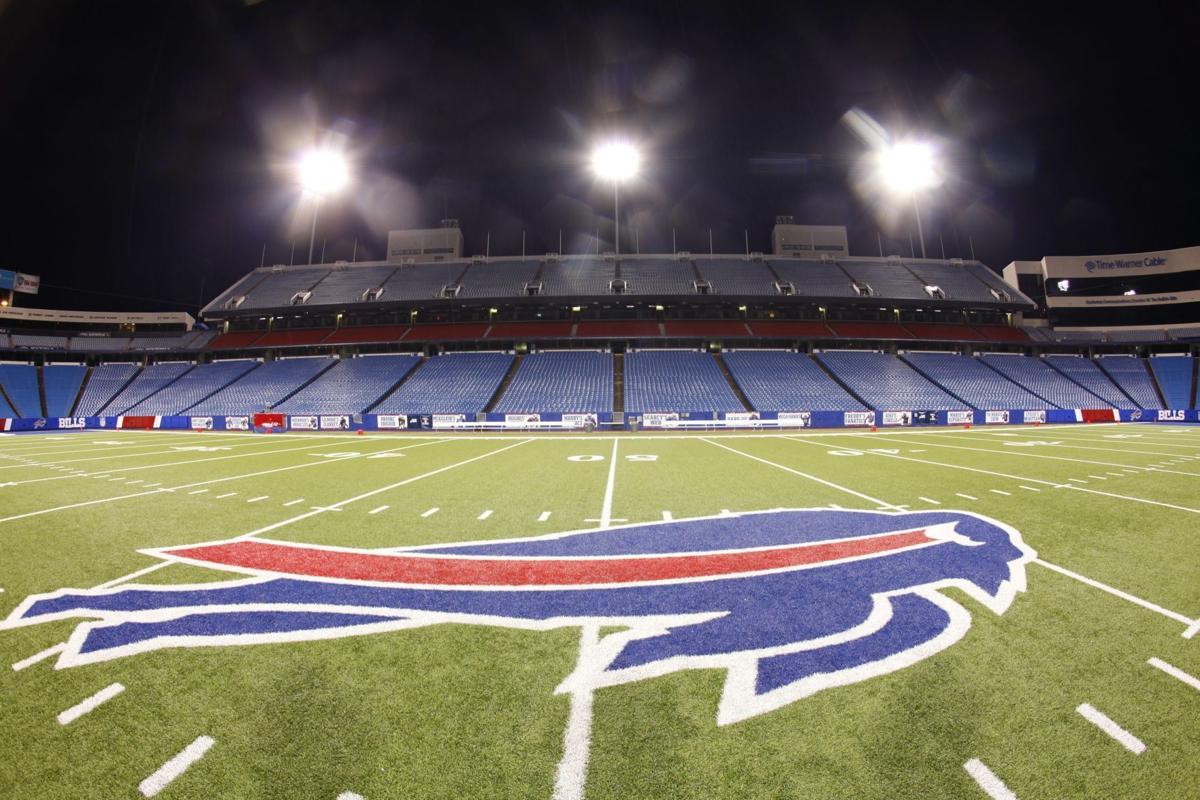
ALBANY – Crystal Peoples-Stokes is the second most powerful lawmaker in the State Assembly and a longtime backer of the Buffalo Bills.
“I’m a die-hard fan,’’ Peoples-Stokes said last week, a line she uses whenever the subject of the Buffalo Bills comes up.
As talk of a new stadium swirls again, Peoples-Stokes makes it clear: She would love to see a new facility built in downtown Buffalo, her city. But she is also on board with the Pegula Sports & Entertainment plan to build a new stadium next to the Bills' longtime home in Orchard Park.
What’s she’s not OK with is what she has been told about the negotiations: an ask by the Pegula company for a 100% taxpayer-financed stadium.
“Because the amount is so large, it seems like a non-starter,’’ Peoples-Stokes said last week in an interview.
People are also reading…
The public will have to pay some portion of a new stadium project, she believes, because the stadium would be, like the existing one, county-owned and one she believes is a taxpayer resource with a healthy return on the investment for the state and county.
“But, it certainly should not be 100%,’’ she said.
Lawmakers don’t have a specific seat at the negotiating table, but they are likely going to have to be willing to approve – for years to come – annual state budgets that will, if the Buffalo Bills have their way, include payments of some kind for a new NFL stadium. Gov. Andrew M. Cuomo, in a private meeting at the executive mansion in Albany in early June, brought up a number of big projects in the Buffalo area, including the Pegula stadium proposal, though it was not a formal presentation of the team’s plan.
Some members of the Western New York delegation in the Democratic majority ruling the Assembly and Senate say they are confident a deal can be worked out – perhaps not this year, given that the current stadium’s lease with the county doesn’t expire until 2023.
But they have gasped at the Pegula call for 100% financing.
“The idea of taxpayers funding 100% of a new stadium is a non-starter," said Sen. Sean Ryan, a Buffalo Democrat. “A new, publicly owned stadium would be a year-round asset, which would warrant some support from the people of the State of New York, but 100% is not going to happen."
The early chatter in Buffalo and Albany is that the Bills were dropping an initial offer they knew would not be the final product. But there has also been speculation among some sources, who spoke on condition of anonymity, that the Bills might not be as committed as they have been to remaining in Buffalo if their first bid to try to engage New York State and Erie County was at a level that politicians could never accept, either for financial or political reasons, or both.
Ryan, for one, believes the Pegulas are stable owners who have “demonstrated a strong commitment to Buffalo.” Ryan’s district includes Orchard Park and the current stadium area.

Even though state lawmakers from Western New York call the Buffalo Bills a community asset, they say taxpayers will not – and should not – foot the entire bill for a new football stadium.
"The Pegulas have built their brand around Buffalo, they have invested in our community, and the Bills are the best they have been in years. Moving the team out of Western New York now would be impractical for them and for the National Football League, whose commissioner has professed his desire for stability and for the Bills to be successful in Buffalo. I am confident the state and county will be able to work with the Pegulas to fully explore all options and come up with the best plan for Western New York," the senator said.
The other Democratic senator from Buffalo, Tim Kennedy, said he expects the end deal for a stadium will be a public/private partnership.
“The Bills leaving our community is not an option. While this is the beginning of a negotiation, we expect these conversations will be ongoing over the next many months and couple of years before there is a contract set in stone," Kennedy said last week.
New York State, he believes, “will play a critical role” in keeping the team in the area for the economic boosts the team provides “besides just being the fabric and identity of who we are as a region."
As for the team’s 100% financing ask of taxpayers, Kennedy said: “I think it’s just the beginning of a negotiation, the beginning of a conversation. I expect the conversation is going to change a number of times, if not many times, before a final contract is signed."
Democrats in the two houses of the State Legislature enjoy supermajority status since the party gained control a couple of years ago of the 63-member Senate.
Republicans, while powerless, have served as voices opposing many policy and fiscal plans by Democrats. In this case, though, the top Republican in Albany from Western New York – Senate Minority Leader Rob Ortt, a North Tonawanda lawmaker – declined to comment late last month or again last week on stadium issues, including the team’s 100% public financing idea.
The Buffalo News last week reported that the Bills were seeking at least $1.1 billion in taxpayer assistance – grants, tax breaks and other possible funding streams – to finance a new stadium. Multiple sources with knowledge of the talks later confirmed to The News that the actual amount the team tossed out in its first proposal was $1.4 billion.
Peoples-Stokes, the Assembly’s majority leader, said her understanding of the team’s public financing requests approaches or hits $1.5 billion, but she cautioned that she’s not been given any specific details about the kind of stadium project the Pegulas have in mind.
As for the Pegulas proposing Orchard Park over downtown Buffalo for a new stadium, she said: “I’m still OK with that, even though I’m getting a lot of pressure to insist that it be downtown.” She said the downtown location would end up being more costly, because of land acquisition expenses.
“I’d like to see us with a new stadium," said Peoples-Stokes, adding that she believes a new facility would convince the NFL to select the Orchard Park stadium to host a Super Bowl. As for the stadium talks between the sides, she joked about the team's playoff run last season: “If the Bills continue with the season they had last year … I think these conversations will be a lot easier."
Assemblyman Pat Burke, a Buffalo Democrat whose Assembly district includes Orchard Park and the stadium, is not worried about a deal, though he raised questions about the notion of 100% taxpayer financing.
“It’s going to be settled. The Buffalo Bills are going to remain the Buffalo Bills and they are going to remain in Orchard Park," Burke said in an interview.
“The Pegulas are billionaires. They chose this place … Do I think they’re going? I don’t think they’re going to bail on everything they’ve invested in. Their identity is so intertwined with Buffalo that the chance of them leaving is not realistic. Even them pretending to leave is not realistic," he said.
An individual with knowledge of the talks said the team’s representatives have not threatened to leave Buffalo, but said they have made clear that other cities would like to get an NFL team.
Burke said public money will be involved in any new stadium deal – precisely how is far from certain – because the existing stadium is already a taxpayer-funded investment. He said he doesn’t agree with critics who argue against any public money for a pro football stadium owned by a billionaire.
“I don’t see it the same as some of those other public/private partnerships, which are often just big giveaways for very powerful, multinational corporations," he said.
But a 100% publicly funded deal? “That’s not going to happen,’’ Burke said.
Assemblywoman Monica Wallace, a Lancaster Democrat, said it’s important to recognize the value of the Bills to the Buffalo area.
“They are critical to the identity of Buffalo, the spirit of Buffalo. Regardless of political party, regardless of income level, regardless of gender or race, everybody loves the Buffalo Bills. They are what brings us together as a community," she said last week.
“At the same time, we have to be responsible with taxpayer dollars, and while I do think that we should use some public money to support a new stadium if it’s needed … I think 100% (publicly funded) is not feasible at this point,’’ Wallace added.
Asked if it was not feasible because the state can’t afford it or if 100% public financing is not a way such stadium deals should occur, she said: “Both. We don’t have that kind of money, but if we did I think the owners and those profiting from it should have some responsibility to invest in their own business.”


