

The Buffalo Bills could begin playing in a new stadium as soon as the 2026 season.
That timeline – a year earlier than previously projected – is possible should the NFL team and New York State quickly reach an agreement for the construction of the Bills’ proposed $1.4 billion venue in Orchard Park.
“If we get an answer on a stadium by the end of this year and construction doesn’t get delayed, we can be ready for the 2026 season,” Ron Raccuia, the executive vice president of Pegula Sports and Entertainment, told The Buffalo News.
Raccuia represented Bills owners Kim and Terry Pegula at the NFL fall meeting last week in midtown Manhattan, where league owners were briefed for the first time about the team’s plans to build a stadium and the status of its negotiations with New York State and Erie County for public funding.
People are also reading…
PSE and state representatives are meeting at least weekly, and “everyone’s happy with the collaboration and the effort,” Raccuia said, noting that momentum toward reaching a deal has been building since August, when Kathy Hochul, a Buffalo-area native, replaced Andrew Cuomo as governor of New York.
Hochul, who spoke with The News later Wednesday at her Manhattan office, said progress has been “very positive” and that she expects to include the stadium project in the state budget.
Erie County Executive Mark Poloncarz has said a deal could be reached by the end of the year.
Why the urgency?
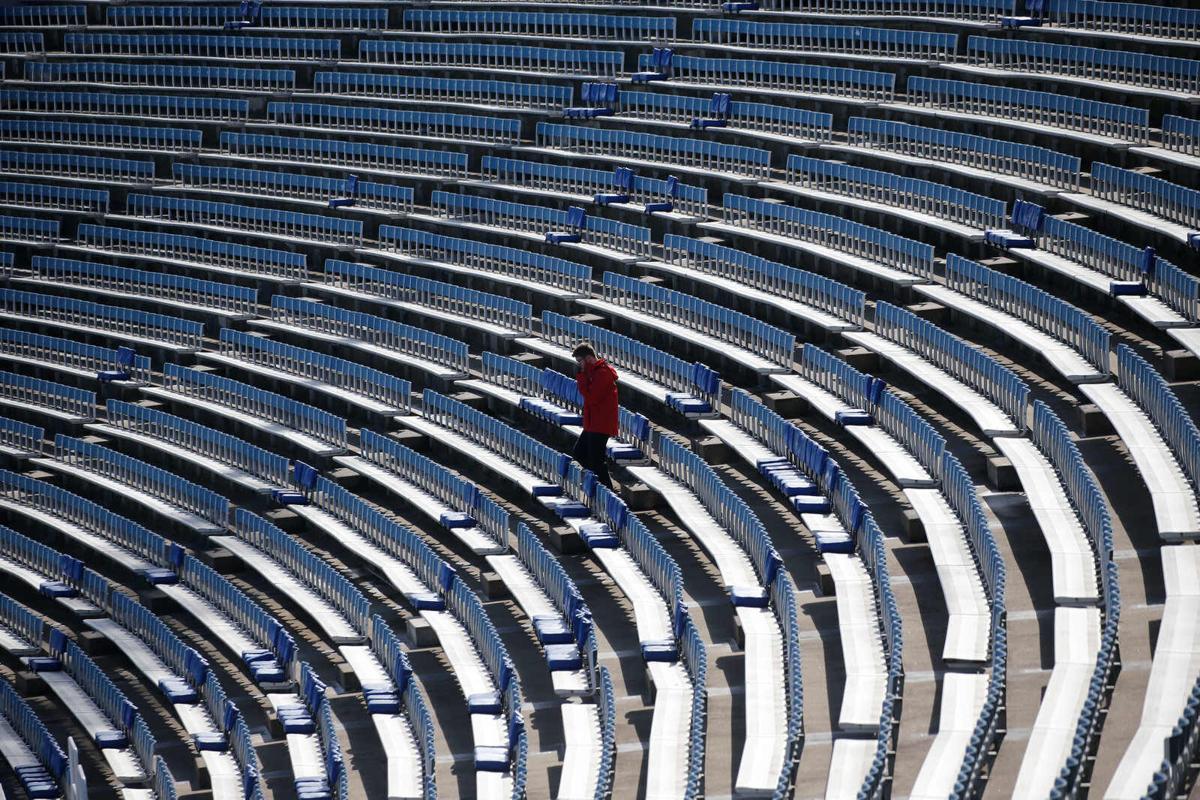
Multiple calendars are driving the discussions: One is the Bills’ current lease on Highmark Stadium, which expires in July 2023. Another is the lifespan of the nearly 50-year-old facility in Orchard Park. A county-commissioned engineering study says the upper deck will likely need to be largely replaced in five to seven years.
“We have one year left on our lease,” Raccuia said. “We have a current stadium that has structural deficiencies and this has been kicked down the road going back a decade or more.”
When the Bills, county and state were negotiating the current lease in 2012, the idea of building a new stadium “was discussed as an option,” then-Lieutenant Governor Robert Duffy, who was part of those talks, told The News recently. But the Bills’ original owner, Ralph C. Wilson Jr., was 93 at the time and planned for his family to sell the team after his death. Wilson wanted the Bills to remain in Buffalo under the new owners and preferred a lease that minimized debt.
That meant renovating – but not overhauling or replacing – the Orchard Park venue, and leaving the decision on a new stadium for the next owners. The Pegulas bought the team following Wilson's death in 2014, and within a few years, it became apparent that Highmark Stadium was nearing the end of its lifespan. Within the next decade, the upper deck and lower bowl ring wall will need major repair or replacement, as will multiple roofs, a drainage system and several parts of the stadium’s plumbing and wiring systems, among other issues, according to an engineering study commissioned by Erie County.
The Bills’ own studies, which the team has not released in full, indicate that building a new stadium is more cost effective than renovating Highmark.
“It’s time to get a deal done now,” Raccuia said. “We have the right people in place. The governor is committed. The county executive has been terrific ... We’re ready to do a deal.”
For practical purposes, key events on the NFL’s corporate schedule are vital to the process. Those include the league’s fall meeting, which marked the first time the owners' semiannual gathering was held in person since December 2019.
“While it is a small market, it’s tremendously visible,” Dallas Cowboys owner Jerry Jones told The News when asked about Buffalo’s importance to the NFL.
Jones’ support isn’t surprising. He’s close with the Pegulas, who hired his consulting company, Legends Global Partnerships, to work on the Bills’ stadium project. But the backing of Jones and owners like him is important, because they can influence decisions that help small-market teams such as the Bills continue to thrive in a mega-dollar league.
“Today was huge,” Raccuia said Wednesday afternoon, about an hour after the league updated the owners on the Bills stadium negotiations. Raccuia noted there were no public questions posed by the owners following the presentation, which he estimated to be about five to 10 minutes long, and that a half-dozen or so owners gave him positive feedback.
“They were very receptive and we’re going to need them and the league to be actively involved in getting this deal done,” Raccuia said. “The fact that we got through today in a positive way is a good sign. Now, we’ve got to do our job.”
What’s next?
The Bills are meeting at least weekly with negotiators from New York State, which is likely to shoulder most of the projected $1.4 billion for a new stadium, as well as with Erie County, which owns Highmark Stadium.
The sides have agreed to not discuss details of the negotiations in public, so specifics are scant. But all have indicated that talks are, at a minimum, constructive.
"I think we all want to get the deal done," Poloncarz told WIVB earlier this month, indicating his hope that an agreement can be reached by year’s end.
Hochul told The News at a Manhattan news conference last week that she expects to work with state legislators to have the stadium in the next state budget, which must be finalized by April 1.
“There will be plenty of time to get the job done, so the Buffalo Bills know there’s a commitment, a shared effort, to finance this and those are the details that are being worked out,” Hochul said. “It is very positive right now.”
Hochul also said she plans to soon release a state-commissioned study on the feasibility of renovating Highmark Stadium or building a stadium in downtown Buffalo or Orchard Park.
“I promised transparency,” Hochul said. “It is a little unprecedented, but I want to get that in the hands of everyone.”
Building a stadium downtown would cost an additional $1 billion, according to a study commissioned by PSE, which also noted other obstacles that could delay the project for years. A location across the street from the current stadium in Orchard Park is owned by Erie County and is shovel ready. That land is adjacent to Erie Community College’s South Campus, which could potentially close as part of a campus consolidation. Raccuia noted a new stadium complex “might need some ECC land, but it would be very minimal, if any.”
The projected $1.4 billion for a new Orchard Park venue also includes the cost of demolishing Highmark Stadium and turning it into a parking lot.
“We’ve spent years studying the various locations and we know unequivocally that Orchard Park is the most feasible, the most efficient, the most cost-effective location,” Raccuia said. “Downtown is a location, but it is not any of those things.”
Maintaining the gameday culture of tailgating is important to customers, Raccuia added, noting that in surveys conducted by the team, fans “overwhelmingly” preferred an Orchard Park stadium because it allows for pre- and post-game partying.
“Tailgating is who we are as a fanbase and a community,” Raccuia said. “It’s just not possible downtown. And our fans overwhelmingly said they want tailgating.”
How do the politics play?
Hochul might be the biggest reason negotiations are moving forward.
Raccuia told The News “there was a lack of engagement from the state during 2019 and early 2020” when Cuomo was governor. Hochul, who had served as lieutenant governor since 2015, took over when Cuomo resigned in August. Negotiations began in earnest shortly thereafter.
“They’re happening now,” Raccuia said. “They weren’t happening before.”
By political calculation, they need to happen now. Hochul, who is running for a four-year term, will face challengers, including state Attorney General Letitia James, in the Democratic primary in June. If Hochul delivers a billion dollars or more for a football stadium – which is not a major economic driver, economists have largely determined – she’ll be criticized on the left for helping to fund a stadium for billionaire owners. If she doesn’t, the Bills’ future in Western New York might be in peril, testing an otherwise ironclad and much-needed bastion of electoral support.
Either way, Hochul and other politicians involved will face criticism. That’s unavoidable. But timing and clarity are within her control.
Decisive action can help avoid stadium financing from being an issue leading up to the primaries and the general election, particularly with state legislators facing voters, said sports consultant Marc Ganis, who spoke with The News in the lobby of the InterContinental New York Barclay hotel, where the owners’ meetings took place.
“It then becomes a political football,” Ganis said. “And then you also can’t get anything approved in the legislature, because they’re up for reelection in November, and there may actually be a competitive gubernatorial election. So you just can’t let that happen, which is why there’s a time urgency to get this done in a matter of single-digit number of months, rather than longer.”


