

When 1,400 people walked off the job at Raytheon in early November, managers at the defense technology company weren't the only ones who noticed.
Six days later, Tucson Unified School District officials were actively recruiting Raytheon Missile Systems employees to try to fill their serious bus-driver shortage.
Down by more than 25 drivers this year, the district has seen late arrivals for hundreds of students. The extent of the problem is unknown, even to TUSD, because the district does not maintain bus attendance logs or records of late arrivals.
TUSD has scrambled to find more drivers. Twenty school buses have been fitted with signs advertising the job openings. Ads have run in local papers. Recruiters were sent to two union job fairs for striking employees and TUSD held its own job fair in November. And in early December, TUSD donated a bus to Clear Channel Radio for its Toys for Tots campaign and received radio promotions for its bus-driver search.
People are also reading…
TUSD is planning another advertising campaign at the beginning of the year, around the time Internet service provider America Online closes its Tucson call center.
On Oct. 18, after the announcement that AOL would close that facility, TUSD Transportation ombudsperson Alex Bendyna suggested in an e-mail, obtained by the Star through a public records request for information on the shortage, that TUSD should try to recruit those workers.
"Many of these people probably earn about what our drivers do and will be looking for work now to replace those jobs," he wrote.
Bendyna concluded the e-mail by stating: "I believe we ought to be able to recruit at least some of these people, and we are absolutely desperate for applicants. Even 20-25 successful applicants out of this pool would be a real break for us."
On Tuesday, Bendyna said: "It's not that we thought AOL or Raytheon employees would be more qualified than anyone else. This is recognizing there would be people looking for work coming out of Raytheon and AOL and let them know we're looking for people."
Officials also pointed to the lack of available skilled workers in Tucson. Unemployment in the metro area is below the national average — 4.1 percent this year, compared with 4.6 nationally.
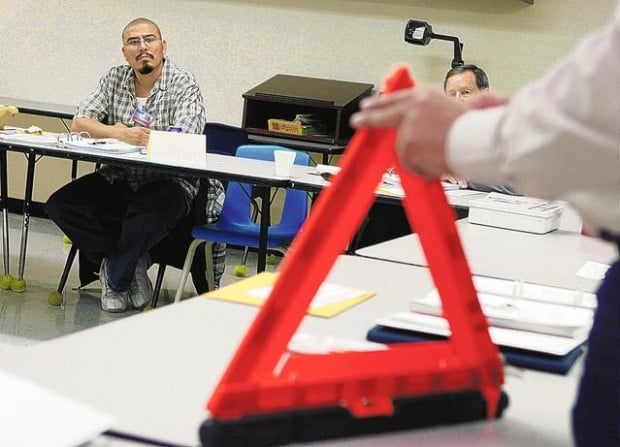
Bus-driver recruits, regardless of background, are subject to the same training standards, said Bud Waters, TUSD safety manager and staff commander. They must complete 10 days of classroom training, practice driving seven routes, with one day for each route, and have a week of on-the-job training.
Eight people began training to be bus drivers for TUSD on Monday. In total, 19 applicants had been offered the gig. One of the eight quit Wednesday morning. Of the seven remaining, two are from Raytheon, one of whom signed on at a job recruiting fair organized by the International Association of Machinists and Aerospace Workers Local 933.
"Whatever it takes to take care of my family, that's what I'm going to do," said Lyle Inscho, 48, who worked for one year in production storage at Raytheon.
Inscho and Guillermo Molina, 36, both said the union prepared members for a possible strike, including discussing other sources of income.
"They had been planning 'What if' for quite some time," Inscho explained. "They knew jobs in the interim would make or break the strike."
Many of the striking workers were making $10 to $25 an hour before the strike. The union pays its members $150 a week to picket Raytheon sites during the strike and estimates half of its 1,400 members have found temporary, seasonal or permanent jobs since the strike began Nov. 6.
In November, TUSD Transportation Director Bill Ball attended two job fairs hosted by the union. Sahuarita Unified School District also attended one of the fairs. Inscho said he signed up to be a bus driver at one of the events.
Molina, who has worked at Raytheon for 10 years, said he applied for the bus-driver position after seeing an advertisement in a local newspaper.
He said he plans to return to Raytheon once the strike ends.
"That's one thing I informed TUSD," he said. "Once Raytheon comes into an agreement with the union, I most likely will go back."
Rick Montaño, a field safety supervisor for TUSD and bus-driver instructor, said he knows some of the prospective drivers are temporary.
"We need to fill our need for bus drivers, whether that be for a week or a month," he said. "If you're willing to work, we're willing to train you."
About 90 percent of the 1,400 strikers have told the union they want to return to their Raytheon jobs after the strike ends, said Ed Meyer, co-chair of the union committee that helps members find jobs.
"A number of our members have found fairly decent jobs and aren't even coming back," he said.
But the issue of strike work shouldn't be cast as merely member retention, Inscho said.
"It's not the union losing people. The union is helping people cope and survive in this time."
Those who have found permanent work include a few electricians, who can take their skills anywhere, a few who are training to become correctional officers, and a few who are training to become truck drivers for companies such as Swift Transportation Co., Inc.
The commonality in those industries is hiring shortages. Many of the skilled trades have labor shortages, the U.S. Department of Labor reports. The Arizona Department of Corrections has more than 800 job openings statewide and the long-haul trucking industry is short 20,000 drivers, the American Trucking Associations reports.
Meyer said strikers are valuable new hires in these industries, because they are skilled and steady. Additionally, "almost all of us have government-issued security clearances, which means the government has investigated us already. It eliminates the need for companies to do background checks," he said.
Raytheon officials say the company isn't hurting without the workers. Production levels at the missile factories were slightly higher in November than pre-strike levels, company spokeswoman Sara HammondZ said.


