Hector Noriega wants people to ask about his tattoo — a large image of hands clasped in prayer, holding a rosary. Above it are the words: "In the company of angels."
Their questions conjure memories of his 12-year-old brother, Jaime Luna, who died of cancer in 1998. Noriega got the memorial tattoo a year later. "I felt kind of like I was forgetting a lot about him," Noriega said.
"I felt as though the memories were fading and he wasn't as prominent on my mind, and that upset me. I felt like if I continued the path I was on I would forget about him completely."
Tattoos, once the hallmarks of bikers, sailors and the disenfranchised, have become mainstream, increasingly seen on adults of all ages and walks of life. More than 45 million Americans — 15 percent of the population — have at least one tattoo, according to a 2006 report from the U.S. Food and Drug Administration.
People are also reading…
A growing trend in the tattoo industry is ink memorials to friends and loved ones who have died, called memorial tattoos, in-loving-memory tattoos or R.I.P. tattoos.
Though memorial tattoos date at least to the Civil War, artists say interest was reignited following the 9/11 attacks in 2001, and since the first casualties of war were reported in Iraq and Afghanistan.
Ken Deets, a tattoo artist at Enchanted Dragon, 4243 E. Speedway, estimated 30 percent to 40 percent of the shop's business is memorial tattoos.
"It's something they can hold onto," he said. "You can't lose it. You can't get rid of it. You can't sell it. It's yours. It's personal, something not only for yourself, but for others to see."
Photographs, said Daniel Jungenberg, can be lost or destroyed. That's why he opted for a tattoo on his chest in remembrance of his World War II veteran grandfather, Ernest Evers Nelson.
"The only way this portrait of my grandfather is going anywhere is if I'm with it," said Jungenberg, an apprentice at Fast Lane Tattoo, 1108 S. Wilmot Road. "When I brush my teeth or shave my face in the morning, I see him."
Nykol Scheick had a portrait of her father, Mickey, tattooed on her calf this year, on the fifth anniversary of his death.
"My dad was my best friend, and I'd always wanted to get something that showed he was still here watching over me," she said. The tattoo "is identical to the picture I had. It looks exactly like my father."
Scheick is getting a second tattoo in remembrance of her dad, a reproduction of a sketch he drew a month after she was born: a Camaro transforming into a dragon as it speeds toward the heavens.
"I felt it was an outlet to get my emotions out and show everybody the dedication and love I had for my dad," she said.
Memorial tattoos honor the dead and remind those left behind of their own mortality, said Jeff Greenberg, head of the University of Arizona's social psychology program.
"The idea of trying to keep alive loved ones who've passed on." Greenberg said. "It could be as simple as people we love who gave us a sense of security and connection in the world, attachment figures.
"We want to keep a sense that they have a presence in our lives. We also want to pay tribute to them and (know), in a sense, that something lives on beyond their normal lives," he said.
"We want to think we have some kind of permanent place in this world that will transcend our own death. People who are still here in some way give us hope that we will still be here after our death."
Ken Sprague has been a tattoo artist for eight years. He designs at least 10 or 15 memorial tattoos each month.
His specialty is the increasingly popular photorealistic black-and-gray portrait, though he works with clients to create unique designs.
An ethical tattoo artist will help clients choose tattoos that are right for them. A design chosen in haste, during a time of bereavement, could be regretted.
"I personally think it's always good to sleep on the idea of a tattoo," Sprague said. "You should never rush into something that's permanent."
Earlier this summer, nine family members and friends of Gilbert Alire Jr. went to see Sprague at Fast Lane Tattoo. They were mourning the loss of Alire, who died in an auto accident June 5 at age 30.
Alire was an aficionado of classic Japanese imagery, and Sprague had given him a samurai tattoo on his arm.
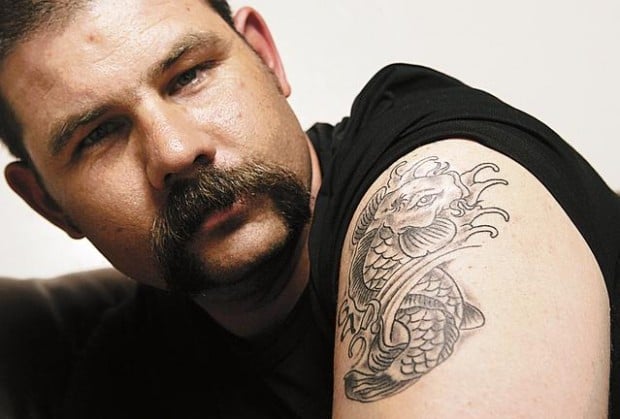
His family took in a design of a koi fish, another Japanese symbol, which they wanted to use for memorial tattoos.
He worked with the family to fine-tune the design.
"Just to see that outpouring of support and emotion from his family was a pretty incredible thing," he said. "I think our shop was fortunate to help them with what they were trying to accomplish."
Alire's family wanted tattoos that represented him in both life and spirit. In Japanese mythology, they learned, koi represented courage, strength and perseverance.
In ancient folklore, only the most determined koi could swim successfully upstream. Those who made the leap up waterfalls would be rewarded by turning into dragons.
A different symbol held meaning for Alire's friend Larry Miller. He got an armband tattoo that incorporated Alire's initials. It stemmed from a conversation the men had shortly before Alire's death.
Miller had been talking to his friend about getting a tattoo, and Alire suggested he start with an armband. Because the inner arm is so sensitive, Alire thought Miller should make his first tattoo the most painful so he could get it over with.
For many who are grieving, a group trip to the tattoo parlor can be cathartic.
"It's a shared experience that emotionally is a very charged event," Sprague said.
"People are telling stories on their skin. It's kind of a highly personal way of pinning a note to your chest to never forget."
Tattoos link many whose lives were touched by special man
Gilbert Alire Jr. never missed an opportunity.
Karate black belt, ordained minister, drag racer, cage fighter, wedding crasher, bungee jumper, scuba diver, mechanical-bull rider, Mexican hat dancer, NASCAR pit crew member.
Any chance he was offered, Alire grabbed onto with both hands. A strapping man, Alire would do the splits on a dare, just to prove he could.
"When we'd be at the bar and they'd play the country line dance, Gil would go out there and do his own line dance, and pretty soon everybody would forget about doing it the right way and start doing it Gil's way," friend Larry Miller said.
Outgoing and personable, Alire's charisma and desire to make people laugh, even at his own expense, drew people to him. He was always looking out for others, willing to lend a hand, an ear or advice.
"The true definition of a friend," said Drew Gillooly, Alire's co-worker at Discount Tire on West Ina Road.
Alire was the kind of person who inspired nine family members and friends to get memorial tattoos in his honor after his death in a freak car accident June 5. He was 30.
Several other friends are in the process of designing ink tributes to Alire.
Born in Tucson, Alire was a shy and cautious boy, unwilling even to play in the park across the street from his home unless accompanied by his best friend and cousin, John Campbell. By the time he started school, though, Alire's gregarious personality emerged.
"The best thing for Gil was to talk to people, to entertain people," said Sheldon Scott, who is married to Alire's cousin Susan.
"Everybody loved having Gil at a party," Susan Scott said.
Alire began working at Discount Tire part time while still in high school. He studied computer engineering in college for a couple of years but decided it wasn't for him.
"He decided he couldn't work a desk job crunching numbers," Campbell said. "He needed to interact with people."
It was with Campbell that Alire went bungee jumping when they were teens. On a trip to Las Vegas with Alire's mother, Campbell talked his cousin into leaping from a bungee platform on The Strip.
"Gil didn't want to do it," Campbell said. "I spent the whole day talking him into it. We finally got up there and I'm having second thoughts.
"I said, 'You go first, Gil.' And he does this perfect Greg Louganis dive backwards" off the platform, while a still-hesitant Campbell followed — by rolling off the platform.
"He had no fear. Once he made up his mind to do it, he'd do it," Campbell said.
It didn't surprise friends and family when Alire, wearing a sombrero and a Hawaiian shirt, hopped on a mechanical bull during a bucking contest at a bar.
The round ended with Alire doing a Mexican hat dance and challenging the bull to a face-off after being bucked.
Alire didn't make it into the bull-riding finals, but he was so entertaining that the organizers invited him back to ride again the next week.
Though Alire was adventurous, he wasn't reckless. He had a close bond with his sister Michele and took care of her and her son, Dominic.
He bought a house they could share and named her the beneficiary of his life insurance and retirement plans. When he won a trip to Hawaii two years ago, he took his sister along.
"Gil and I were the best friends. He was my world," Michele Alire said.
"He crammed more into his life than I think I ever will if I live to 70 or 80," John Campbell said.
Family members memorialized Alire by getting tattoos of koi. They chose the fish because it was symbolic, in Japanese mythology, of courage, strength and perseverance.
Other friends designed tattoos that were representative of their personal relationships with Alire.
Several co-workers at Discount Tire got the words "Carry on" tattooed on their wrists.
The words were meaningful to the co-workers because it was what Alire always said instead of "goodbye."
"My dad was my best friend, and I'd always wanted to get something that showed he was still here watching over me. The tattoo . . . looks exactly like my father."
Nykol Scheick, who had a portrait of her father, Mickey, tattooed on her calf