

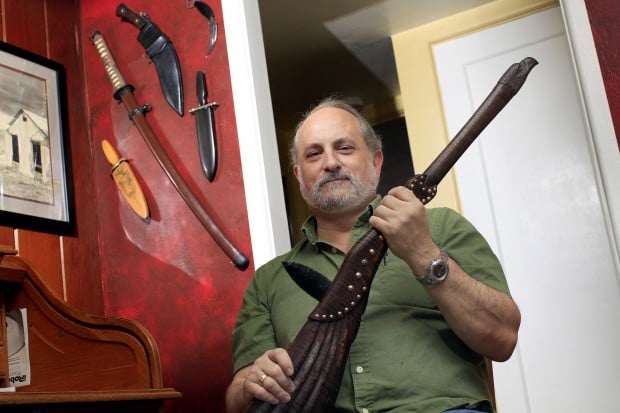
Larry Gotkin's interests are all over the place, both geographically and in time - as long as they involve artful bladed weapons and tools, or things associated with them.
He's made ceremonial sgain dubh Scottish Highlander knives and replicas of war clubs and tomahawks used by northeastern Native American warriors in the 1700s, Finnish puukko knives, ancient Japanese swords and more.
He started out making plastic models as a kid, then scale-model wooden ships, before moving on to scrimshaw in the late 1970s, after his parents brought some of the decorated animal teeth or bone back from a trip to Alaska.
"Once I started doing scrimshaw, you needed something to do scrimshaw on. So I started making knife handles," he says.
From there it was on to other styles of knives, and other parts of knives, and swords and tomahawks and war axes. Learning to make blades, or finish blade blanks, was a natural progression.
People are also reading…
Where other craftsmen might specialize in a single part of a particular device from a specific period and culture, Gotkin keeps studying more bladed things and reproducing as many as he can.
He says there are people who put his work to shame, and he enthusiastically points out their work on the craftsmen's websites.
Clearly, he still sees himself as a hobbyist. His own website, which has brought in commissions and sales of work he's done on spec, was a matter of luck. His sister, a Web designer, did it for him.
"It's a hobby. I ran out of room. Literally, that's how it started. I ran out of room."
The 52-year-old native Tucsonan is an architect, and is reluctant to let his ever-deepening hobby become a commercial enterprise.
He says he's seen hobbies ruined when they become jobs and it's no longer a joyous thing.
"I kind of break even on the hobby," Gotkin says. One of his elaborate tomahawks may sell for $400 to $600, and an ornately carved but functional powder horn can go for $150 to $190.
Given the amount of handcrafting and detailed finish work, it's hard to imagine the prices would make his time very valuable.
One of his gunstock war clubs has an elaborate handle that looks a bit like a gunstock, but is carved to look like the profile of an eagle in flight. Protruding vertically from the top of the stock, near where the hammer would be, is a wicked, sharp-edged, pointed blade.
Still, it's beautiful, made of gorgeously grained dark wood. It would be a shame to whack someone over the head with it.
Gotkin, who is also a history buff, says it's not known if these clubs were made to look like rifles, but he says they're potent weapons.
Uhrs Chantell, a hobbyist blacksmith, has been teaming up with Gotkin, making some of the blades used in Gotkin's projects.
"I actually do what he calls the grunt work, the heavy work," Chantell says. "I form a lot of the pieces. I use a hammer and a furnace, do heat treatment and clean them up as much as possible, and then hand them over to him."
Like Gotkin, Chantell has a day job - he works for the Arizona Department of Economic Security connecting developmentally disabled people with services. Blacksmithing is strictly a hobby.
"Right now architecture is kind of sucking air," Gotkin says of the recession's effects on his profession. That's left him with a little more time to work on his hobby.
He's not sure his hobby could provide a living, even if he wanted to pursue it commercially.
"How many $1,000 swords can you sell?"
Still, there are people who like his work enough to pay several hundred dollars, sometimes more, for a piece.
He has a commission to build replicas of some of the weapons used in the 1992 film adaptation of James Fenimore Cooper's "The Last of the Mohicans."
"I spent a lot of time going through that (film) frame by frame," Gotkin says of trying to replicate the look of weapons and a powder horn carried by characters in the movie.
For him, part of the appeal is that he is always learning. In fact, he's often literally in school.
He doesn't have a forge, for making blades, but he has access to one when he's enrolled in a college class at Pima Community College.
"It's Art 175, Forging and Tool Making, at Pima West. You can take it as many times as you want," Gotkin says.
Few of the weapons he makes are as elaborate or detailed as the Japanese swords and knives. There is a precise name for each tiny part of a Japanese bladed weapon, no matter how small.
"They turned it into religion," says Gotkin of the Japanese attention to detail and perfection - and, always, function.
In the case of Samurai swords, he says, some bumps in the silk woven handles were there so they would not slip from the swordsman's grip when soaked in blood.
Find out more
For more about Larry Gotkin's work, go to www.larrygotkin.com
Contact reporter Dan Sorenson at 573-4185 or dsorenson@azstarnet.com


 Nancy Guthrie's Tucson neighbors: Life with streamers 'unbearable'


