
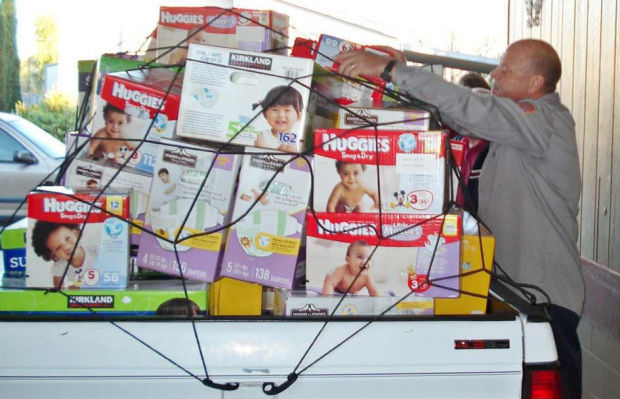
Every December for the past seven years, Tucsonan Trent Rowley has been knee-deep in fluffy white stuff. This year, the volunteer for the Diaper Bank of Southern Arizona would like nothing more than a whiteout in the Old Pueblo.
“So far we have collected over 32,000 diapers for the December Diaper Drive. We collected so many that we did a surprise drop-off of 29,500 at the radio station (94.9 MIXfm), and right now I have several thousand at my house and another $1,000 in cash donations. It has just gone nuts this year,” said Rowley, who works for University Termite & Pest Control.
He credits the generous donations to the “wonderful customers” who have supported his annual effort since he began his campaign with the help of his wife.
“Twelve years ago I had to get clean and sober and change everything about my life: new friends, new activities ... it was starting at ground zero. I had been following the Diaper Drive for a few years by listening to Bobby Rich on the radio and we decided to get involved and see what we could do. We just got hooked,” he said.
People are also reading…
Rowley is sensitive to the needs of those who use the donations collected by the Diaper Bank, which partners with 48 area agencies to distribute diapers and incontinence supplies to needy residents.
Last year the Diaper Bank provided 742,000 diapers to the community; 155,000 of those were incontinence supplies for older disabled children, adults and seniors. Since July, the Diaper Bank has distributed more than 391,000 infant and toddler diapers.
“Coming from a place at one time in my life of having been on the street, I know what it is like not to have anything, and diapers are very expensive,” Rowley said.
Rowley is particularly interested in promoting awareness about the need for incontinence supplies, which cost a senior $100 monthly and are not covered by regular Medicare or other supplemental insurance plans.
Historically, the supplies have not been covered by plans such as the Arizona Health Care Cost Containment System or the Arizona Long Term Care System, although new legislation is forecasting change.
In the meantime, Rowley plans to make collecting incontinence supplies his main focus. “I personally have people in my life who would not be out and about rolling around town if it were not for incontinence supplies,” he said.
Incontinence supplies are a health and hygiene issue as well as a quality of life issue, said Tony Estrada, who oversees the Pima Council on Aging Incontinence Supply Program, which is under the umbrella of the council’s home care program.
The program serves more 1,635 low-income seniors annually with home services ranging from housekeeping and personal care (assistance with bathing and hygiene) to adult day care and shopping assistance. The Incontinence Supply Program helps about 50 clients at any given time.
“Seniors don’t want to become shut-ins, and incontinence supplies help them maintain normalcy and allow them to go out,” Estrada said.
“These supplies can take a lot of stress off of caregivers who constantly having to change the bedding and do laundry because they are caring for a parent or family member.”
Estrada said that in spite of the heroic efforts of the Diaper Bank, there is a constant shortage of incontinence supplies — particularly the pull-up briefs without side tabs since the tabs can be difficult for seniors to manipulate.
“We have to limit the amount we can give to individuals because of the number of supplies we receive. We know the Diaper Bank is being generous to us, but the need is there,” he said.
Armory Park Senior Center sees ongoing need as well for 45 to 65 seniors, according to Shylah McNellis, a recreational assistant who handles distribution of incontinence supplies. McNellis often splits packages between clients since there are not enough to go around.
“People think of children needing diapers, but we have a lot of older adults that need these incontinence supplies. These are seniors who receive maybe $365 for Social Security each month and have to cover their rent and food and live on that … these incontinence supplies from the Diaper Bank mean a lot to them,” she said.


 New Tucson lounge to embrace dark and cozy