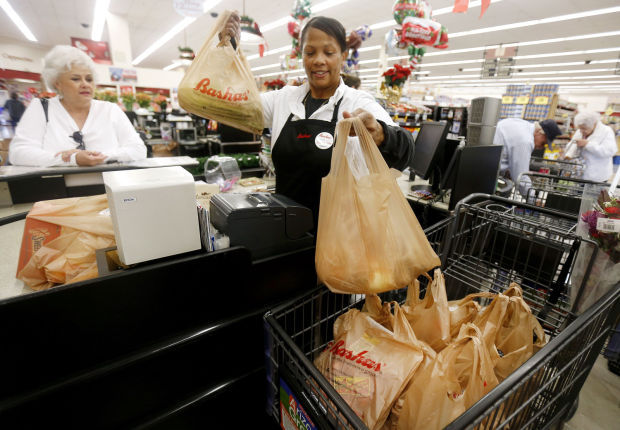
The city of Tucson’s Environmental Services will begin an audit of area grocery stores’ use of plastic bags this month.
“It’s kind of an education opportunity for the stores and also for us,” Nancy Petersen, deputy director of the city’s Environmental Services Department, said of the audit.
During the first three quarters of this year, stores in Tucson distributed more than 114 million plastic bags. About 42 percent of those were recycled back to the stores.
The city began tracking the numbers in the second quarter of 2013 after a plastic-bag ordinance was adopted by the City Council in November 2012. The ordinance requires grocers to report the number of single-use plastic bags given out and recycled.
The audit will examine grocers’ compliance to the ordinance, which has five main components, to measure its success and determine what can be improved, Petersen said. The audit’s results will be brought to the City Council for review next year.
People are also reading…
Grocers are required to provide clearly marked, easily accessible recycling bins, recycle bags that were returned by customers through those bins, provide the option of reusable grocery bags for purchase, incorporate a “reduce, reuse and recycle” message on all bags, and display educational information on the plastic-bag recycling program.
What the city focuses on reducing is the bags-per-transaction figure, said Francis LaSala, environmental manager for the city.
In the second quarter of 2013, when the first report was produced by the city after the ordinance’s passage, the number was 3.6. In the third quarter of 2014 — the most recent data available — it showed that the number had decreased to 2.33.
The city’s goal is to bring the per-transaction figure down to two, which LaSala said would take a “monumental effort” from both the consumers and the retailers.
“From the public, it should be ‘I don’t need a bag,’ ” he said. “For businesses, it should be asking, ‘Do you need a bag?’ ”
No other municipality in the state of Arizona has a policy like Tucson’s plastic-bag ordinance, said Tim McCabe, president of the Arizona Food Marketing Alliance, an organization that represents all the retail grocery stores in the state.
“Tucson is the only city to require the grocers to provide all of the information and for them to have training programs,” he said.
The alliance, which works closely with Tucson and other municipalities, had its own recycling program called “Bag Central Station” for about seven years, he said. Its standards and recommendations for recycling were adopted by the city, McCabe said.
Each retailer is responsible for its own educational program to train employees to be aware of the “reduce, reuse and recycle” message and ask customers if they would like bags before handing them out, he said. But generally, retailers would give the customers as many as they want, he added.
“A lot of customers want them to reuse” to pick up dog poop or use during vacation, he said.
The grocery industry already makes an effort to divert waste efficiently, he said. While grocers would comply with any municipalities’ ordinances, McCabe said, extra regulations and requirements to maintain recycling bins and report numbers are a burden to retailers.
“The idea of making the retailers do more puts more restraint on the retailers,” he said. “It’s not just a retailer issue. It’s a city issue and a consumer issue.”
Contact reporter Yoohyun Jung at yjung@tucson.com or 520-573-4224. On Twitter: @yoohyun_jung

Yoohyun Jung
Data reporter

 Lake Mead's drops raise prospect of unaffordable Hoover Dam electricity