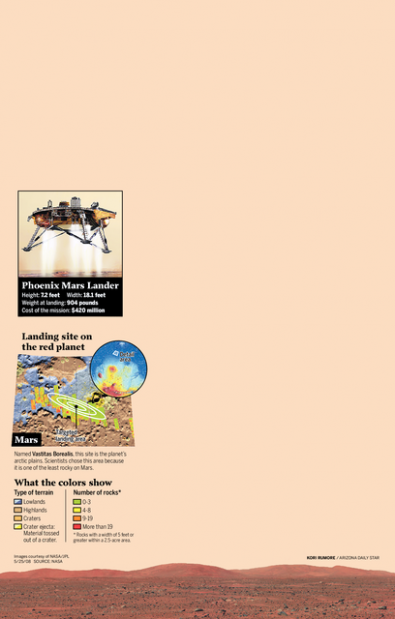
The Phoenix Mars Lander has spent nearly 10 months zipping 422 million miles from Earth to the red planet, but today its fate all comes down to seven dramatic minutes.
Mission scientists call it the "seven minutes of terror."
As the unmanned lander hits the Mars atmosphere seven minutes before landing, gravitational pull will speed it to 12,500 miles per hour.
It must slow to 5.4 miles per hour — through a series of complex steps — to touch down without crashing.
"It's one of the most frightening periods you are going to come across," says Michael J. Drake, head of the University of Arizona's Lunar and Planetary Laboratory, which is leading the mission's science.
"That's where everything can go wrong. It's like flying an airplane. The scary times are takeoff and landing. When you are actually in the air, you are generally very, very safe."
People are also reading…
The spacecraft until today has been encased in protection that Ed Sedivy of spacecraft builder Lockheed Martin compares to a cocoon. By the time it lands on Mars, it is supposed to have jettisoned its outer armor.
Then it will deploy its round solar panels, which pop out on either side of the lander, like "a beautiful butterfly," Sedivy says.
Arrival time is set for 4:38 p.m. Tucson time. The first radio signal confirming the landing is expected at 4:53 p.m.
After the landing, NASA will turn mission control over to the UA's team, led by principal investigator Peter H. Smith.
Smith remains optimistic.
"It could be seven minutes of joy," he says.
— Stephanie Innes
On StarNet: Head to azstarnet.com/science this afternoon for updates, photo galleries, multimedia presentations and videos documenting the Phoenix Mars Mission.