

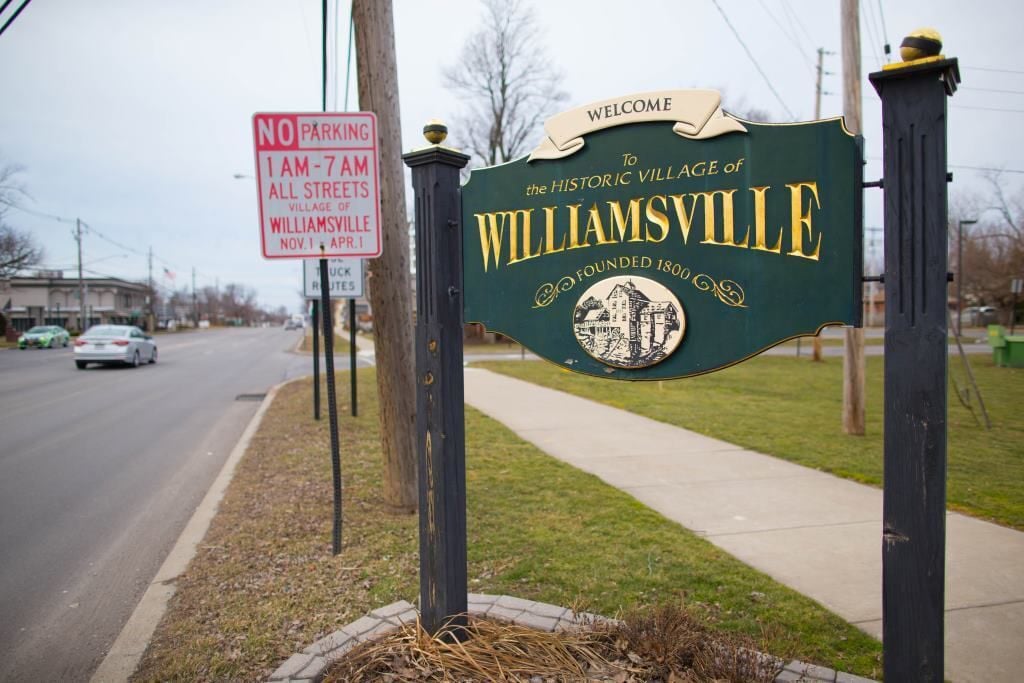
The school district isn't the only part of Williamsville where things are getting acrimonious.
Tensions have risen over the past year in the village of 5,000 people, where the biggest issue before this was the time roadwork on Main Street clogged traffic and upended commerce.
The points of contention include:
• A fight over whether to create a historic district on the street where the mayor lives.
• The lengthy battle over a plan to convert a senior residence into mixed-income apartments, with opponents blasting the village for mishandling the review process and accusing a Village Board member of a conflict of interest.
• For the first time in years, a contested election for a Village Board seat that saw a sitting trustee lose.
People are also reading…
• And the recent removal of a volunteer committee member who is alternately praised for her dedicated efforts to uphold Williamsville's character and criticized for her treatment of a village employee, among others.
What's going on in Williamsville, the village so desirable homeowners and businesses located miles away claim it as their address?
"It all circles around change, if you have to sum it up in one word," Mayor Deborah Rogers said in an interview.
Others say it reflects dissatisfaction with the government.
"Village residents want to be heard, and they've told me that they haven't been," said the newest trustee, Eileen Torre.
Historic debate
The first real discontent started brewing last fall, when the village's Historic Preservation Commission proposed creating a historic district covering about 40 properties on a section of South Cayuga Road, where buildings date to the mid-1800s.
The Amherst Bee extensively covered the debate. Supporters said the designation would help prevent inappropriate development or demolition.
Many property owners on South Cayuga, however, said they felt blindsided and feared it would hinder their ability to sell or improve their properties.
Rogers, who had taken over as mayor earlier in 2019, and her husband, Michael, had lived on South Cayuga but had recently moved into a neighboring home.
Rogers said she believes Kate Waterman-Kulpa, the chair of the commission, brought up the possibility of the historic district to block the Rogers' plans to renovate their new home. Waterman-Kulpa, who declined an interview request, previously has said creating the district would benefit the village.
Ultimately, the proposal stalled after a survey found a majority of property owners within the district boundaries objected to the plan and weren't swayed by efforts to tout its value.
"People just don’t seem to want to hear it. And I’m sad that they don’t. I can’t change their mind," said Mary Lowther, a member of the commission and former village mayor. "And maybe we won’t ever make that a district."
'Angry outburst'
Hard feelings over the historic district fight might have underpinned an encounter at a Village Board work session that led trustees to formally chastise Waterman-Kulpa, who is the wife of Amherst Town Supervisor Brian Kulpa.
It started when Keaton DePriest, Williamsville's community development director, at the request of the Village Board reached out with a question to the village's grant writer and to New York's State Historic Preservation Office.
At the work session preceding the Dec. 9 Village Board meeting, Waterman-Kulpa criticized DePriest for failing to consult her or to copy her on the email exchange with those parties, according to people in attendance.
Village Board members say Waterman-Kulpa harangued DePriest, who tried to cut off the discussion, for several minutes before she abruptly left the meeting.
Several days after the session, DePriest wrote a letter asking Village Board members to inform Waterman-Kulpa her conduct was disrespectful and unacceptable.
"In village government, we should not tolerate such reprehensible behavior," DePriest said in the letter obtained through a public records request. He declined further comment on the encounter.
Deputy Mayor Basil Piazza penned a handwritten letter to Waterman-Kulpa on behalf of the Village Board that praised her history of volunteerism but decried her "angry outburst" as "unwarranted, unprofessional and counterproductive."
Waterman-Kulpa never responded to the letter, Piazza said.
Blocher Homes fight
At the same time, the bitter fight over the fate of the Blocher Homes senior residence on Evans Street continued.
People Inc. in late summer 2019 had proposed converting the facility to apartments for low- and middle-income residents and for the developmentally disabled. The human services agency said this housing is needed in Williamsville and Amherst.
The village's Planning Board and Zoning Board of Appeals conducted a review of the $31.5 million project, which was opposed by seniors who didn't want to leave Blocher; workers who feared losing their jobs; and neighbors who said it wasn't a good fit for the area.
Critics pointed to a conflict of interest for Trustee Matthew Etu, a Tredo Engineers employee who served as site designer for the project.
Village Attorney Charles "Chip" Grieco initially said Etu, who is the Village Board liaison to the Planning and Zoning boards, did not have a conflict because he wouldn't have a vote on the project.
But in response to a complaint filed in August 2019 by village resident Douglas Coppola, among others, Etu opted to recuse himself from the liaison role during the Blocher review process.
However, on March 2, Etu weighed back in. He sent an email to members of the Planning Board and other village officials responding to an email earlier that day from an alternate member wondering if it was worth meeting that night if the Planning Board would not have a quorum of members.
"Yes it is ... the (environmental impact) determination is holding up the ZBA which is holding up the site plan approval ... this needs to move along one way or another," Etu replied, according to records obtained through a Freedom of Information Law request.
“I don’t think it’s appropriate that, on the one hand, if he’s saying he’s recusing himself from participation in this process, that he still finds himself in the midst of the process," Coppola said of the email.
Etu replied to The Buffalo News: "My email was reminding the Planning Board of their responsibilities to make informed decisions within reasonable time frames."
The Planning Board approved the project's site plan, by a 4-3 vote, Sept. 8.
Rare contested vote
One week after Blocher received its final required approval, Williamsville prepared for something unusual: a contested village election.
The special election for a trustee's seat was scheduled to take place on June 16 but was delayed until Sept. 15 because of the Covid-19 pandemic.
Trustee John Murphy, who was appointed to his seat in 2019 when Rogers was elected mayor, failed to collect enough valid signatures to make the ballot but continued as a write-in candidate, as did another contender.
The only named candidate was Eileen Torre, a community activist. Torre won easily and said she believes some of her support came from Blocher opponents.
“I think perhaps because there’s been absolutely no competition for those seats for 10 years, that everybody just got sort of fat and happy and weren’t really paying that much attention," Lowther added. "And that’s not healthy.”
Tensions boil over
Two weeks later, some of this simmering acrimony reached a boiling point at the Village Board's reorganizational meeting.
Trustees were set to reappoint, or replace, members of various Williamsville advisory boards whose terms were up – a task that rarely generates controversy.
But when the Village Board began discussing how to fill seats on the Historic Preservation Commission and, later, the Planning Board, Rogers made clear she didn't want to reappoint Waterman-Kulpa.
The Village Board has an obligation "to ensure that our village employees can work in an environment that is harassment-free," she said at the Sept. 28 virtual meeting.
Torre went to Waterman-Kulpa's defense, saying she asks blunt but necessary questions of applicants and researches their plans.
Etu, for his part, conceded the concerns about her demeanor but said Waterman-Kulpa has deep professional knowledge – she's an architect – and almost irreplaceable experience on the committees.
Following a lengthy debate, the Village Board voted to leave Waterman-Kulpa off the commission and, later, not to reappoint her as a full Planning Board member.
Waterman-Kulpa's supporters were disappointed and said it was cruel to talk about a dedicated village volunteer in this manner in an open meeting.
Rogers in an interview last week said her opposition to Waterman-Kulpa's reappointment is based on her obligations as mayor and not a personal feud.
"This isn't a Deb-Kate thing," she said.
Waterman-Kulpa, for her part, declined to discuss what happened in detail but sent a text message: "After 14-plus years of dedicated service, I consider this a well-deserved hiatus. I love my community too much to stay away for long. I'll be back."
2021 races eyed
Where does the village go from here?
The Historic Preservation Commission could revive the South Cayuga historic district proposal, though it would make a recommendation to the Village Board for the final up-or-down vote.
A lawsuit seeking to overturn the approval of the Blocher Homes project continues in state court.
And Waterman-Kulpa said she is pretty sure she will accept her appointment as an alternate member of the Planning Board. It's a situation that frustrates her husband, now the the Amherst town supervisor and a former Williamsville mayor.
"Kate loves this village. She loves the history of this village. She loves the residents of this village. She’s worked hard to uphold a higher level of design standards in this village," Kulpa said. "And she is being miscast here."
Observers now are looking to next year's village election, when Torre must run for a full term as trustee and Piazza's seat also is on the ballot. Piazza said he will not seek re-election.
Rogers said she expects the open seat to draw interest.
"We need new people. We need new people in these positions with new ideas," she said. "That’s a good thing."


