

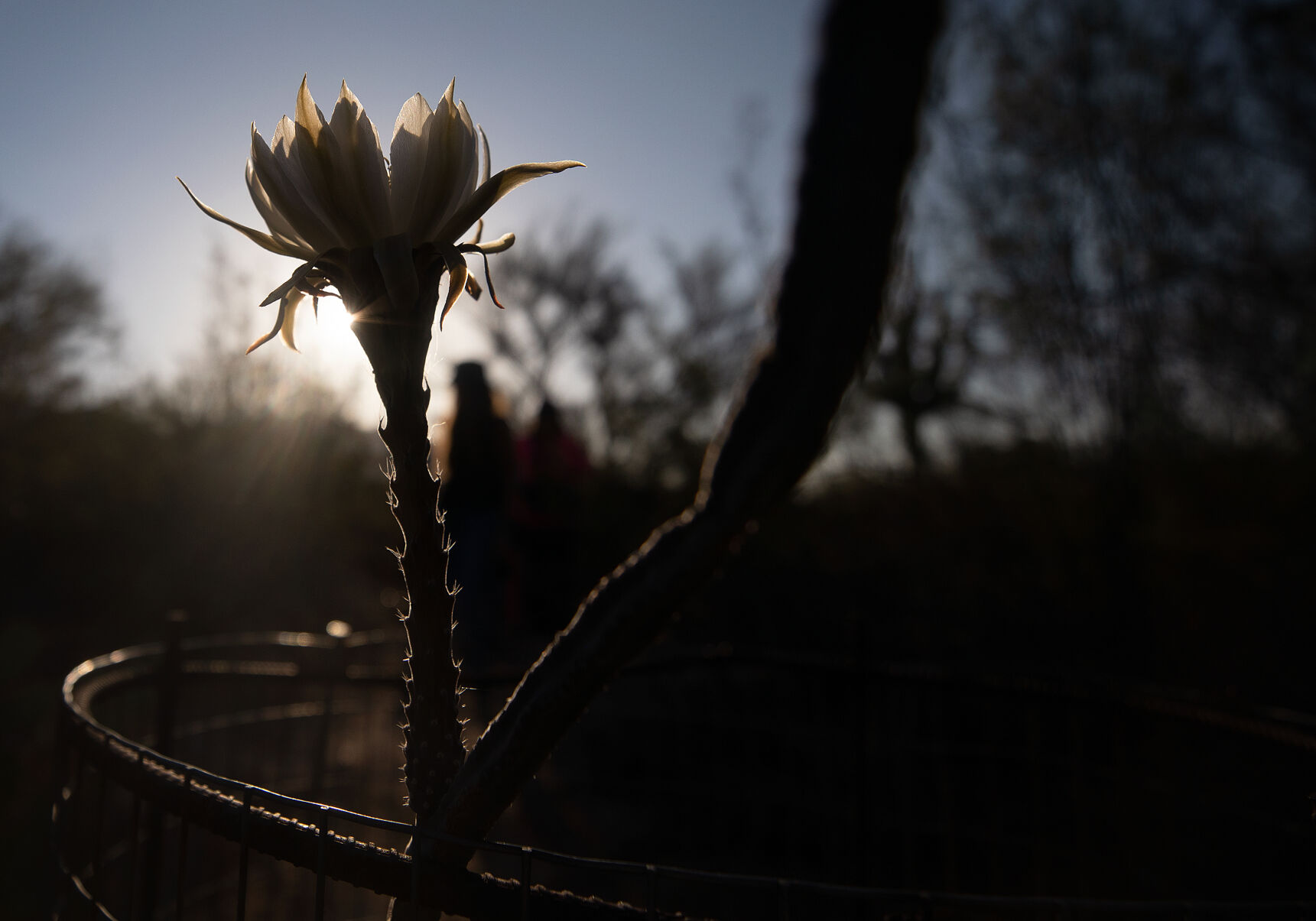
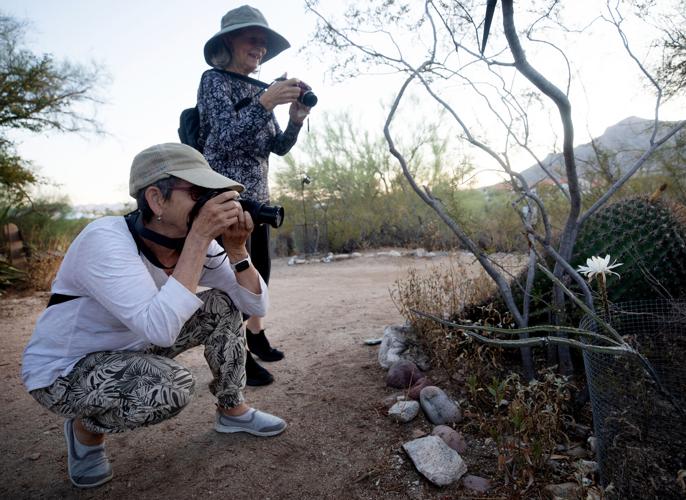

After weeks of waiting and monitoring, the Queen of the Night made its annual appearance at Tohono Chul on Tucson’s northwest side Sunday.
The night-blooming cereus (variation peniocereus greggii), which normally looks like a pile of dead sticks, put its beautiful white blooms on full display for the night before wilting away with the sun on Monday morning.
The cactus blooms just once each year, usually between late May and July. Tohono Chul, 7366 N. Paseo del Norte, is home to the largest known private collection of night-blooming cereus in the world.
For weeks, gardeners at Tohono Chul kept a close eye on all of the cacti, measuring the buds at least twice a week. They considered when the buds began to grow and how fast they were growing, and then they accounted for a time of stalling — which is when the bud typically pauses its growth for a week or two. When it begins to grow again, it reaches a critical size where it’s “very unlikely to stall anymore and will probably finish their growth,” said Stephen Spikes, Tohono Chul’s interpretive programs manager.
People are also reading…
No one knows exactly how the plants decide when to bloom, but it appears to be a regional thing. For example, the night-blooming cereus blooms on the same night at both Tohono Chul and the park’s surrounding neighborhoods. But people who have night-blooming cereus in their own gardens across Tucson might not see it bloom until an entirely different day or week.
Researchers have found that because the plant can’t self-pollinate, it relies on pollinators like the white-lined sphinx moth. The more blooms that are open at the same time, the better chances of reproduction.
“There’s some sort of mechanism that the plants have to use to coordinate their blooming,” Spikes said.
Photos: 'Queen of the Night' blooms over the years in Tucson
2023

Flower enthusiasts approach one of the night-blooming cereus (peniocereus greggii) under a rising sun the morning after the annual Bloom Night at Tohono Chul on July 24, 2023, in Tucson. Five of the blooming flowers were seen along the Desert View Trail.
2023

A night-blooming cereus (Peniocereus greggii) blooms at the Tohono Chul Park on July 24, 2023.
2023

A night-blooming cereus (Peniocereus greggii) blooms at the Tohono Chul Park on July 24, 2023.
2019

Docent Janel Feierabend talks about the night-blooming cereus to onlookers during the 2019 Bloom Night at Tohono Chul.
2019

Lauran Penn gets a sniff of one of flower on the night-blooming cereus named Tentacles during the annual Bloom Night at Tohono Chul Park, Saturday, July 13, 2019.
2019

Sarah Kazy composes a two-bloom shot on Emerald, one of the dozen or so night-blooming cereus producing flowers at the Annual Bloom Night at Tohono Chul Park, Saturday, July 13, 2019, Tucson, Ariz.
2019

One of the three flowers the night-blooming cereus Emerald produced on her one night of the year during the Annual Bloom Night at Tohono Chul Park on July 13, 2019.
2018

Maia Irigoyen gets a sniff of Emerald, one of the hundreds of night-blooming cereus flowering during Bloom Night at Tohono Chul on Saturday, June 23, 2018. Emerald put out six blooms that year, one of the more prolific of the one-night only flowers.
2017

The "Queen of the Night" night-blooming cereus plant begins to open during the Bloom Night event at Tohono Chul Park on July 18, 2017, in Tucson, Ariz.
2017

A photo of the Queen of the Night plant, prior to blooming, taken during the Bloom Night event.
2017

Bill Morrow snaps a photo of the Queen of the Night.
2016

A mass bloom of The Queen of the Night (Peniocereus greggii) happens one night a year at Tohono Chul Park, 7366 N. Paseo del Norte.
2016

Kyle Cripps, 4, leans in to smell the sweet aroma of the Peniocereus greggii.
2016

Ants crawl on a a blooming Peniocereus greggii plant during Bloom Night 2016.
2016

A Peniocereus greggii plant named "Emerald" begins to open up her blooms the during Bloom Night 2016.
2016

Lee Mason, director of general services at Tohono Chul Park, gives a talk about the "Queen of the Night," which blooms during Monsoon season.
2015

The night-blooming cereus, or the "Queen of the Night," opens just after sunset at Tohono Chul Park at 7366 North Paseo del Norte on June 12, 2015.
2014

The night-blooming cereus known as Ruby, this time sporting five blooms for its only flowering of the year, opens shortly after sunset at Tohono Chul Park, Thursday, July 10, 2014.
2014

Rick Fitzpatrick, left, and Michael Timko line up their shot of the night-blooming cereus known as Ruby.
2010

The setting sun makes for a unique backdrop as a night-blooming cereus flower, highlighted with a flashlight, begins to open at Tohono Chul Park.
2010
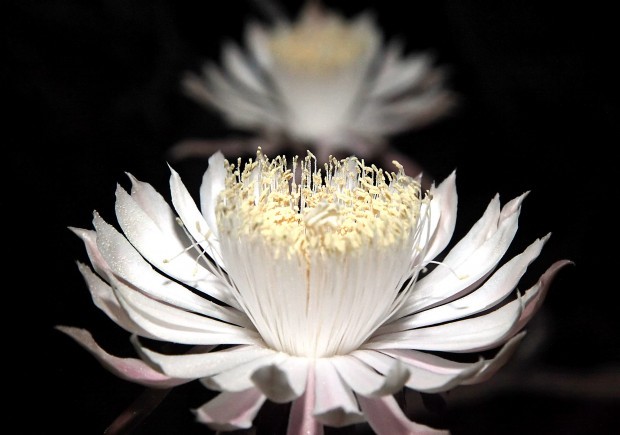
Fully open night-blooming cereus flowers at Tohono Chul Park on June 30, 2010.
2008

Sisters Rebecca (left) and Kacie Bauer take photos of the night-blooming cereus during the annual Bloom Night on July 2, 2008, at Tohono Chul Park in Tucson, Ariz. Hundreds of people turned out to see, smell and photograph the Peniocereus greggii, which blooms for only one night a year.
2007
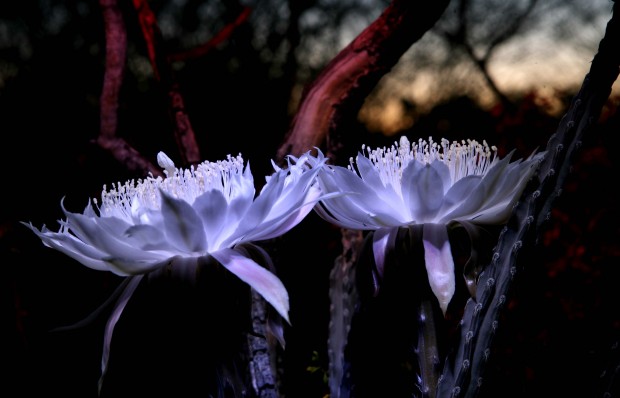
A pair of night-blooming cereus bloom at Tohono Chul Park. Colored lights were used to illuminate the flower.
2006

Pat Coleman takes a photo with a disposable camera of a night-blooming cereus (Peniocereus greggii) at Tohono Chul Park on June 13, 2006.
2005
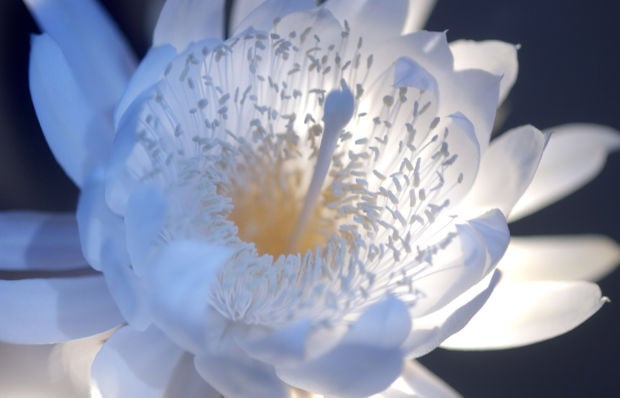
A night-blooming cereus shows its stuff at Tohono Chul Park on July 29, 2005.
2004

A night-blooming cereus seen at Tohono Chul Park on July 5, 2004. Each plant blooms only once a year, opening its petals at sunset and closing them when the sun comes up.
2003

Jennifer and her son, Kyle, 5, get close enough to smell the night-blooming cereus during the annual Night-blooming Cereus Celebration at Tohono Chul Park on June 6, 2003.

 $25M distribution center to be built in Tucson


