


Blue Moon, Enchanted Hills, Poets Square — some of Tucson's most unusual neighborhood names sound like places that exist only in the movies.
But the stories behind their monikers are real, with roots that in some cases trace back to before Arizona's statehood in 1912.
There was the enterprising pioneer who made a name for himself — and the University-area neighborhood that bears his name — selling pies.
And the Southwest Side neighborhood meant to be reminiscent of Camelot.
Barrio Hollywood
It all started as a joke tinged with a combination of bitterness and pride.
Residents of a West Side neighborhood began calling their area "Hollywood" during the late 1930s and early '40s, when it was a sharp contrast to the California Hollywood where movie stars lived, worked and played.
People are also reading…
At that time, the barrio's adobe homes had dirt yards, no cooling systems and "cracks so big they let the daylight in," reporter Judy Donovan wrote in a 1978 Arizona Daily Star article.
But, as Donovan wrote, for some the name "Hollywood" reflected pride in a community that, though not fancy, meant "home, family and modest success."
Boundaries: West Speedway on the north, the Santa Cruz River on the east, North Silverbell Road on the west and West St. Mary's Road on the south.
Enchanted Hills
The neighborhood got its name because the developer wanted to go for a King Arthur theme, said Jesse Aguilar, 76, who has lived in Enchanted Hills since 1963. Newly married, he and his wife Olga bought their home there a few years after it was built.
The area's street names are accordingly reminiscent of Arthurian legend — sporting names such as West Merlin and Camelot roads, and South Castle Drive.
Boundaries: West 36th Street on the north, South Lands End Road on the east, South La Cholla Boulevard on the west and West 44th Street on the south.
Barrio Blue Moon
The Blue Moon Ballroom burned down in 1947, but its memory lives on in the Central Tucson barrio that carries its name.
Longtime residents remember dancing in the ballroom, which attracted notable performers, including Tommy Dorsey, a neighborhood history of the barrio said.
That history is available online at www.neighborhoodlink.com/tucson/bluemoon.
Barrio Anita
Annie Hughes moved in with her brother, Thomas Hughes Sr., after his wife died to help raise his children.
Hughes, who had in 1902 bought land that he called McKinley Park, named the area’s main street after her, calling it “Annie Avenue.” The street soon became known by the Spanish form of Annie — Anita — and that’s where the Central Tucson neighborhood took its name.
Pie Allen
The University-area neighborhood was ranch land with some adobe buildings during the days of homesteader John B. Allen, nicknamed “Pie” for a business venture he took.
In 1862, Allen heard members of the U.S. Cavalry wishing for pie and decided to fulfill their wishes. Allen sold pies to soldiers for $1 each.
He became a prominent citizen, serving two terms as Tucson’s mayor, among other offices.
Boundaries: East Sixth Street on the north, North Park Avenue on the east, North Fifth Avenue on the west and East Broadway on the south.
Poets Square
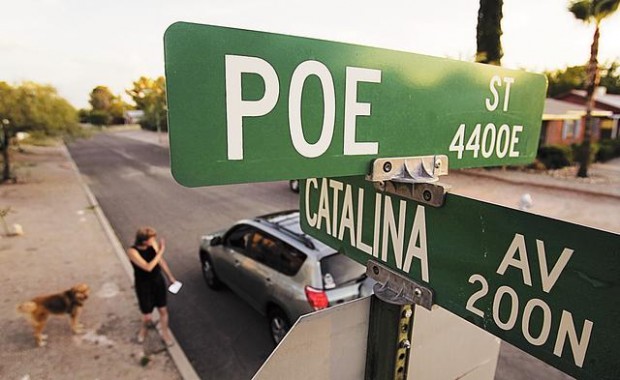
Edgar Allan Poe and Robert Burns never ran alongside each other in life, since Burns died before Poe was even born. But streets that bear their names run parallel in the Poets Square neighborhood in Midtown.
Many of the area’s streets are named after famous poets — including Poe, Burns, Walt Whitman and Oliver Wendell Holmes — hence the neighborhood’s name.
Boundaries: East Fifth Street on the north, North Swan Road on the east, North Columbus Boulevard on the west and East Broadway on the south.
More neighborhood names
• El G.H.E.K.O. — East Side — A loose acronym for Green Hills, Harold Bell Wright, El Dorado and Kingston Knolls Organization. Those are the neighborhood's four subdivisions.
• Iron Horse — University area — refers to what American Indians called the train. Railroad tracks run through part of the neighborhood's southern area.
• Barrio Kroeger Lane — West Side — Named after Dr. Clarence Kroeger, who gave medical care to poor people during the 1930s and '40s.
• Honea Heights — Marana — Founded by Ray Honea, who was on the first Marana Town Council and is the father of the town's current mayor, Ed Honea.
Resources
The following sources were used to research this story:
• Arizona Historical Society and Arizona Daily Star archives.
Books:
• "Tucson: The Life and Times of an American City," by C.L. Sonnichsen.
• "Visions of Barrio Anita: Looking Through the Eyes of Different Generations," edited by Alicia Pérez.
• "Tucson: The Old Pueblo," by Frank C. Lockwood and Donald W. Page.
Web sites:
• Tucson Department of Neighborhood Resources, www.tucsonaz. gov/dnr/index.html.
• Barrio Blue Moon Neighborhood Association on Neighborhood Link, www.neighborhoodlink.com/ tucson/bluemoon.



 Air adventure park to open in Tucson with ziplines and more


