

The competition between Tucson and Phoenix is over.
"Declare Phoenix the winner," said Dan Hunting, economic and policy analyst for the Sonoran Institute.
"Nobody is better at turning desert into houses than Phoenix," Hunting told a forum held Wednesday by Imagine Greater Tucson, a community group attempting to create a "vision" for Tucson's future. The forum was co-hosted by the Urban Land Institute.
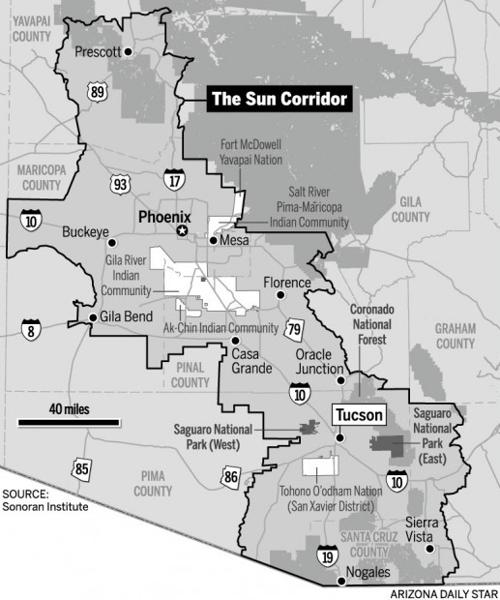
Hunting told the group that the Tucson region should look to capitalize on the Phoenix area's success by positioning itself as the best place to live and work in the "Sun Corridor" that stretches from the Mexican border to Prescott.
There is no point in complaining about Phoenix, he said. Sure they stole the Capitol years ago and stole baseball spring training just this year, but Phoenix is four times bigger and Tucson just needs to learn how to take advantage of the lopsided situation.
People are also reading…
"Imagine you have a relative who's completely crazy, but he's also extremely rich," Hunting said. "Phoenix is Tucson's crazy cousin," he said.
Arizona's Sun Corridor is one of 11 emerging megaregions of the country, said Petra Todorovich, director of a national urban planning initiative called America 2050.
The cities in the regions are not necessarily contiguous, she told the group. The best planning model is densely populated hubs connected by mass transit that recognize and allow for open space, watersheds and other natural considerations.
Tucson, said Luther Propst, executive director of the Sonoran Institute, should position itself as the livable hub along the Sun Corridor, capitalizing on its natural beauty and attractive lifestyle. It should promote and enhance its trailheads, bike paths and mountain views.
He urged reform of rules governing state trust lands to allow preservation of key parts of the natural spaces that nearly ring Tucson.
Getting rid of the requirement for the state to auction land to the highest bidder would also ease planning for renewable energy and a high-speed-rail link to Phoenix, Propst said.
Todorovich said Tucson might not be in a position to seek federal funds for such a rail link right now. Her group, which advocates nationally for such programs, did analyses of the best targets. Phoenix to Tucson did not make the list.
"It's unlikely to be successful if you're connecting two auto-oriented places," Todorovich said.
"High-speed rail is the crown of a robust, regional, intermodal transportation plan. I wouldn't build it as the first piece, but that's just me."
Hunting, who lives in Phoenix, said he'd rather be in Tucson but moved his family to Phoenix for the economic opportunities it provided.
A report that he and Propst co-authored with Joe Kalt of Harvard's John F. Kennedy School of Government argues that the Tucson region can change that by burnishing its natural amenities and marketing itself as the livable hub of the economic colossus created by Phoenix.
Propst said the Sonoran Institute arrived at its strategy by examining what paths would lead to the greatest conservation of our natural resources, but other groups, such as Tucson Regional Economic Opportunity, have come to a similar conclusion by aiming for economic growth.
The Sonoran Institute report, "Tucson's New Prosperity - Capitalizing on the Sun Corridor," urges Tucson to embrace its partnership with Phoenix.
"Standing alone, Tucson is a pleasant, but unremarkable city in the eyes of the world," it concludes. "But when viewed as part of the Sun Corridor, Tucson has unique advantages as part of the largest economy of the Intermountain West."
Imagine Greater Tucson is an outgrowth of a 2007 Tucson Town Hall meeting on Tucson's future. It will gather community views as it begins its process of creating a vision for Tucson later this year. It hopes to complete the process by the end of 2011.
The Arizona Daily Star is a partner in the effort.
Contact reporter Tom Beal at tbeal@azstarnet.com or 573-4158.


