

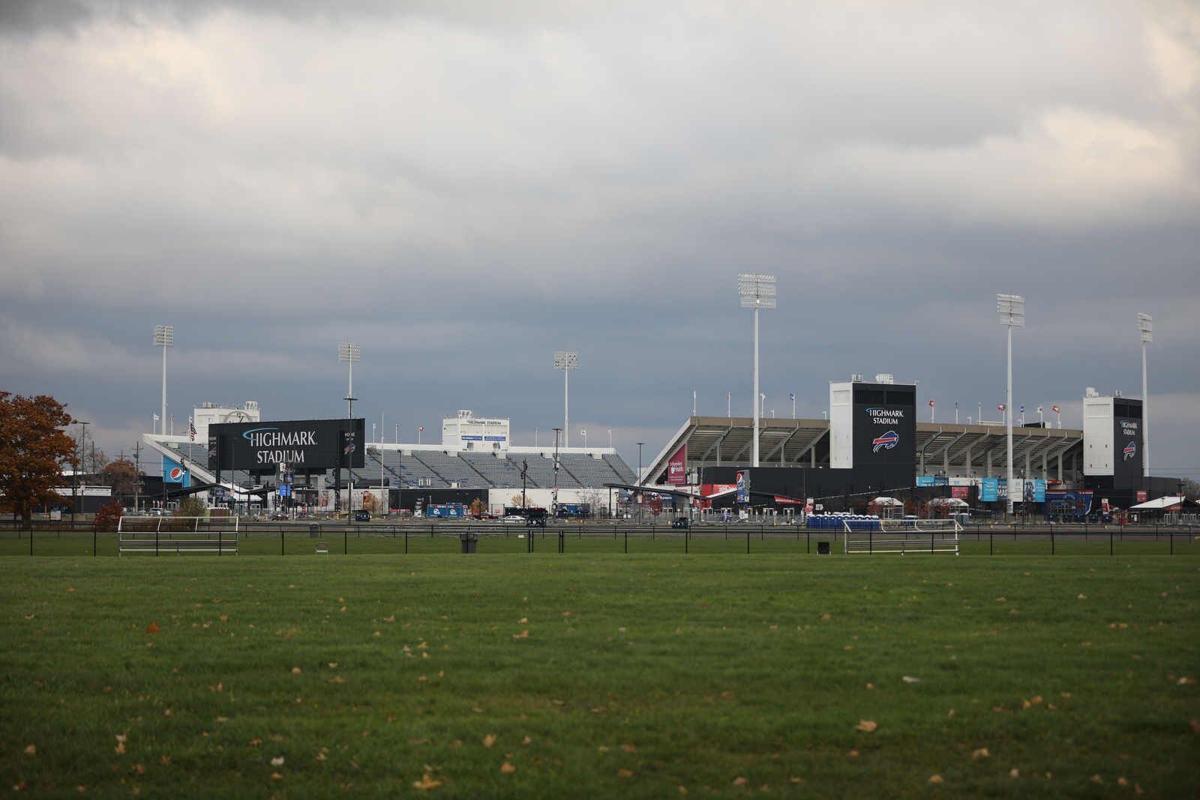
In the public debate over a new NFL stadium in Western New York, there is plenty of talk.
Developers can push ideas. Fans can chime in. Legislators can demand updates.
But the only parties whose opinions will truly shape a stadium agreement are in the negotiation room: the Buffalo Bills, Erie County and the State of New York. Representatives for Bills owners Terry and Kim Pegula, Gov. Kathy Hochul and Erie County Executive Mark Poloncarz are talking regularly in hopes of securing an agreement in the next several weeks. That deal would ultimately need to be approved by the Erie County Legislature, NFL owners and by the state Legislature when it votes this spring on Hochul’s budget.
The three sides agree on two major points: A new venue needs to be built to replace 48-year-old Highmark Stadium, and both the Bills and the government need to help pay for it.
People are also reading…
But the sticking points are complicated. Among the biggest: Where will the stadium be built – across the street from Highmark in Orchard Park, or on the outskirts of downtown Buffalo? In the public-private partnership that will fund the stadium, how much will the Bills – and perhaps the NFL – be expected to contribute? And how ironclad will this deal be? If Bills management wanted to break the lease and move the team, how easily could it do it?
Here’s a look at the leverage points each side brings to the bargaining table, based on interviews with people on the inside of the negotiations, those with close knowledge of the situation and people with expertise on sports facility deals.
Buffalo Bills
Location preference: Orchard Park. Bills officials say a venue built across the street from Highmark Stadium will cost a projected $1.4 billion and could be open by 2026, if an agreement is reached by the end of the year.
Leverage: Owning the team gives Terry and Kim Pegula the ultimate leverage point: the ability, in theory, to move the team. Buffalo is the NFL’s second-smallest market, and locating the team elsewhere would give the Bills opportunity to sell more robust sponsorship packages and pricier tickets.
The Bills camp doesn’t have to outwardly threaten that prospect. It’s the worst-case outcome that has loomed over Bills lease negotiations for decades.
“You don't want to be a county executive, a governor, a senator, assembly member or anyone else in office, if the Buffalo Bills ever leave Buffalo,” said former Lt. Gov. Robert Duffy, who represented then-Gov. Andrew Cuomo in talks for the 2013 lease. “So I think everybody is motivated.”
If PSE officials had serious discussions with representatives from any of the nearly one dozen cities that could become home to an NFL team, that would crank the heat high in negotiations. That hasn’t happened and likely won’t unless negotiations extend far beyond Dec. 31, the date PSE wants to see the framework of a deal in place.
Limitations: Moving an NFL team is not easy. NFL owners have to approve the move, and the league charges a steep relocation fee. (The Las Vegas Raiders paid $378 million to move from Oakland in 2020.) NFL Commissioner Roger Goodell, a Western New York native, made his intentions clear in August: “I want the Bills to be successful and I want them to continue to be competitive here in Buffalo.”
Whose support do they need? First, the Bills need elected officials at the state and county level to buy into their contention that keeping the team viable in Western New York requires a major public investment. While every NFL team receives significant dollars from revenue sharing – $309.2 million apiece in 2020 – “the distinction is your local revenues and local expenses,” said Marc Ganis, a sports consultant who has worked on deals with the majority of the league’s franchises.
Teams that built their own stadiums, such as the Los Angeles Rams, New York Giants and New York Jets “have significant local expenses,” Ganis said, while teams such as the Cincinnati Bengals, Cleveland Browns, Indianapolis Colts and Tennessee Titans, among others, are playing in venues that were built and largely maintained by the public sector, and thus have lower local expenses. Ganis described the mindset as owners taking the “risk of performing in sales and on the field,” and not of building a stadium, “but the risk of filling it.”
The Bills pay $862,000 in rent to Erie County for Highmark Stadium, and while the team has contributed to capital improvements ($35.5 million in the 2013 lease), their local expenses are controlled. Their goal is to keep it that way.
“The Bills have operated on a business model that’s predicated on a stadium that was paid for by the state and the county, with shared expenses between the Bills and those entities,” said Ron Raccuia, executive vice president of Pegula Sports and Entertainment, which oversees the Pegulas’ holdings. “Any fundamental change to that would require a change in our business model.”
Raccuia, who represents the Pegulas in negotiations, said that change could “result in increased costs, which could result in increased prices, although we are very aware of the price sensitivity in the Buffalo market, and we’ll never price our fans out of their Buffalo Bills experience. In order to do that, we need the type of public-private partnership that ... has been in existence since the opening of Highmark Stadium.”
Essentially, the Bills are engaged in a sales pitch: First is convincing elected officials to buy into the model Ganis is describing here. If that happens, the next pitch is a yearslong effort to elevate sales and sponsorship efforts in Western New York, across the state and even nationally. That will take deep buy-in from the business community, some of which is lining up to help. A volunteer committee of executives and entrepreneurs from Buffalo and across upstate have founded a group called Business Backs Buffalo Football.
“We think we can really be a good sounding board for the franchise today and then into the future,” said Matt Davison, chair of the committee and chief business officer at the Martin Group, a marketing and communications agency. “We’re viewing this as a multiyear effort with the eventual primary goal to be really expanding the team’s prominence out all across the region and upstate and reinforcing that the Bills are New York State’s team.”
Something to watch for: Goodell has expressed support for the process, but if there’s a financial gap as negotiations near the final stages, will the NFL be willing to contribute the money that gets the deal done?
“At the end of the day, Goodell’s No. 1 job responsibility is keep the ownership happy ... put more money in their pockets,” said Dan Etna, an attorney with the New York firm Herrick, Feinstein LLP who has been the lead counsel in several major stadium deals but is not involved in these negotiations.
State of New York
Location preference: Unknown. That decision belongs to Gov. Kathy Hochul, who hasn’t yet provided an answer.
Leverage: It is likely that New York State will contribute at least $1 billion to the cost of a new stadium. That would extend a well-established trend in the NFL: A Buffalo News analysis found that public funding paid for 73% of the stadium costs in the nine regions with the smallest populations. Given Buffalo's relatively small size in comparison to other NFL markets, it's possible the contribution the team is seeking from the government side is higher than 73%. Hochul is the person who has access to the money, and she’s the one who will have to be convinced to do it.
Hochul, a Western New York native, told The News last month that she intends to see the stadium project in the New York State budget, which is proposed in January, negotiated through the winter and required to be finalized by April 1.
“We’re intent on getting this done,” she reiterated during a visit to Buffalo last week, adding: “We are intent on keeping the Buffalo Bills here for many, many, many decades to come.”
Limitations: Financially, the stadium is actually a small slice of a state budget that exceeds $200 billion yearly, especially when you consider that the costs can be extended over years through a variety of budgeting and bonding tools.
Hochul’s real limitation is politics. After taking over for Andrew Cuomo when the former governor resigned in August, Hochul is running in 2022 for a four-year term. She faces a Democratic primary in June, and if she wins that, a difficult general election in November. Funneling $1 billion to a stadium in a league loaded with billionaire owners is guaranteed to stoke criticism from the left flank of her own party.
Hochul also has to play an upstate-downstate game: If she sends money to a large project in Western New York, leaders in other parts of the state will expect their slice of funding, too. Hochul has already been busy touring New York, mostly downstate, and delivering large sums for projects ranging from subways to tourism to fixing potholes.
Whose support is needed? How this plays out in the state Legislature is key for Hochul. Consider how she answered The News’ question about timing for a deal: “This will be a budgetary issue and therefore will show up in the New York State budget as an item once I’ve had a chance to speak to the legislators and garner support for that.”
Working with legislators to get support for putting a new stadium into the budget will require detailed politicking and nuanced dealmaking. To have any shot at being elected to a four-year term, Hochul will need significant support from the New York City-Long Island region, which is largely why she’s spending most of her time there. Satisfying downstate lawmakers – and voters – who are poised to hurl criticism at a billion-dollar Buffalo deal may require supporting sizable projects in other parts of the state, too.
Something to watch for: Sen. Chuck Schumer may play a role here. The Brooklyn Democrat is the Senate majority leader and “plays a very powerful advocacy role,” Duffy said. Don’t expect Schumer to advocate for a stadium location while negotiations are underway, but it’s highly likely the senator will use his political muscle to lock a deal – and thus the Bills – in place. For example, if there’s a need for the NFL to kick in money to make a deal whole, Schumer is a powerful outside party who is in position to push for it.
Erie County
Location preference: Unknown. County Executive Mark Poloncarz “does have a preferred site, but it hasn’t been stated publicly as negotiations are ongoing,” spokesman Peter Anderson told The News in an email.
Leverage: Not as high as the state’s for a simple reason – Albany has more money – but still significant, and made stronger by Poloncarz’s positive and longtime working relationship with Hochul. Erie County is the landlord of the Buffalo Bills’ stadium, and has a clear financial stake. That means Poloncarz is a key player in negotiations, and the Erie County Legislature will need to approve an agreement.
“County Executive Poloncarz has a lot of influence and a lot of contributions to make on this,” said Duffy, who was lieutenant governor under Cuomo when the Bills, state and county negotiated a lease extension for the current stadium one decade ago. “He did the last time, and he will this time.”
Poloncarz is the sole decision-maker in these negotiations who also participated in the last round. The 2012 talks were decidedly simpler in terms of money, since the parties were negotiating a lease extension, not a new stadium.
Poloncarz, an attorney who was then a relatively new county executive, appointed a senior official to handle negotiation details, as is standard practice. But he was also involved personally in many of the meetings, which he described in his 2019, “Beyond the Xs and Os: Keeping the Bills in Buffalo.” In it, he shares the intricate and often very human details of making negotiations work: Chatting with then-Gov. Andrew Cuomo at the Executive Mansion in Albany to emphasize the importance of prioritizing the Bills; trying to read the poker face of then Bills treasurer Jeff Littmann, who was then owner Ralph Wilson Jr.’s right-hand man; and the importance of small, personal connections made by chatting during breaks inside the negotiation room.
Duffy told The News earlier this month, “In the end, I think the governor had more of the cards financially to make it happen, but the county executive had a lot of cards in his hand as well, and you need all of them.”
Limitations: Money. Since the bulk of it will come from the state, that’s not a big card Poloncarz can play in negotiations. But he does have input, since any new stadium will be built in his county, and he has experience and relationships that are key both in politics and in negotiations.
Something to watch for: Poloncarz has a bully pulpit, and uses it. When the Erie County Legislature unanimously passed a resolution demanding updates on negotiations, Poloncarz – who doesn’t discuss details of the talks publicly – shot back, “The Legislature can't force me to do anything.” And when asked about the Buffalo Common Council’s desire for a city location to be considered for the stadium, Poloncarz responded, “You’re going to hear zip from the Common Council, because truthfully, they don't have the money to do it.”
Whose support do they need? Unlike Hochul, Poloncarz isn’t facing immediate political pressure: His term runs through 2023. But any deal he strikes with the state and the Bills will need to be approved by the county Legislature. They may not be looped in on the talks, but they have to be sold on the agreement.
New sports reporter Jason Wolf contributed to this story.


