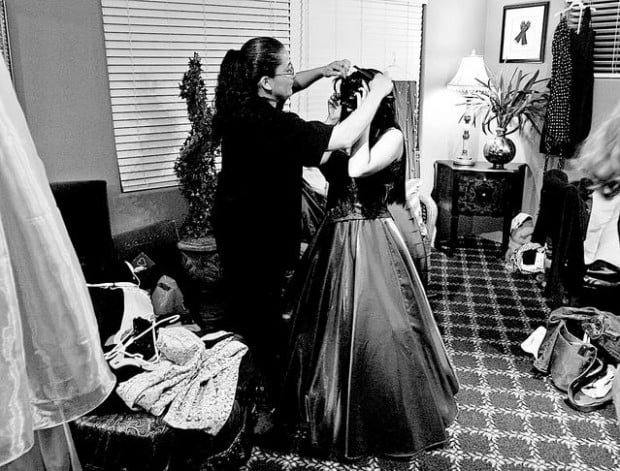

The teens wore tuxes and fancy dresses, and they danced the night away to hip-hop, R&B and rap, but it was hardly a regular prom.
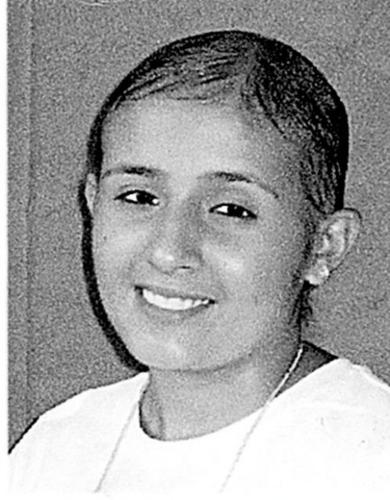
The third annual Candlelighters' Dream Night Prom is for local kids with cancer. Adding to its uniqueness, it's now organized by a Tucson teenager and leukemia survivor who has had two bone marrow transplants.
Saturday night's prom marked the second time that 18-year-old Luisa Diaz coordinated the special dance, which is free for attendees.
The South Side resident, aspiring nurse and survivor of acute myelogenous leukemia spent months preparing for the prom, an occasion to which she added a personal touch this year: a theme of masquerade.
About 50 kids typically attend the event, and most of them are fighting cancer or have fought it in the past. Diaz was first diagnosed with leukemia in April 2003. Others have been diagnosed with life-threatening illnesses.
People are also reading…
They can bring dates, even more than one if they want. In an interview Friday, Diaz said she planned to bring four dates: two classmates, brothers who attend Project MORE where she is a junior; and two of her five brothers.
Diaz was planning to wear a maroon gown with a hoop underneath to give it more poof, and a black feathered eye mask she bought at a costume store. She also had a long, dark wig that she planned to cut to shoulder-length.
But getting ready for the dance was about much more than looking pretty. Diaz had to secure donors, sponsors and the venue, Saguaro Buttes Community Church on the far East Side. The church has offered its space for every year the teens want it.
"We get tuxedo rentals and dresses donated, and Party City donated decorations — whatever I needed," she said. "Party Carousel gave us balloons and a helium tank. We've also had businesses and people donate raffle and door prizes. It's hard sometimes when people turn you down for donations, but most say yes."
Two local hair salons did the teens' hair free of charge, and a beauty school student offered to do the makeup. Panda Express was scheduled to cater. Diaz even secured donations of extra masks, in case some teens didn't have them.
Though some of the teens have been to proms at their schools, the Candlelighters' dance holds extra meaning and camaraderie, Diaz said.
"It's different because these kids come together not knowing each other, but they also get along with each other, knowing they've had the same experience," she said. "Some of them can't attend regular proms due to not going to regular school or to being too sick."
Such was the case for 18-year-old David Robbins, a senior at Compass High School who attended last year's event in a wheelchair. Robbins was diagnosed with acute lymphoblastic leukemia at age 16. He's in remission now. Last year he was fighting a staph infection that led to sepsis.
"I didn't go to my school prom last year, since I wasn't even walking," he said. "But at the Candlelighters' prom, there were other kids with cancer and stuff, so I knew I wouldn't feel by myself. They knew how I felt, and it was a lot of fun. It's cool to hang out with other kids who have cancer."
Robbins planned to attend his second Candlelighters' event Saturday night.
One of Diaz's other tasks has been marketing the prom. She focuses on hospitals and on the 400 or so families affiliated with the non-profit Candlelighters Childhood Cancer Foundation of Southern Arizona. The group is a family-run network that supports, serves and advocates for children with cancer, their families, longtime survivors, bereaved families and the professionals who care for them.
The Candlelighters, a national group, get their name from a Chinese proverb that says it is better to light one candle than to curse the darkness.
About 40 children in Southern Arizona are diagnosed with cancer each year, local Candlelighters Vice President Beverley Tidwell said.
"The only question you have is, 'Why me?' And it can never be answered," said 17-year-old Hannah Read, a junior at Canyon del Oro High School. She planned to bring her three best friends to Saturday night's event.
Read was diagnosed with Hodgkin's lymphoma in September and recently completed chemotherapy treatment. She had to give up swimming on her school's team and work a little harder to keep up with schoolwork, and also cope with the effects of chemotherapy, such as losing her hair. She didn't know many other teens going to Saturday's prom, but she was excited about meeting them. She planned to wear a full-length pink dress that was donated for the event.
"It's a difficult balance having this event, because really for some kids they want to run away and hide," Tidwell said. "The diagnosis is a challenge, but the treatment is as challenging."
She noted that chemotherapy is highly toxic medicine that destroys the body's rapidly dividing cells, as well as hair and the inside lining of the mouth. The result is a compromised immune system.
The prom began in 2006 with a high school project created by Carina Groves, then a senior at Desert Christian High School, whose father died when she was 10 and whose mother battled cancer. In 2007, Diaz took over as organizer.
"Luisa has really taken the ball and run with it," Tidwell said.
Diaz traveled to Washington, D.C., last year to make a presentation about the prom to the Candlelighters' national conference.
She counts her parents and five brothers as her biggest supporters, and she also finds solace in her Catholic church, Santa Cruz Parish.
Her involvement with the prom has brought her a source of fun that was missing after her diagnosis at age 13. She often felt sick, she lost touch with many of her friends, and she didn't have the same zest for shopping and socializing that she had before her illness. Frequently, she felt singled out.
Yet for one night, at least, Diaz and other kids at the Candlelighters' prom can be just like everyone else.
"To me, I always wanted to attend a prom, but due to me being sick I didn't think I'd be able to," Diaz said. "I attended this prom in 2006, and I loved it. I was sort of scared about going, because I didn't know how it was going to be, but I got along with everyone."
Diaz has been leukemia-free since her last bone marrow transplant in 2005, but she still suffers effects from the chemotherapy, most noticeably her hair.
"I feel comfortable, I guess, in the environment, and basically I feel good giving and seeing all the smiles on these teens' faces. It's just a wonderful thing to see."

 Lake Mead's drops raise prospect of unaffordable Hoover Dam electricity