

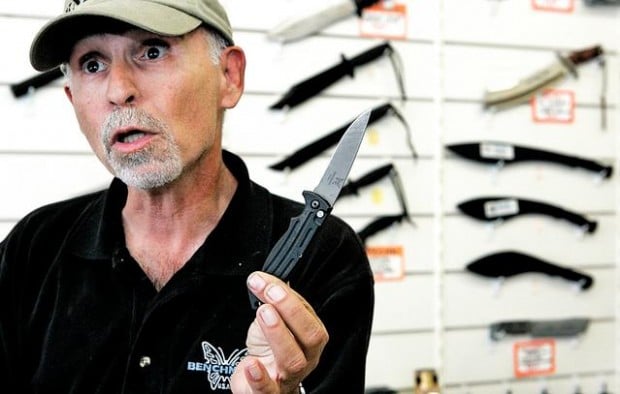
A popular style of pocketknives will no longer be allowed to be imported into the country, if a U.S. Customs and Border Protection proposal is approved.
The knives — those equipped with spring or release-assisted mechanisms — would be considered in the same class as switchblade knives — and thus barred from import — if the agency's plan is approved.
The new classification would not make them illegal to own or sell in the United States, said Brian Levin, U.S. Customs and Border Protection spokesman.
The agency's definition of knives considered to be switchblades would be expanded and it would consolidate conflicting rulings on what knives can or cannot be imported, Levin said.
"It is strictly those types of knives coming in, not those here already or that are American-made," Levin said. "We wanted to unify the definition of what knives can or cannot be imported."
People are also reading…
Oftentimes these knives are mistakenly referred to as switchblades, but they have their differences, said Richard Zwibel, owner of Blade Runner Knives, 907 W. Prince Road.
The automatic-opening knife — commonly known as a switchblade — is spring-operated and is deployed by a separate mechanism, usually a button or slide switch that is separate from the blade.
Assisted-opening knives require the user to apply pressure to the blade to release it, then a torsion bar takes over and swings the blade into its locked position, Zwibel said.
Switchblade knifes are legal to own and carry in Arizona, but laws vary from state to state.
The federal Switchblade Act of 1958 prohibits interstate commerce of switchblades, but licensed dealers are able to send and receive the knives from manufacturers and ship across state lines to law-enforcement and active military personnel, Zwibel said.
The majority of knives sold at Blade Runner Knives are the type named in the proposal, Zwibel said.
"They are quite a bit of our sales," Zwibel said. "The majority of my business is the stick-in-your-pocket folding knives — things people use every day."
Many manufacturers produce knives in America but make certain knives in other countries to save money, Zwibel said. He estimates about half of the assisted-opening knives he carries are made overseas.
"It strikes us in the business as silly and is ambiguous to me as to why they are doing it," Zwibel said. "If it's in the interest of public safety, why differentiate between the two?"
The popular imported knives can cost less than those made in the U.S., Zwibel said. Whether manufacturers respond by making more of the knives here — at a higher price —will be interesting to see, Zwibel said.
"It is too early to tell what the result will be," Zwibel said. "But if it passes, an immediate impact will be that a lot of my hot-selling inventory would be unavailable."
Paul Wilson, who purchased a spring-assisted pocketknife at the store Tuesday to replace one he has owned for four years, said that he carries his each day and uses it often to assist him at work.
"The spring just helps you open it," said Wilson. "I use it a lot of the time for electrical work, to dig into dirt — it's handy."
The proposal refers to commercial import, although it is unclear whether individuals would be able to take their knives out of the country and return with them back into the United States, said Levin.
The proposal was posted on the agency's Web site on May 22 under the Customs Bulletin and Decision listing and was allotted 30 days of comment through the mail.
The commenting period ended on June 22 and began the 30 days that U.S. Customs and Border Protection has to finalize a decision.
U.S. Customs and Border Protection will publish its decision in the same Customs Bulletin and Decision listing and, if adopted, it will then come into effect 60 days later, Levin said.


