

Quick: Name a leader of the national Hispanic community.
That's not easy for some Hispanics, let alone other Americans. Even as the Arizona immigration debate has highlighted concerns of the nation's more than 30 million Latino citizens, it has revealed a lack of name-brand recognition for those dedicated to serving America's largest minority group.
This relative obscurity is largely due to the diversity of Latinos, who come from many countries and cultures with unique concerns that are not easily lumped together - but often are.
"When you're in Colombia, you're a Colombian. When you're in Puerto Rico, you're a Puerto Rican. When you're in the U.S., you're a Latino or Hispanic," said Eric Cortes, a Philadelphia resident and member of a local leadership institute that trains people to work in the Latino community.
People are also reading…
Cortes could not recall the names of any leaders of national Latino organizations, but he knew many locally based activists.
"I feel like every state or region has that person doing national campaigns for rights. … It's hard to pinpoint one person," he said.
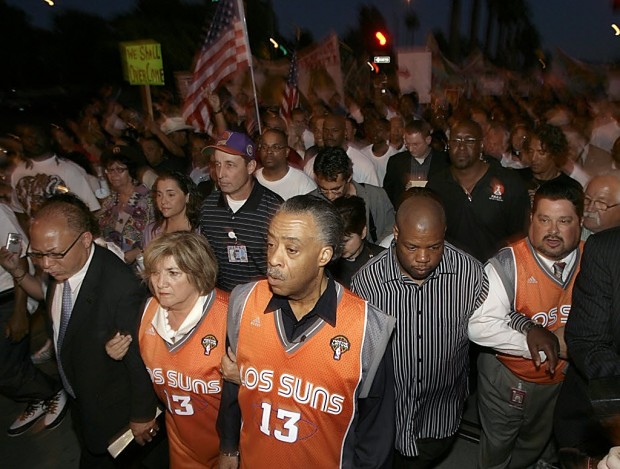
There are, in fact, many Latino leaders with national impact. Yet in the Arizona debate they have been overshadowed by the Rev. Al Sharpton, who led a march in Phoenix on Wednesday, debated Maricopa County Sheriff Joe Arpaio, an immigration-law supporter, on television and made numerous other appearances and statements.
Several Latino leaders said it's better to have multiple leaders and groups who can focus on different areas.
"The political sector, the civil-rights sector, the business sector, small business, immigrants' rights, organized labor," said Thomas Saenz, president and general counsel of the Mexican American Legal Defense and Educational Fund. "I don't know if this is a community that can or ought to depend on a single or very small group of leaders."
MALDEF was founded in 1968 to focus on legal activism. It was born from the League of United Latin American Citizens, or LULAC, the nation's oldest Latino rights group, which was founded in 1929.
Another major organization is the National Council of La Raza, known as NCLR. On Thursday, it gathered seven other organizations at its headquarters to call for a national boycott of Arizona over the new law requiring police to question people's immigration status, which many Latinos say encourages racial profiling.
"I worry less about emerging as a singular leader than thinking about what work can I do in the community," said Janet Murguia, NCLR's president and CEO. "When you're in a movement to create change, you don't do that without leaders across the board."
Hispanic groups have helped millions of citizens - desegregating schools and other public places, helping create the Head Start program, pushing for the Immigration Reform and Control Act of 1986. Yet people like Murguia, Saenz and Brent Wilkes, LULAC's national executive director, remain unknown to many.


