

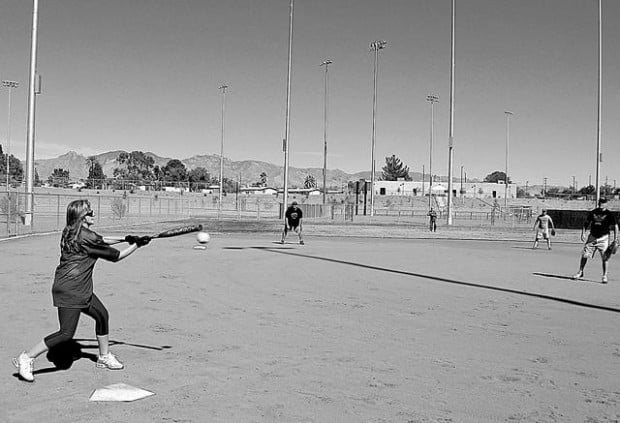
Cherry Field, now the newly built $20 million Cherry Field Detention Basin, looks different from its historic predecessor. But it has the dual purposes of flood control and giving Tucson High Magnet School's athletic teams a home.
The city, Pima County Regional Flood Control District, Tucson Unified School District, U.S. Army Corps of Engineers' Los Angeles District and contracted company Granite Construction Co. demolished the old Cherry Field and built the new Cherry Field Detention Basin.
Generations of Tucson High athletes played on old Cherry Field, west of South Kino Parkway at South Cherry Avenue and East 13th Street.
"We're going to miss the old Cherry Field," said Herman House, the assistant principal in charge of athletics at Tucson High, 400 N. Second Ave.
"But this is exciting because it's something new," he said. "They are very good-quality fields. … We've got lights on all the fields, where before we only had lights on two of the fields, so we're able to do more for the kids."
People are also reading…
Tucson High's baseball, softball and soccer teams used the fields and have relocated to various fields, including Hi Corbett, during construction of the new Cherry Field Detention Basin, which began in summer 2007.
House estimates that students will be able to start using Cherry Field in January.
The school's baseball, softball, soccer and freshman football teams, and the marching band, will all use the facility at some point, though the school's baseball and softball teams will be the primary users, he said.
Along with giving Tucson High athletes a place to play, the Cherry Field Detention Basin will play a role in flood control.
"This basin is made to function when you get a 20-year or larger storm," said Suzanne Shields, director of the Pima County Regional Flood Control District, referring to a storm large enough that it would be expected to hit only once every two decades.
"The water would come in here, be detained and then drain out in about 30 hours," she said. "It will reduce the amount of flow that goes down Arroyo Chico to the Fourth Avenue area and to Downtown Tucson."
The Cherry Field Detention Basin is the second phase of the the Tucson Drainage Area/Arroyo Chico Project, which combines flood control, recreation and environmental restoration.
When completed, the project will take 2,200 homes out of the 100-year flood plain, Shields said.
Representatives from agencies working on the project were among the 70 or so people at the Cherry Field Detention Basin's Nov. 1 dedication ceremony. A softball game followed the ceremony.
During the dedication, Col. Thomas H. Magness spoke of the U.S. Army Corps of Engineers' work in Tucson, including creating the new field and detention basin. He's the district commander for the Los Angeles District.
Through the Army Corps of Engineers, the federal government has nearly $400 million in projects under way in the Tucson area, he said.
"And I believe more is coming. The center is clearly moving this way," he said, referring to civil works projects, the military program at Davis-Monthan Air Force Base and border and economic security.
"The investment from my organization in this area is clear and it's clearly becoming a top priority," he said.
The first phase of the overall Tucson Drainage Area / Arroyo Chico Project was the $15 million Randolph South Detention Basin, completed in April 1996. That's at the city's Dell Urich Golf Course, formerly called Randolph South, 600 S. Alvernon Way.
The project's third phase, which has an estimated cost of $24 million, will add three more basins and is awaiting federal funding, Shields said.
Though the phases work best together, they can also work independently.
"If there was a large storm right now, it would take a bulk of the flood volume off," Shields said.
central


 Tucson's iconic Arizona Inn to add rental homes to its property


