

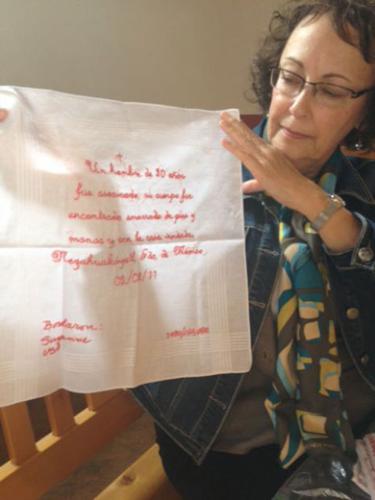

Stitch by red stitch, Suzanne Hesh has embroidered the names of dead people, each on a man’s white handkerchief. She didn’t know the individuals but each pañuelo has some information about their deaths.
The names of the dead are victims in Mexico’s long and violent clash in the international drug trade that has claimed the lives of 100,000 or more people since 2000. The Human Rights Watch, in a 2013 report, claimed that more than 60,000 people died from December 2006 to December 2012.
“It’s a small act of redemption,” said Hesh, who is part of a small but growing movement to bring voices to the dead in Mexico.
Fuentes Rojas/Embordando por la Paz (Red Fountains/Embroidering for Peace) originated in Mexico City in 2011 out of frustration and despair over the mounting deaths across the country. It has spread to other communities in Mexico, across the border to Tucson, and has reached Canada and Brazil.
People are also reading…
Hesh and a small group of Tucsonans meet regularly to stitch and converse. The finished pañuelos are sent to Mexico where activists there string them together and use them in their peaceful demonstrations. Their next stitching session is Dec. 18 at 2:30 p.m. at Mercado San Agustín on West Congress Street.
Jane Brundage, an American living in Mexico City with her husband, said that the handkerchiefs are strong symbols of the growing intolerance of the Mexican people to the drug related violence.
“We can participate in protests. However we can stitch and we do,” said Brundage, who moved from New York to Mexico in 2008.
Brundage said the fact that Americans and other non-Mexicans are joining Bordando por la Paz shows the Mexican people that they are not alone. “There are Americans who care and who are willing to stand with them,” she added.
The governments, both Mexican and the U.S., have shown an indifference to the dead, but the act of embroidering names gives them identities and reminds Mexico and the world of the tragic consequences. Hesh said embroidering “is a way to show that they (the victims) are human beings.”
Mexicans are raising their hands and shouting “don’t shoot” because they can no longer breathe.
The embroiderers do not differentiate between the victims. The names of the dead are narcos who wielded AK-47s or friends who were lunching at a restaurant sprayed by high-caliber bullets or children who were walking home from school and were in the wrong place at the wrong time. The international drug war doesn’t differentiate between its victims.
They are all equal in the eyes of God, said Hesh, whom I recently met at Southside Presbyterian Church.
It’s easy for Tucsonans and people north of the border to ignore the deaths in Mexico. It’s easy to blame the drug war on Mexico alone. And it’s easy to believe that the Mexican drug violence was created and operates in a vacuum.
And we do. But the deaths and violence in Mexico have direct connections to the United States. Drugs flow north and arms travel south. And the billions of illicit dollars made from drugs and arms pour into international banks, from Mexico City to New York to Switzerland. The corrosiveness of the unabated rush of dollars results in corruption along the money trail.
In his 2002 book “Down by the River,” the late Tucson author Charles Bowden chronicled the cross-border corruption and drug trade. The binational ties are real, as are the increasing deaths in Mexico. Blame can be spread around, as the international border is not barrier, Bowden wrote.
“How can we turn a blind eye to this?” asked Brundage.
This being a 10-year-old boy whose name Hesh recently embroidered. She also stitched the name of a 3-year-old boy.
The deaths are made invisible but the stitching makes them visible.
“Every stitch that I stitch is a stitch to make visible someone’s death who was invisible,” said Brundage.
The stitching seems insignificant. It’s a microbe in a much larger, sick body. But these actions, along with other acts of protest against the status quo that allows the drug wars to continue and to claim lives, innocent or not, will bring more attention and pressure on Mexico City and Washington, D.C., to cease and desist.
“We’re in complicity until we speak out,” Hesh said.
Ernesto “Neto” Portillo Jr. is editor of La Estrella de Tucsón. He can be contacted at netopjr@tucson.com or at 573-4187.


