Mayoral candidate India Walton says police should not be first responders to mental health-related calls.
In many cases, in Buffalo and many other communities, they already aren't.
At the same time, mental health professionals sometimes want or need police to show up.
The debate about the appropriate role police should take in mental health response often gets oversimplified, but most agree police involvement should be limited, said Elizabeth L. Mauro, CEO of Endeavor Health Services, a local nonprofit that provides mental and behavioral health services, including alongside city police.
"When we talk about the role of law enforcement, in a very simplified form, it's they should be used when they're needed and not otherwise," Mauro said.
"And actually everyone's agreeing," she said. "If you peel back all the layers, everyone is actually in agreement on that."
People are also reading…

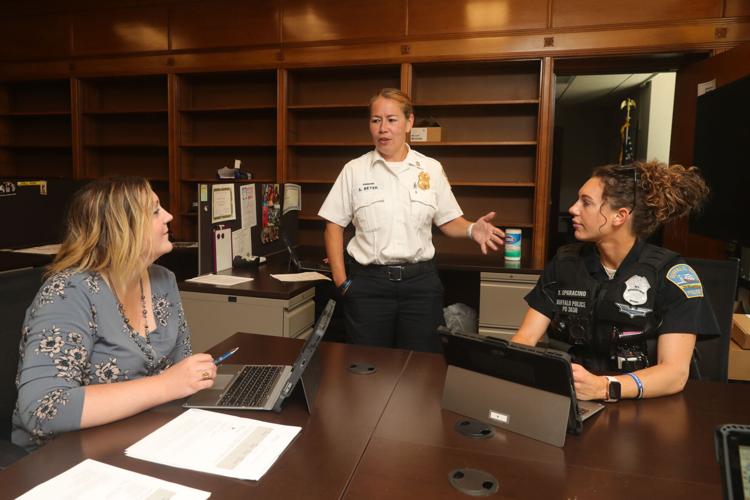
Buffalo Police Capt. Amber Beyer, center, talks with Cait Connors, left, a mental health clinician with Endeavor Health Services, and Officer Rosie Sparacino in the Behavioral Health Team offices in police headquarters.
Endeavor Health partners with the Buffalo Police Department for the department's Behavioral Health Team, a unit created a year ago that pairs specially trained police officers with mental health clinicians. Grant funding Endeavor received pays for the team's work.
Police involved when safety an issue
Dealing with people who have mental health issues can be a volatile situation for police. And sometimes an incident that involves a person having a mental health problem is initially reported as a different type of police call, so officers don't always know what they are walking into, said Buffalo Police Capt. Amber Beyer, who leads the Behavioral Health Team.
"It's a no-brainer that police are needed on some of these calls," Beyer said.
"The police presence is essential for everyone involved, for safety reasons," Beyer said. "And a lot of the mental health professionals that are doing the work on the ground don’t want to be there without police in a lot of cases. They feel more comfortable where they take the primary role, but police are there just in case."

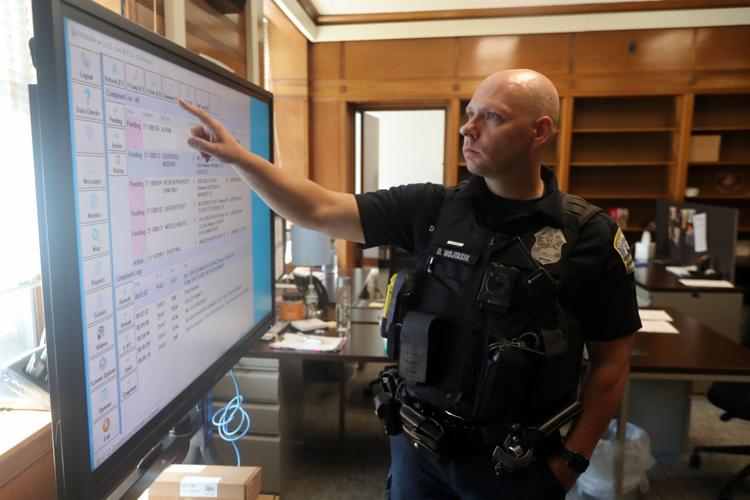
Buffalo Police Officer David Wojtasik, a member of the department's Behavioral Health Team, reviews a screen showing active police calls in the city to determine whether the team may be needed.
Clinicians for mental health providers regularly call police for assistance on calls where there are potential safety issues, Beyer said.
When someone calls 911, a call taker at Central Police Services determines what resources are needed, and can send police, firefighters and/or an ambulance.
If there are no safety concerns, sometimes a dispatcher – who has crisis intervention training – will send an ambulance. Sometimes, situations may be reported to police as domestic disputes that end up being mental health-related.
"They will never have enough training to see through a phone, though, and know what actually is going on on scene," Beyer said.
2020 police shooting increases attention
After a Buffalo police officer last year shot a homeless man said to be having a mental health crisis, increased scrutiny and public protests followed.
Shortly after 3 p.m. Sept. 12, 2020, near Genesee and Ash streets, an officer fired twice at Willie Henley, shooting him once in the abdomen, after Henley allegedly swung a metal baseball bat at the officer's partner and struck her in the upper arm. Officers deployed pepper spray, but that failed to subdue Henley, according to police.
None of the officers at the scene where Henley was shot had Tasers. Plans to equip more officers in the city with the less-lethal weapons has been delayed for years. Plans again were put on hold last fall when the Brown administration said funds to purchase the equipment were not available.
Brown and the Common Council included funding for Tasers in this year's city budget.
Henley, who was hospitalized after the shooting, was charged with assault. In March, he was found not competent to proceed with the criminal case against him.
Walton, who at that point had yet to declare her intention to run for mayor, came to the shooting scene that day.
Later, during a rally of about 200 people supporting Henley, Walton said Henley had cause to be fearful during the police encounter.
"I'm already scared and I can't see," she said, describing Henley's plight after being pepper-sprayed. "What the hell did you expect him to do?"
Demonstrators called on the mayor and law enforcement leaders to resign, pointing to the shooting as another example of persons of color becoming victims of police violence.
Two days after Henley was shot, Mayor Byron Brown announced the department's new Behavioral Health Team would begin operating the following month.
What Walton wants
Earlier in her campaign, Walton said she wanted police removed from having a role in "most mental health calls."
During an interview with the Buffalo News Editorial Board in September, she said police officers are burdened "with doing jobs that they're not hired for," including homeless outreach and mental health response.
Police should be given the time and space to perform their jobs, while agencies designed to specifically address needs of the homeless or those with mental health issues also deserve additional funding, Walton said.
"I want to free police up to do police work," she said.
The winner of June's Democratic primary also said she would reduce police spending in some areas and use it to "fully fund mental health services," improve homeless outreach, invest in diversion programs, as well as to increase officers' base pay.
Walton has said her administration would create a "mental health first responder corps" that would send out mobile crisis teams that include therapists and social workers.
Pairing of officers, clinicians
A study of data from nine police agencies from across the country published in July found a little more than 1% of 911 calls are for mental health issues.
In Buffalo, from Oct. 1, 2020, through Sept. 30, 2021, the Behavioral Health Team responded to 1,110 of the department's 6,742 mental health-related calls. The team also performed about 1,400 follow-ups, according to the department.
Of the roughly 2,500 individual interactions the team had, an individual was taken to Erie County Medical Center's Comprehensive Psychiatric Emergency Program 135 times, the department said.
Under state law, anyone found to need transport to the hospital for a psychiatric evaluation, who is not going voluntarily, must be taken with police assistance. Crisis Services is the nonprofit designated with the authority by Erie County to make a determination if a person needs to be transported for further psychiatric evaluation, said CEO Jessica Pirro. Police can also transport a person without an assessment by a mental health professional.
Crisis Services, which operates a 24-hour crisis hotline, has a mobile outreach operation for people in need of mental health assistance, and in cases where there may be safety concerns, police are requested, Pirro said. Such "heightened cases" are "not the norm," she said.
Crisis Services has offered a mobile crisis response since 1980, Pirro said. About 60% of the agency's mobile outreach calls have no police involvement, she said.
The police department's Behavioral Health Team has six officers and two lieutenants who work with three clinicians and a program supervisor from Endeavor.
It's called a "co-responder model," putting the two types of professionals together. The model is meant to reduce hospitalizations, more efficiently use an officer's time and improve access to and speed of receiving care, said Mauro, of Endeavor.
The team works 8 a.m. to 6 p.m. Monday through Friday. Officers citywide are able to request Behavioral Health Team members assist on calls. As of the summer, about 140 officers in the department have received crisis intervention training.
When the Behavioral Health Team arrives at a scene, the clinician's role is to assess, de-escalate and figure out what a person, or "the client," needs, said Beyer, who became the department's crisis intervention training coordinator in 2018.
The team, when possible, tries to avoid putting the client into the criminal justice system. Facilities in the city provide services to those who don't need "acute stabilization" at ECMC. Those include walk-in clinics, clubhouses and respite centers, which is akin to an urgent care center for mental health.
But they don't always have a choice.
"Sometimes the only way to keep this person safe from themselves is to incarcerate them," Beyer said, "because there's limitations on the mental health system on what they can make somebody do."
"And if somebody refuses to engage in treatment, if somebody refuses to get help themselves and they're out there conducting themselves criminally and putting themselves and the community in dangerous situations, then ultimately we have to look at that option," she said.
Still, there are calls that could be handled by different agencies and not by police, Beyer said.
After Brown announced the formation of the Behavioral Health Team, a group of social workers, mental health professionals and community members denounced the plan outside City Hall.
In an opinion piece published in The Buffalo News in November 2020, four educators in counseling and social work from area colleges and universities called on the city to stop using police as first responders to mental health calls.
Police are just one part of the mental health system, which providers say as a whole can be improved.
"It's a system, a continuum," said Mauro. "I don't know how you pull any piece out of it, frankly."
News staff reporter Maki Becker contributed to this article.