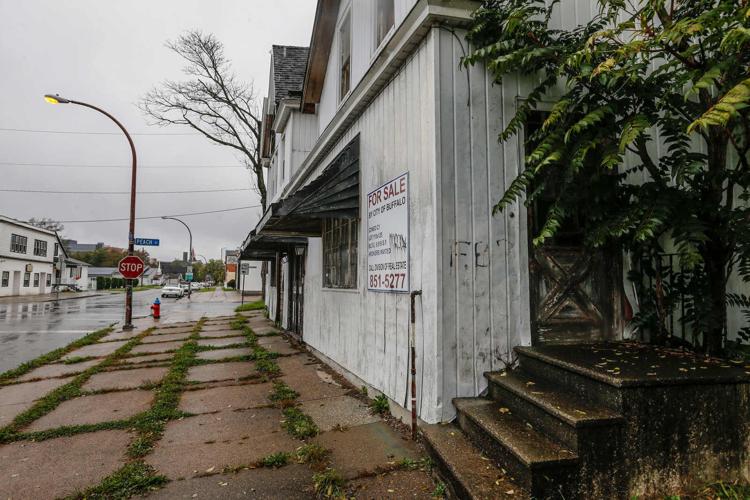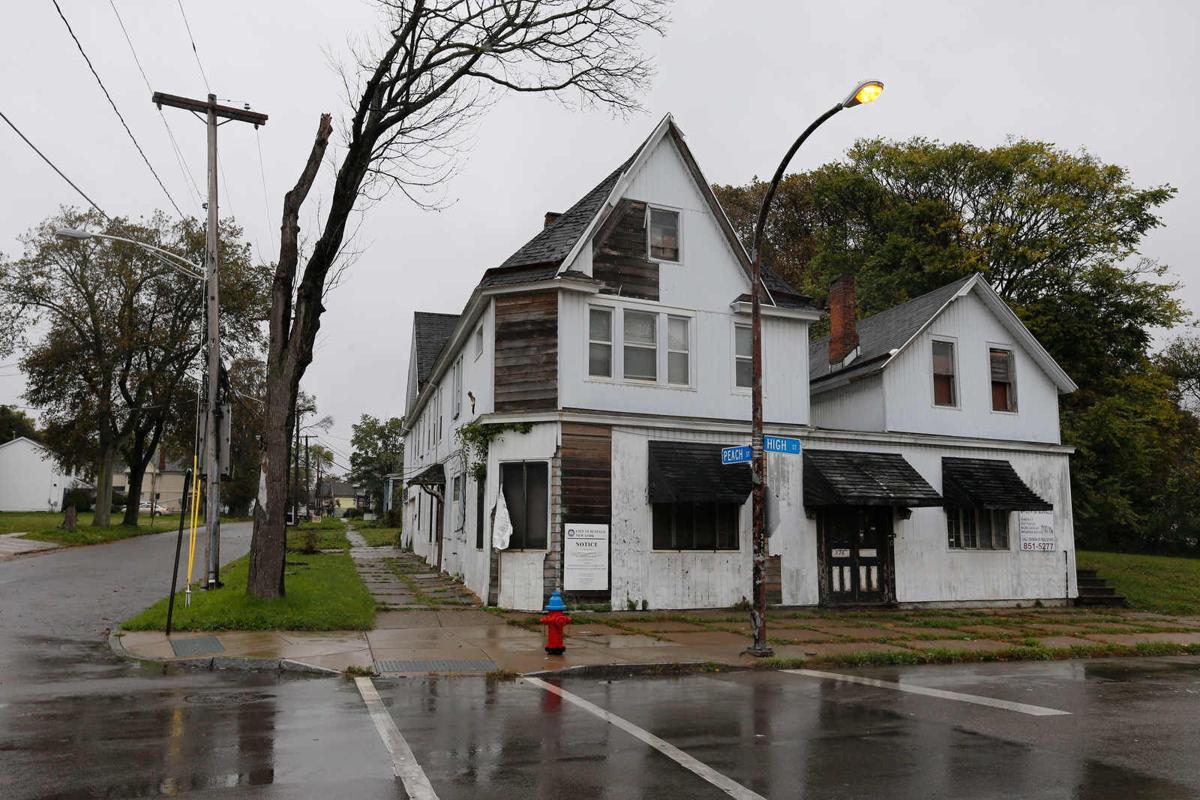
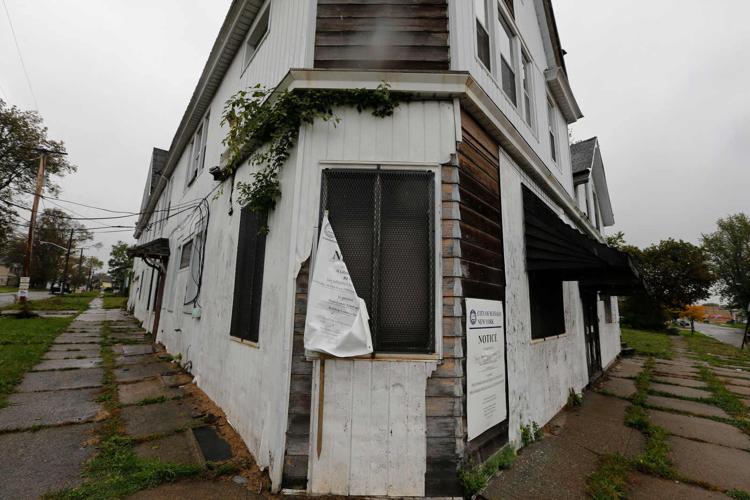
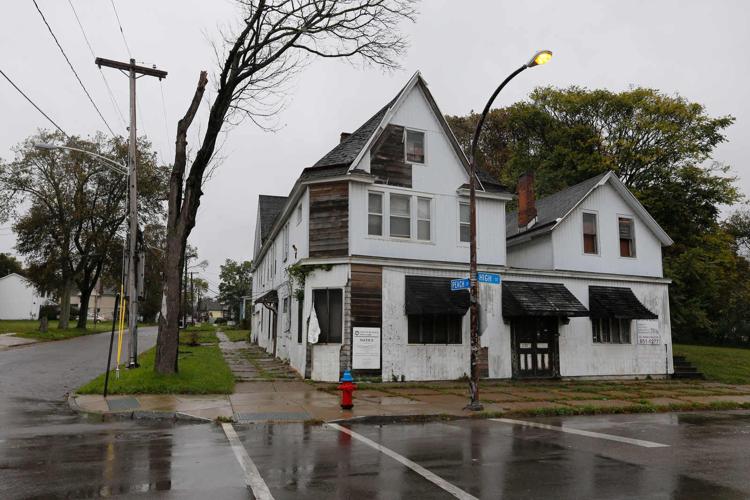
If India Walton had her way, the battered two-story building at High and Peach streets would have been fixed up or replaced a long time ago.
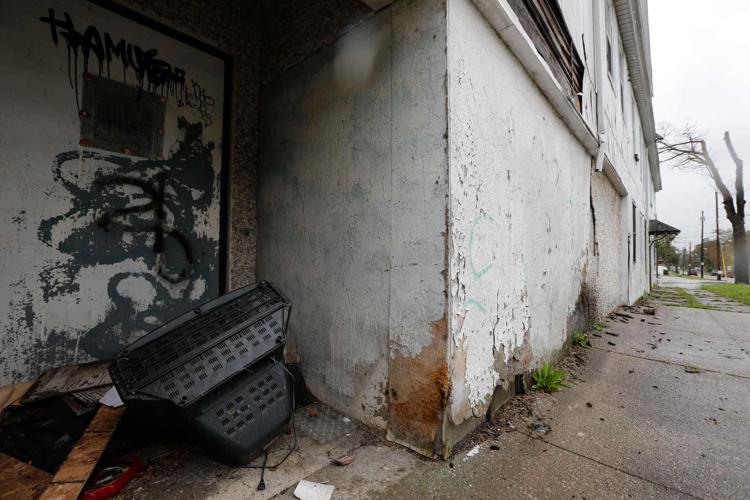
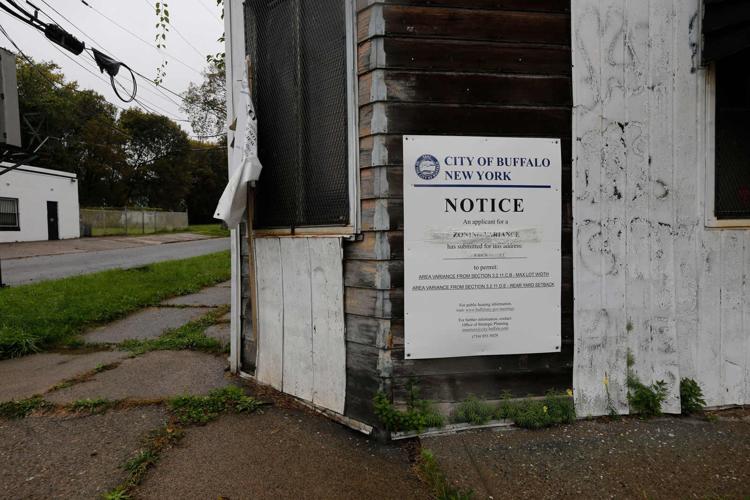
Instead, Buffalo’s Democratic mayoral nominee stood in the building’s shadow on a hot October morning, gesturing at the weeds in the foundation and the jagged glass in the broken second-story windows. Since at least the early '90s, the vacant building – once the office of an anti-poverty organization – has belonged to the City of Buffalo, which made tremendous infrastructure and planning investments down the street at the Buffalo Niagara Medical Campus.
Now, Walton said, the building serves as an example of how anti-poverty policy would look different under her administration: namely, that she’ll prioritize issues such as affordable housing and neighborhood conditions over just about any other policy objective.
People are also reading…
“We can't just pretend as if our current policies have been doing the job,” Walton said. “Because, clearly, they haven't.”

India Walton says this vacant building at the corner of High Street and Peach Street serves as an example of how anti-poverty policy would look different under her administration: namely, that she’ll prioritize issues such as affordable housing and neighborhood conditions over just about any other policy objective.
Few would argue that poverty isn’t a colossal problem in Buffalo – a problem so entrenched and ubiquitous, in fact, that it’s almost taken as a given. When Walton’s opponent, incumbent Mayor Byron Brown, entered office in 2006, the citywide poverty rate sat at 29.9%. It has not changed appreciably since then.
But Walton and Brown differ sharply in their beliefs about the policies best suited to address it. Brown, who rarely uses the word “poverty” in interviews or public appearances, has bet that economic development and partnerships with nonprofit organizations will improve neighborhood conditions and generate new and better jobs for low-income residents.
Walton, a self-described democratic socialist who has made poverty the key theme of her campaign, advocates for what some progressives call “regenerative” economics – collective ownership, such as co-operative businesses and community land trusts, that she says will more equitably spread wealth and power.
Evaluating the relative merits of these approaches is difficult: The effectiveness of anti-poverty interventions comes down to implementation, said Laura Tach, a sociologist at Cornell University who studies social policy. City governments also have only limited influence over the big-picture, macroeconomic factors that contribute to poverty.
“Political cycles are shorter than the time horizon it’s going to take” to lower the poverty rate, Tach said. “So it’s a difficult thing to solve, and an easy thing to critique.”

Mayor Byron Brown sees a city on the rise. His opponent, Democratic nominee India Walton, sees an aging city mired in failed policies of the past.
Deep poverty, little progress
Almost half of Buffalo’s children live in poverty, according to the Census Bureau, and roughly 30% of the city’s renters spend at least half their income on housing. While statistical variables make it difficult to produce a definitive ranking, Buffalo also falls among the very poorest large and mid-sized U.S. cities.
That distinction has dogged Brown, perhaps unfairly, since the earliest days of his administration. Researchers and advocates who study poverty caution that federal and state policies – such as tax credits, rent assistance and food benefits – influence poverty rates far more than municipal interventions. In 2019, the National Academies of Sciences published a landmark 600-page blueprint for reducing child poverty in the United States, modeling the strategies that would most benefit low-income households. They found that a package of federal program expansions – such as the enhanced child tax credit implemented in March – would most directly, and quickly, bring child poverty down.
That said – while poverty rates have for years remained level in upstate cities such as Buffalo, Syracuse and Albany – Rochester’s poverty rate has fallen since 2015, coinciding with the launch of an aggressive campaign to raise wages, better fund basic services and provide low-income adults with intensive career mentoring.
Nationally, the poverty rate has fluctuated with the health of the economy, dropping to a record low of 10.5% in 2019.

Brown's supporters in Buffalo's immigrant communities say he is doing the right things to make newcomers feel welcome in the city, but India Walton says she will do even more for them.
“By definition, those communities that have the most severe poverty are those that have the least ability to raise revenue to address it,” said Kate Breslin, the president of the non-profit Schuyler Center for Analysis and Advocacy, which studies poverty in New York. “There are things municipalities can do, but municipalities need the state, and the states need the federal government.”
Even with that caveat, however, Brown has failed to deliver on anti-poverty commitments he made early in his tenure. In 2009, for instance, after releasing an 80-page report titled the “Buffalo Poverty Reduction Blueprint,” Brown promised to empanel a task force of experts that would develop a concrete strategy for attacking what he has called the city’s “alarming” poverty numbers.
The task force, however, received no dedicated staff or city funds, and within months “fizzled out” from lack of support, said Henry Louis Taylor, Jr., the University at Buffalo academic whom Brown appointed to co-chair it. Brown told The News the city never sought to reinstate the task force because it determined that agencies could coordinate anti-poverty efforts themselves.
On Oct. 21, Taylor and the UB Center for Urban Studies published a report that found Black Buffalonians “had not made progress” on several critical measures, including unemployment and poverty, in more than 30 years. A more aggressive anti-poverty agenda could have moved the needle, he said, adding that none of the city’s last three mayors "understood" poverty or prioritized anti-poverty programs.
Brown has pitched development and infrastructure projects in poor neighborhoods as a means of reducing poverty, as he did in a 2016 interview with Channel 4 News. Asked to respond to an earlier story about the city’s high poverty rate, Brown brought the station a list of East Side development projects supported or funded over his term.

That disagreement comes against the backdrop of a broader national debate: Academics and others cite a lack of statistical evidence that becoming a sanctuary city increases crime; immigration skeptics cite isolated anecdotal evidence to the contrary.
Those investments, which typically draw from a combination of state, local and federal funds, total in the hundreds of millions of dollars, according to the governor’s office. Such investments improve neighborhood conditions and quality of life, Brown has said, and generate better-paying jobs for low-income residents.
“Our approach has been pretty strategic: to partner with other entities, recognizing that no one entity can eradicate poverty,” Brown said. “It hasn’t been done federally and it hasn’t been done by one state or county or city. It has to be all hands on deck.”
Research shows low-income residents see small employment and wage gains from some types of nearby infrastructure and economic development, said Tach, the Cornell sociologist, which has made it a popular tactic in both state and federal aid programs. But because the benefits to low-income people are minimal and pose a risk of displacement, critics often use the same research to argue against revitalization as a means of fighting poverty, she added.
In an October interview about his anti-poverty agenda, Brown also emphasized the property tax rate cuts made during his administration, which he said may have prevented even larger rent increases than many low-income households experienced. His administration sponsors summer reading and employment programs for young adults, he added, and beautifies roughly 30 blocks a year through its Clean Sweep program.
Brown also cites his investments in the Northland Workforce Training Center and Say Yes to Education. The executive directors of both organizations say Brown lobbied to bring them to Buffalo. Northland, a state workforce development initiative that trains Western New Yorkers for advanced manufacturing jobs, currently enrolls 143 students from the city of Buffalo. Say Yes, meanwhile, reports that since its launch in 2012, high school graduation rates in Buffalo Public Schools climbed by 16 percentage points before the pandemic – one of several leading indicators that might signal a future change in the poverty rate, researchers said.
The City of Buffalo provides a small fraction of the organization’s annual funding. Brown’s deputy mayor also meets every three weeks with an advisory board of policymakers, parent groups and other Say Yes partners, said David Rust, the organization’s executive director.
“The mayor has served as an ambassador for this coalition,” said Rust, one of two nonprofit executives who agreed to discuss the persistence of poverty in Buffalo. Representatives from the John R. Oishei Foundation, the Community Foundation for Greater Buffalo and the Community Action Organization of Western New York all declined, citing busy schedules or an inability to comment on issues that some might consider political.
“But again, these are deeply entrenched problems that have taken a long time to get to the point we're at today, and it’s going to take time to move the needle on some of them,” Rust said.

The City of Buffalo owns this vacant building at the corner of High Street and Peach Street in the Fruit Belt neighborhood. Photo taken Tuesday, Oct. 26, 2021.
Walton's approach
In contrast to Brown, Walton has centered her campaign around questions such as affordable housing, racial equity and labor market gaps, speaking often about the problems faced by Buffalo's poorest. In that alone, she already diverges from a long political legacy in Buffalo, Taylor said.
“Fight for the poor, the working class, the vulnerable,” she wrote on Twitter last week, “not those who brutalize, harass, exploit, and condemn them.”
In nearly 900 posts, Brown has never tweeted the words “poor,” “poverty” or “low-income” from his campaign Twitter account.
It’s far from clear, however, whether Walton’s agenda could lower the poverty rate where Brown’s could not. A former community activist and organizer who said she “grew up poor,” Walton favors a bottom-up approach to anti-poverty policy, leaning on existing community networks and programs that give low-income people the ability to buy homes and open businesses.
Walton plans, for instance, to set up a network of “street teams” that would walk door-to-door connecting residents with city and social services. Such a program has no direct precedent in New York State, said the Schuyler Center’s Breslin, and Walton said she didn’t yet know how she would fund it.
Walton has also championed community land trusts, which can give low-income people a path to secure, affordable homeownership. In a typical residential land trust, families own their homes outright, but lease the land beneath it from the trust. They only have to buy the house. The trust sets certain terms in its land leases. For instance, it can artificially keep the home price lower than market value when it's sold, or it can put income restrictions on buyers. And many land trusts also have down payment programs.

The contrasting philosophies of Mayor Byron Brown and challenger India Walton on policing mirror a nationwide dialogue about the American criminal justice system.
Walton has also said she would seek to launch a universal basic income pilot with Mayors for a Guaranteed Income, a national alliance whose membership includes the mayors of Pittsburgh and Rochester.
Walton said she would model her pilot on a high-profile, grant-funded trial in Stockton, Calif., which for two years gave $500 per month to 125 low-income families, no strings attached. According to a study of the trial published in March, participants were twice as likely as their neighbors to find full-time jobs and reported better physical and emotional health.
Brown also proposed a basic income pilot earlier this year, but later rescinded it in favor of a proposal that would provide services such as child care and transportation to low-income people in job training programs.
“I believe that there are just certain universal things that should be true: that everyone deserves housing, that everyone deserves decent food,” Walton said. “Everyone deserves clean water to drink and clean air to breathe. And as a society, we have enough resources to at least take care of that.”

The City of Buffalo owns this vacant building at the corner of High Street and Peach Street in the Fruit Belt neighborhood. Photo taken Tuesday, Oct. 26, 2021.
Policy experts cautioned that it’s difficult to judge the merits of Walton’s proposals without knowing how she would implement them. Unlike Brown, who has 16 years of policies to dissect, Walton comes to the job with no political experience, and city governments have not tested her proposals at the scale she envisions.
For instance, the notion of assembling an on-the-ground infrastructure capable of connecting nearly 280,000 residents to city services “sounds unrealistic” on its face, Breslin said. She points out that most cities don’t even maintain the sort of comprehensive service directory that canvassers would need to make referrals.
But there is a large and growing body of research that shows direct cash transfers, like those in basic income programs, can lift people out of poverty, said Sheila Smith, a researcher at the National Center for Children in Poverty. Twenty-seven U.S. cities have adopted pilots, according to Mayors for a Guaranteed Income, including Baltimore, St. Paul, Minn., and Newark, N.J.

Dealing with people who have mental health issues can be a volatile situation for police.
Hundreds of U.S. cities have also embraced community land trusts: non-profit, community-based landholding organizations that seek to help low-income buyers obtain affordable homes. While land trusts operate independent of city government, many municipalities, including New York City and Seattle, have incentivized them with measures including tax exemptions and land and building donations. The building at High and Peach streets could have been one such donation, Walton said.
Walton has blamed the slow progress of the Fruit Belt Community Land Trust, where she served as executive director until 2019, on the Brown administration’s choice not to offer similar supportive measures. The land trust built two new houses in total, and a plan brokered by Walton to build 50 additional affordable housing units in the Fruit Belt fell apart in mid-October.
In a televised debate on Wednesday, Brown seized on the project’s collapse: “She has no record of success with her ideas or philosophies,” he said. “In fact, she's been a failed housing executive.”
But Walton said her lived experience – both at the land trust, and before that, as a nurse and young mother – give her an unrivaled understanding of the issues and policies that drag down the city’s poorest people.
“Don’t be fooled – experience ain’t sitting behind some desk in somebody’s city hall,” she told supporters during a primary campaign speech over the summer. “Experience is being out here working hard, raising children, and sometimes wondering where your next meal is going to come from.”
This is the last in a series of stories looking at election issues in Buffalo ahead of the election for mayor. Read more:
• 2021 Election: How should police handle mental health calls? Buffalo's next mayor will help decide