

For decades, authorities have used trained dogs to sniff out drugs, explosives and other contraband.
The Arizona Department of Corrections has found a new item for dogs to detect: cell phones.
The department has four dogs that are either working or being trained to work in one of the state's 10 prisons to search for cell phones being hidden by inmates, officials said.
Cell phones are banned in prisons. Prisoners found with phones can face disciplinary action and even criminal charges, depending on the severity of an incident in which a phone was used.
Inmates can use the phones to conduct criminal activity, including drug transactions and gang business, beyond prison walls, said Ralph Pendergast, trainer for the service-dog program and an administrator with the Corrections Department.
People are also reading…
Cell phones also can aid inmates who try to escape or actually do escape, said Angelo Daniels, commander of the Correctional Officer Training Academy on Tucson's West Side, where the dogs are trained.
"If they have the ability to arrange a ride, they can take off," Daniels said.
The department began training the dogs last May, making Arizona one of only a few states in the country to use dogs to detect cell phones, Pendergast said.
Currently, the Department of Corrections dogs rotate to each of its facilities, but officials hope to have a cell-phone-detection dog at each state prison by the end of next year, Pendergast said.
Virginia was the first state to start using dogs to find cell phones, and Maryland and Arizona began using the dogs last year, he said.
For the past few years, prison officials around the country have been dealing with an increase in cell phones behind bars.
In California, state legislators have considered making cell-phone possession inside a prison a misdemeanor with a maximum penalty of a $5,000 fine.
The number of cell phones confiscated in California doubled from 1,400 in 2007 to about 2,800 in 2008.
In Arizona, the dogs have have helped corrections officers confiscate about 50 phones since last May, Pendergast said.
Other states, such as South Carolina, have examined the possibility of installing technology that jams cell phone signals. Not only is that method expensive, Pendergast said, but it's also illegal, and violators can be fined by the federal government.
"Cell phones have become a nightmare for the state and private prisons," he said.
Inmates usually get or buy the cell phones from visitors, contractors who work at the prison and staff members who sneak the phones in, said Kenny Vance, a service-dog trainer for the Corrections Department.
It can cost between $400 and $800 for an inmate to buy a cell phone inside a prison, Vance said.
The phones have caused more problems in prisons within the last decade as they have become smaller, Daniels said.
"When they started getting smaller and easier to conceal, that became a problem," he said. "The smaller they get, the more concerned we get."
The inmates are allowed to have face-to-face visits with family members and other visitors, making it easier for an outsider to give a phone to an inmate, Vance said.
Visitors and contractors have to get past a security checkpoint when they enter a prison. Corrections officers and other staff members are not allowed to take phones into prisons, he said.
Vance recalled an incident when a contractor tried to sneak a phone into a prison by hiding it in a bag of Cheetos.
That cell phone was not found by a dog. "The contractor had it at the checkpoint," Vance said.
If a phone gets into the prison, an inmate can charge others for using it, he said.
The prisoners prefer to use cell phones because prison phones are monitored, Pendergast said.
Department of Corrections personnel train the dogs to identify four unique odors associated with cell phones and their components, he said. The dogs also can detect batteries and phone chargers, Vance said.
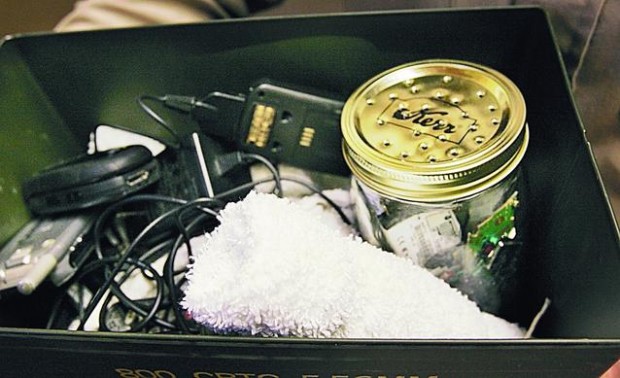
Corrections officers use towels that have been stuffed in jars with cell phone parts to train the dogs, Pendergast said.
"We transfer the odor to the towels to train the dogs. We hide the towels, and the dogs have to find them," he said. "It becomes like a hide-and-seek game."
Two of the dogs, Sprint and Cricket, are named after cell-phone companies. The other two dogs, Emma and Billy, already had been named when the department obtained them, Vance said.
The department takes dogs from no-kill shelters and trains them. It can cost up to $500 to obtain a dog and train it, he said.
Cricket graduated from the academy a little over a week ago after spending nine weeks sniffing out cell phones and cell-phone-scented towels.
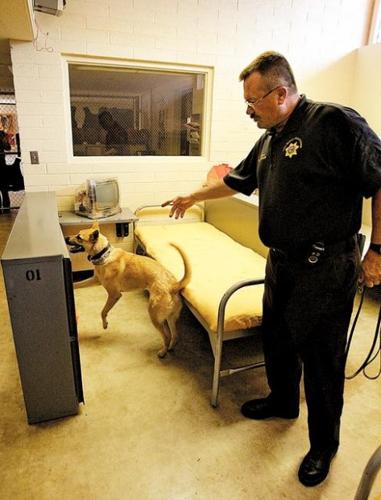
During a recent demonstration, the energetic dog darted into a simulated prison cell to sniff mattresses, closets and desks while looking for cell phones planted by the trainers.
The dogs look for the hidden cell phones, but they're trained to ignore phones that are visible, Pendergast said.
They are rewarded by playing with their favorite object or toy. For Cricket, she was allowed to gnaw on a piece of an old canvas fire hose after the demonstration.
The state prison system is the only agency in Arizona to use the dogs to find cell phones, Pendergast said.
The Pima County jail relies on its corrections officers to find cell phones and other contraband, said Capt. Greg Gearhart, security support division commander for the jail.
"Our corrections officers do regular room searches, and all inmates are patted down prior to coming into the jail," Gearhart said.
Officers are not allowed to bring their own phones into the jail, he said.
Jail officials have never found a cell phone on an inmate, he said.
Department of Corrections officers also use metal detectors, conduct searches and do pat-downs to look for cell phones, but the dogs have something that officers and metal detectors lack, Pendergast said.
"The main tool they have is their nose. Dogs can go to a pinpoint area," he said. "We have to look at dogs as our tool."
By the numbers
The Arizona Department of Corrections has more than 90 dogs that work in state prisons, including:
• 4 dogs used to detect cell phones;
• 52 dogs for detecting drugs;
• 35 dogs used to track escaped inmates;
• 1 dog used for detecting explosives.


