

University of Arizona researchers are preparing their first concerted attack against buffelgrass, an invading species that threatens to forever change this part of the Sonoran Desert.
The search-and-destroy mission begins Aug. 2 at the Santa Rita Experimental Range east of Sahuarita, followed a couple of weeks later by an assault on thick stands of the tough, hard-to-kill plant on Tumamoc Hill, on Tucson's West Side.
Buffelgrass, brought to this area decades ago from Africa as a possible source of erosion control and cattle forage, has spread like wildfire, crowding out native vegetation and creating a severe fire hazard.
That makes it more than just an environmental issue — it's now a public-safety concern, said Travis Bean, a principal research specialist at the UA Desert Laboratory and buffelgrass expert.
People are also reading…
"Life and property, by far, are our priority, number-one concerns," Bean said.
"If you've got the stuff anywhere within 30 feet of your home, you're in a pretty scary position," Bean said.
"Number two is the threat to saguaros — those saguaro-studded viewscapes that we all love, that fuel the tourism and development sectors of our economy," he said.
Because buffelgrass has spread so quickly, and because local efforts have so far been sporadic, it has become a serious problem, Bean said.
"We've got houses in South Tucson that are embedded in the grass, and we've got multimillion-dollar houses in the Foothills that also are embedded," he said.
Experts say buffelgrass infestation in Central and Southern Arizona is doubling each year.
Heidi Schewel, a Forest Service spokeswoman who has been the head of that agency's local buffelgrass-control efforts over the past year, said firefighters have had to adopt different strategies for buffelgrass-fueled wildfires.
Dugger Hughes, wildland fire battalion chief for Northwest Fire District, says, "Buffelgrass is a huge fire danger. It's turning the desert into an explosive tinderbox."
In response to increasing awareness of the problem and the need for a regional response, the Pima Association of Governments governing council in February hosted a "buffelgrass summit" attended by more than 120 federal, state and local officials.
Declared a noxious weed
The council declared buffelgrass a threat, and called for greater cooperation among governments to combat it.
The county Board of Supervisors affirmed that in a resolution supporting the council's actions. A 2005 board resolution includes buffelgrass as one of several invasive species that must be controlled, said Kerry Baldwin, natural resources manager with the county's Natural Resources, Parks and Recreation Department.
The Arizona Department of Agriculture has declared buffelgrass a noxious weed, meaning neither the plant nor seeds can be brought into the state, he said.
UA officials hope to learn a lot about buffelgrass and how to stop it during the projects that will begin next month, said Mitch McClaran, director of research at the experimental range.
The projects will be for both research and maintenance purposes, he said: research on how the plant grows and spreads, among other things; and maintenance to keep the spread of buffelgrass from harming experiments under way on the range.
Eradication done during monsoon
The 320 buffelgrass patches scattered around the 51,000-acre range, infesting a total of about 40 acres, also could cause problems for desert plant and wildlife species there, some of which are endangered, McClaran said.
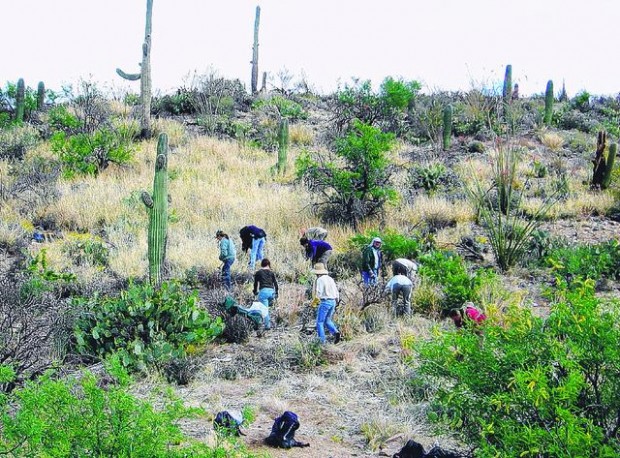
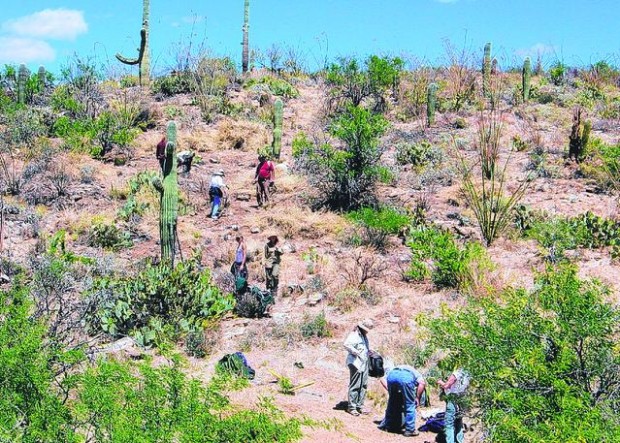
That will require the crew to fan out across the range, using GPS instruments to pinpoint patches or even single plants that were identified during surveys conducted over the winter, he said.
In contrast, crew members will attack dense patches of buffelgrass on Tumamoc Hill, site of the UA Desert Laboratory.
The crew members will spray glyphosate, the active ingredient in the widely available Roundup herbicide, on all buffelgrass they encounter.
The project must be done during the monsoon, when the plant greens up — turns bright green — and can be killed with the herbicide.
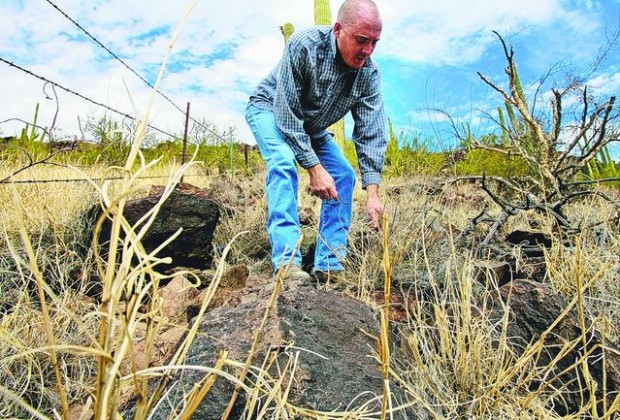
It can be cut or pulled, but that's not enough to stop the plant from coming back, said Bean, who has pulled many plants on Tumamoc.
Manually removing the plant is hard work, he said, and isn't the best way to treat the problem on Tumamoc, because it could cause erosion and harm archeological sites there.
Perry Grissom, a fire ecologist at Saguaro National Park East who has headed up several buffelgrass-control projects at the park, agrees.
It's a tough plant," he said. "Very adaptable. Anytime it gets rain, it's going to grow."
Even after it's removed, it's hard to keep it from coming back after it's pulled.
Buffelgrass is impervious to the herbicide during the 10 months of dormancy, when it turns the color of straw — and becomes the perfect fuel for wildfires.
Fire officials say wildfires burning in buffelgrass can generate heat 800 to 1,200 degrees Fahrenheit — twice as hot as the typical 400- to 700-degree wildfire — and can generate flames up to 20 feet high.
So, Bean said, when it's not choking out native plants, it's creating fuel that can wipe out desert vegetation that has never had to survive wildfire.
"Either it's an overnight thing, an immediate transformation where you boil the saguaros in a fire; or you have this slow choking out of the vegetation," he said.
"One way or the other, we're facing the same possible end of the desert ecosystem," he said.
McClaran said one of the reasons that the UA will undertake the effort on the Experimental Range is that it's one of the places where buffelgrass was introduced into this area in the 1970-1980s, before the U.S. Department of Agriculture handed it over to the UA in 1987.
Potential to spread was unknown
The department's Agricultural Research Service is helping pay for the project, along with the UA College of Agriculture and Life Sciences because both institutions have ongoing research that could be hampered by buffelgrass, he said.
Bean's research suggests many other sources of buffelgrass in the Tucson area. In the Sahuarita-Green Valley area, for example, it was planted on the mountainous mine tailings to revegetate the bare slopes.
It seems to spread along roadways, as evidenced by its heavy presence along I-19, he said.
McClaran said the researchers who introduced buffelgrass intended to help ranchers — and didn't anticipate that it would spread so quickly.
"You have to appreciate that it's a different mind-set now than the time when it was first introduced," he said.
"It was planted as forage, and it wasn't known that it would create a huge fire danger," he said. "Also, it probably wasn't known to spread as quickly and widely as it has.
"My guess is it's doing better than anybody's wildest dream."
To learn more
• For more information about buffelgrass, go to:
http://www.buffelgrass.org, a site hosted by the Pima Association of Governments Environmental Planning Division; or call Dennis Dickerson, PAG environmental-planning coordinator, at 792-1093.
http://www.desertmuseum.org, the Arizona-Sonora Desert Museum; click on the Invaders link on the right side of page.
http://aznps.org, the Arizona Native Plant Society; or call 1-480-510-5511 or send an e-mail to anps@aznps.org.
http://aznps.org/invasives/weedwackers. html, Tucson Weedwackers (volunteer group that works mainly in the Tucson Mountains); or call Doug Siegel, at 877-6000.
http://www.tucsonaz.gov/tcb, Tucson Clean and Beautiful; or call 791-3109.
http://www.rmfire.com/buffelgrass, Rural Metro Fire Department.
You can help
The Sonoran Desert Weedwackers, one of the most active local groups combating buffelgrass, is looking for volunteers to help control buffelgrass in the Tucson Mountains.
The group's get-together will be July 21 at the G4 pullout on Gates Pass Road. Volunteers should meet at 6 a.m. at the caretaker's house across from the Desert Museum, 2021 N. Kinney Road. Hiking boots, sunscreen, water and a hat are strongly recommended.
For more information, contact co-leader Doug Siegel at doug.siegel@pima.gov or call 877-6000.
Volunteer training
Volunteers interested in training for anti-buffelgrass efforts can sign up for any of four sessions to be held next month at the Desert Museum.
An Aug. 4 session is required for anyone interested in follow-up team-leader training sessions to be held Aug. 11 and 25. The sessions are free with a commitment to volunteer in future anti-buffelgrass efforts, organizers said.
For more information or to sign up, contact Katy Goudschaal, with Pima County Natural Resources, Parks and Recreation Department, at 615-7855, Ext. 103, or send an e-mail to her at katy.goudschaal@pima.gov.
Did you know...
The 51,000-acre UA Experimental Range was established in 1903 by the federal government and administered by the U.S. Forest Service until 1987, when the UA College of Agriculture took over administration.
By the numbers
There are 320 buffelgrass patches scattered around the 51,000-acre UA Experimental Range, infesting a total of 40 acres.
Fire officials say wildfires burning in buffelgrass can generate heat 800 to 1,200 degrees Fahrenheit — twice as hot as the typical 400- to 700-degree wildfire — and can generate flames up to 20 feet high.


