

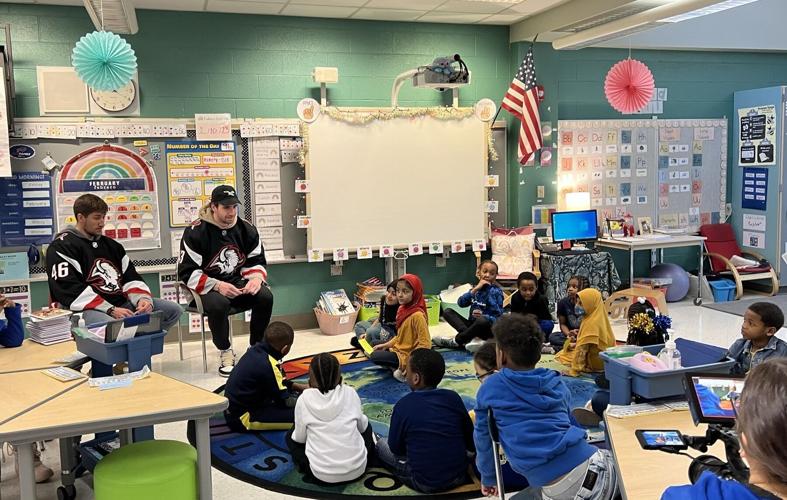
Students in Maria Northrup and Bailey Monin's first-grade class at Stanley Makowski Early Childhood Center looked up – way up – at larger-than-life pro athletes Mattias Samuelsson and Ilya Lyubushkin, two of six Buffalo Sabres to visit the Buffalo school Friday.
There was a collective "ooh" when 6-foot-2 Lyubushkin told the class he was born in Russia, while a particularly inquisitive student asked 6-foor-4 Samuelsson an innocent question: "How did you guys get so good?"
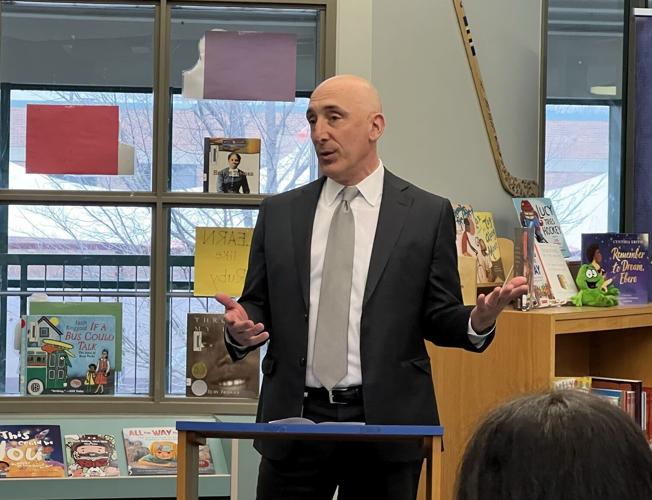
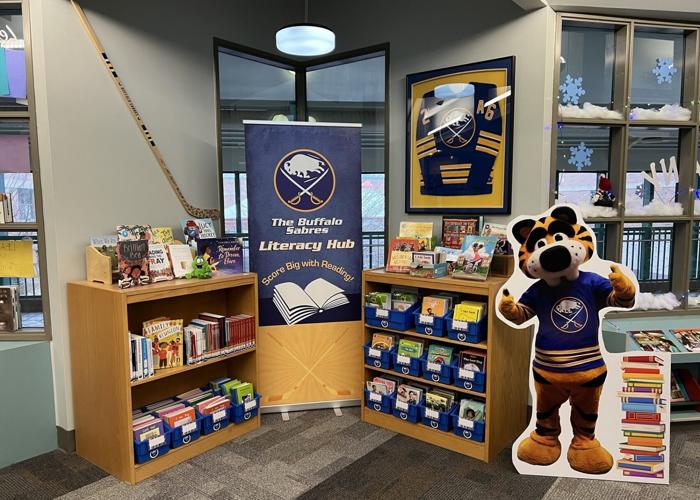
The Buffalo hockey players visited the Jefferson Avenue prekindergarten-fourth-grade school to trumpet a new academic initiative: a special area in the library, called a literacy hub, that houses about 750 "decodable" books for young students and instruction guides for teachers. The materials are united by their fidelity to the science of reading, or a body of research that demonstrates how students learn to read.
People are also reading…
The Sabres Foundation, the team's community outreach arm led by president Rich Jureller, joined the WNY Literacy Initiative's Tarja Parssinen, several leaders from Albany-based Teach My Kid to Read and Buffalo Schools' Chief Academic Officer Anne Botticelli and Board Member Larry Scott to explain the hub's purpose before the post-practice arrival of Samuelsson, Lyubushkin, Jack Quinn, Dylan Cozens, Ukko-Pekka Luukkonen, Eric Comrie and lively mascot Sabretooth.
The literacy hub at Stanley Makowski was funded by a $35,000 donation by the Sabres Foundation, Jureller said, and similar hubs will be implemented in two more yet-to-be-determined schools in the Buffalo area by the end of the 2023. If these hubs prove successful, it's possible more schools could receive these resources, Jureller said.
These resources are part of a larger quest for Buffalo Schools: to prepare students to read fluently by the end of third grade.
Buffalo is training 800 teachers in the Orton-Gillingham methodology, which follows principles supported by the science of reading. By understanding letters and their relation to the sounds they make when spoken – or phonics – students are then able to "decode" full words, increasing in difficulty in a structured process that results in reading mastery.
"A Pig in His Wig," authored by Jill Lauren and illustrated by Darren McKee, was highlighted as one of the most popular books in the hub; even its title reveals the repeated short "i" sound children would learn in the classroom. The hub's decodable books range from pre-reading level to early readers to more advanced.
"You can't really have the science of reading or structured literacy without decodable books to practice," said Marion Waldman, executive director of Teach My Kid to Read. "It's what kids use to become fluent, and eventually you just recognize the words; it's ingrained in your memory."
Teach My Kid to Read was instrumental in connecting Stanley Makowski, its principal Kathleen Sciolino and librarian Charlin Riccio with books written specifically to align with classroom instruction students receive in decoding words. The collection is anchored in the school's library, but teachers are encouraged to bring them into classrooms.
Implementing decodable books into schools is not as simple as accepting a donation, said Laurie Puhn Feinstein, board president of Teach My Kid to Read.
"There's an enormous amount of hours that go into cataloging these books in systems, getting them out into circulations – this is extra work," Feinstein said. Decodable books are picked out intentionally to reflect a school's diversity, not only in cultural backgrounds but in gender and students with disabilities, too, Waldman added. Sciolino, the principal at Stanley Makowski, said she was excited how many books in the collection could be culturally relevant in Black History Month.
Decodable books are not common throughout the state, Teach My Kid to Read representatives said. Some schools may use decodable passages, but "kids want to read books," Waldman explained. "There's too much of a veil over these resources."
Curriculum and training have been at the heart of Buffalo's overhaul for how it teaches students to read. But additions like the literacy hub at Stanley Makowski are a reminder that more opportunities might be needed for students.
"We want them on grade level, we want them decoding and we want them to be successful learners who love reading," Botticelli said. "One of the keys to that initiative is making sure we have the right resources."
Ben Tsujimoto can be reached at btsujimoto@buffnews.com, at (716) 849-6927 or on Twitter at @Tsuj10.


