
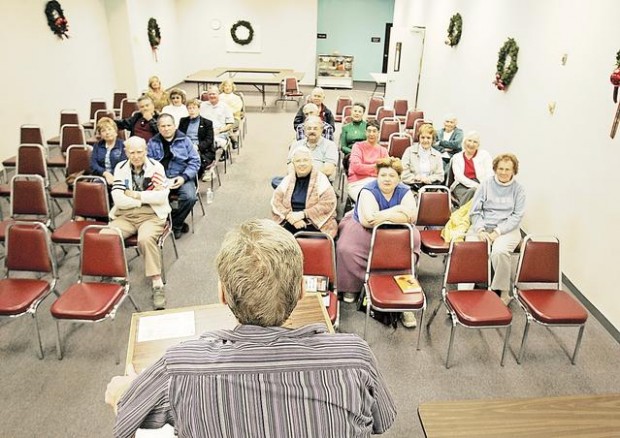

When Lucile Rock heard about Macy's plan to close its doors at El Con Mall, she had more on her mind than where to pick up cosmetics and shoes.
She was worried about the fate of Oasis, a national non-profit group that provides educational opportunities for about 1,300 seniors annually.
For 17 years, seniors have headed to the third floor of the department store for low-cost learning. Macy's has provided 5,400 square feet for six classrooms, several offices and a computer lab. More than 100 classes each semester range from tackling music theory to taking historical walking tours, exploring U.S. drug policy, understanding Islam and becoming proficient in advanced German.
When Rock, a 74-year-old retired administrator, moved from Casa Grande to Tucson seven years ago, she signed up for a short-story class.
"Having been a person busy with my career all my life, I didn't have any hobbies, and retirees soon find they have all this time on their hands," Rock explained. "I found it was a lot of fun to tap into a kind of creativity that one in the business world often doesn't have the opportunity to cultivate."
People are also reading…
Other classes have followed, from yoga to computers to learning to cope with her arthritis-driven chronic pain.
For Acel Scott, a 76-year-old retired secretary, the program has helped serve a social niche, aside from offering mental stimulation. Scott moved to Tucson 12 years ago from Colorado Springs, Colo. "It's been a godsend to me," she said.
"When I moved here, I didn't know anyone other than my son. I think as we get older, it's not as easy to make new friends," Scott added. "It's not like it used to be, when people lived in a small community and had kids in school and met each other that way."
Scott is all set to take a class on anti-Semitism in Ukraine and a travel class on Ireland, as well as moderating a reading-for-pleasure group.
The two women are among the students anxiously awaiting word about what will become of the program.
It's not clear if the program can continue to operate in the space after Macy's closes at the end of February, said Janice Branham, director of communications for the St. Louis-based Oasis Institute. A spokeswoman for Macy's did not return calls seeking comment.
In the short term, classes will continue to be hosted at Macy's through the end of February. After that, classes have been farmed out to spaces around town, from City Councilwoman Nina Trasoff's office to public libraries and churches.
In some ways, Branham said, the move will allow the program to reach more seniors living throughout the larger community instead of remaining centralized at one Midtown location.
What's still missing, however, is administrative office space for use by a few staff members and the nearly 50 regular volunteers who help keep the program going. And the concern is that if the program has to pay for space, it could drive up the reasonable program costs.
One-day sessions generally cost about $4. A seven-session painting program costs $50, while a seven-session tai chi class runs $34 and a six-session computer class is $45.
With Oasis operating in 25 cities across the country, organizers remain committed to staying in Tucson, Branham said.
"It's a really vibrant program," she said, adding that this was one of the first cities to reach the milestone of serving more than 1,000 local students through Oasis' volunteer tutoring program.
Branham said organizers are looking for about 2,500 to 3,000 square feet, although they are open to suggestions.
"The space issue created a big challenge for the organization," said Julia Strange, a spokeswoman for Tucson Medical Center, which is one of the program's major sponsors. She hopes a solution will emerge.
"We believe it is important for seniors to remain active and to be healthy," Strange said. "In that sense, their mission meshes with our mission."
With the erosion of the old stereotype of shuffleboard-playing seniors, more options have opened for senior learning experiences. The University of Arizona, for example, is affiliated with the non-profit OLLI Society, designed for the 50-plus set. Enrollment costs are higher, however, and for someone like Rock, who took classes at the university, the parking was a hassle and expensive, too. "I felt I could take a lot more classes and have more experiences by going to Oasis," she said.
Jean Discorfano, 66, who has taught computer classes for the past five years through Oasis, said she was devastated to hear about the closure. "Not so much for myself, but because I see these people who have no other places to go. In some cases, it's like their lifeline to the outside world," Discorfano said.
Oasis is a place for people to go to find purpose in their transition, she said, keeping them engaged and challenged.
But for now, she's concerned. "We really are between a rock and a hard place."
Did you know . . .
Tucson's first resort was El Conquistador Hotel, which opened on Nov. 22, 1928, on Broadway east of Country Club Road, where part of El Con Mall now sits. Ground was broken in 1959 for Tucson's first shopping mall, El Con, just east of the hotel. Developers said the hotel would be integrated with the mall. Four years later, the hotel closed and was razed.
The site of the soon-to-be-closed Macy's has been home to several stores, including Levy's, Sanger Harris, Foley's and Robinsons-May.
Source: Star archives