


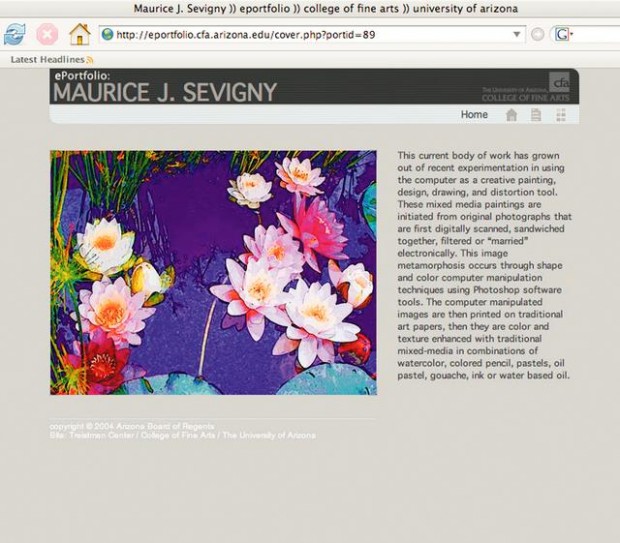
The portfolio — a way of life for art students — is going virtual.
At the University of Arizona, an online program soaring in popularity is allowing students to spend more time creating and organizing their best work, and less time lugging around a case stuffed full of it.
With ePortfolio — a software program developed at the College of Fine Arts — everyone from first-semester freshmen to the dean can post their art online, refining the collection as they progress and putting their art before an audience potentially much larger than they could reach before.
The ePortfolio site went live last spring but first saw widespread use during the fall semester. About 150 students, faculty and staff have ePortfolios, ranging from the visual arts to dance and music. As word spreads among students and in class, the program is expected to grow even faster.
People are also reading…
"It's become a portfolio for the college itself," said Michael Wyman, director of the Treistman Center for New Media, which created ePortfolio. "The group of portfolios helps show all the different things going on at the College of Fine Arts."
Students see the ePortfolio as a means for self-promotion, a way to augment personal Web sites and a way to grab viewers who'd likely never see the work otherwise.
"It can be a great tool for someone who wants an online portfolio but doesn't have any Web experience," said David Blohm, a studio art senior.
Blohm, who started his online portfolio last semester and is working to refine it as he gets ready to graduate in May, said he's enticed by the chance that somebody browsing through will see his work. He's phasing out some earlier illustrations as he concentrates on getting a job in graphic design, and he plans to add a résumé.
Students can interact more with one another, offering critiques and suggestions and even receiving inspiration.
Mike Holcomb, the assistant dean for fine arts technology who helped create ePortfolio, said the college wanted a custom program with a clean, simple presentation that functions as its own gallery that perfectly fits student artwork.
"It's very aware you're housing the work of artists," Holcomb said. "It expands the studio across all these disciplines."
Other online portfolio software programs exist but are typically used for student assessment rather than showcasing work, and they don't work for a broad range of disciplines.
"My ambition is to make it more accessible and encourage all arts disciplines to make use of it," Holcomb said.
With the ability to host sound and video files in addition to images, ePortfolio encourages students from a variety of departments — visual arts, dance, theater, media arts and music. Visual artwork has several modes of display on the site, from thumbnail-sized images to previews and full-scale images. Users can display up to 20 objects, and the ePortfolio will remain after a student has graduated.
With password-protected access for users, students can change or add to their portfolios and turn them on and off whenever they wish, working on them "with the hood up," Holcomb said. Students can post résumés and personal statements, artwork and descriptions, or just a single image
"There's a nice, layered complexity to it," Wyman said. "You can put your toe in the water with it or spend some time and start to tinker with it."
Anybody can browse through the ePortfolio site — eportfolio.cfa.arizona.edu — which is featured prominently on the college's main page.
The college showed ePortfolio at an international new media consortium last year in Honolulu and received a warm reception, Holcomb said. With some modifications, the original software can be used in the admissions process, with potential students submitting work in much the same way students and professors post theirs.
The Treistman Center is working with the university's technology transfer office on potentially marketing the software.
"We're in the business of building the future," Holcomb said. "We may do more with it, but we're sharing it freely on campus."
Master's student Tulley Straub said he was attracted to ePortfolio because it's a way to have online display without building his own Web site, a long-delayed goal. Having lots of work in one place should attract more people browsing through, he said.
"It provides a secondary means of disseminating your information," Straub said. "Ostensibly, you're in an arena you wouldn't be in otherwise and drawing a different cross-section of Internet traffic."
The ePortfolio is plain, simple and without impediments, and as it becomes better known will only be a stronger asset for students, he said.
"You can just get on with the business of showing your work and not labor over it," he said. "It provides a rich display of student assets."
Straub, who is a staunch supporter of traditional media and prefers oil on canvas in his own work, said the digital realm is a good way to display work, far less tedious than creating slides.
"I've never been able to browse such a democratic, multi-tiered array of student work," Straub said.


