

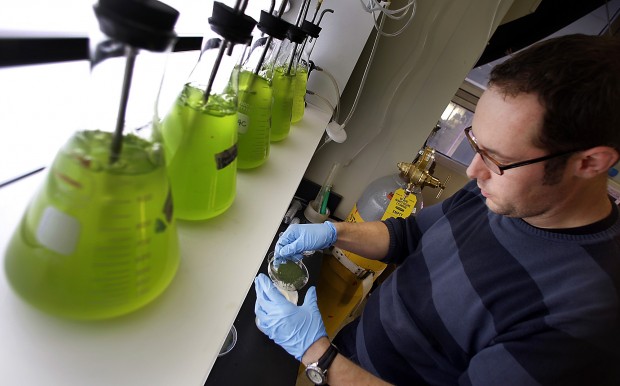

What if you could grow fuel and food while cleaning wastewater and capturing unwanted carbon dioxide?
That's the promise of turning algae into a biofuel and the premise on which the Department of Energy is investing hundreds of millions of research dollars.
You know algae - you've probably grown it inadvertently. It's a stream-clogging, pool-fouling aquatic plant that some scientists have spent careers trying to prevent.
But it has its good points. It removes the carbon from carbon dioxide. It thrives in wastewater and can even clean it up. It produces fatty lipids that can be easily turned into clean-burning biodiesel and other fuels. The leftover green mass can be fed to cattle or burned as fuel.
Scientists think algae will be a big improvement from corn, the most commonly used biofuel. Corn's production for ethanol is highly subsidized and has been criticized because it takes nearly as much energy to produce as it provides.
People are also reading…
You could say the same for algae at present, but University of Arizona researchers hope to change the equation and are participating in a $43 million federal study aimed at solving a variety of problems that have kept algae from being economically turned into a fuel.
The goal, said Michael Cusanovich, regents professor of biochemistry, is $3-a-gallon algae biofuel.
"All of this stuff has been done for some time in small processes," Cusanovich said. "I can do lots of things in the lab. When you put them out in the field, you face some interesting problems."
Kim Ogden, UA chemical and environmental engineering professor, is lead engineer on the three-year grant given to the National Alliance for Advanced Biofuels and Bioproducts and principal investigator for the UA's $3 million share of that federal research money.
Ogden's expertise is in reactors, but she said the program will investigate the entire life-cycle of an algae/biofuel process.
Algae isn't tough to grow, she said, but it takes a lot of water to produce a small amount - a liter contains 2 to 3 grams, she said.
"Dewatering" those batches of algae using traditional methods such as a centrifuge is an energy-expensive process, Ogden said, and any process that uses a lot of energy to produce a fuel is self-defeating.
Solving the problem isn't just about solving that step. Rather than aim for one big breakthrough, the team wants to improve each step of the process and integrate all those steps, Ogden said.
First, you need to find the best possible strain of algae.
Cusanovich, who is concentrating on developing the most productive strain of algae, said his goal is 50 percent lipids - the fats that produce a clean-burning biofuel.
Then, especially in the water-starved Southwest, you need to find ways to cut down on the use of water.
One of algae's attributes is that it thrives in nonpotable water. Cusanovich is among several researchers using partly treated wastewater to grow his varieties of algae.
Joel Cuello, professor of agricultural and biosystems engineering, grows algae in a photo-bioreactor he developed and patented at the research greenhouses on Campbell Avenue. He said Southern Arizona is a great place to grow algae with that one exception. "We have a lot of sunlight and land, but not a lot of water," he said.
Sewage that hasn't been totally treated for waste is one solution. "We consider it waste, but from the point of view of the algae - it's nutrients," he said.
Another of algae's alluring attributes is its ability to capture carbon. It grows better in a CO2-enriched atmosphere, which is why carbon dioxide is bubbling through beakers of green liquid all over campus these days.
One thought is to locate algae farms next to power plants. The Department of Energy recently awarded a $70.5 million grant to Arizona Public Service to do just that at its coal-fired Cholla Power Plant near Holbrook.
How to grow algae is another part of the investigation.
"Racetracks" - ovals of shallow circulating water are one possibility. Kevin Fitzsimmons, professor of soil, water and environmental sciences, spent the early part of his career figuring out how to get rid of algae in the canals of the Salt River Project and the Central Arizona Project.
He now works with algae growers in the Casa Grande area, where algae was originally grown as feed for fish and shrimp but is increasingly looked at as a product itself.
Years of scientifically controlling algae blooms created the expertise to make them happen, he said.
"We can get it to work when we want it to in raceway systems," he said. "Getting the target algae to bloom without getting other things, that's the biological question I'll be involved with."
Work at the UA might identify the best methods for growing algae in the Southwest, Ogden said, while university researchers and industrial partners devise solutions for different locations.
There are many questions, Ogden said, and they require expertise from a variety of areas.
The goal is to develop a "cradle to grave" system that not only solves the engineering problems but makes use of every byproduct and deals with waste created, she said.
"We're doing a life-cycle analysis. How much energy does it take? Does the whole thing work?"
Ogden expects the research will be productive enough to merit renewal when this three-year study is done and it's time to "scale-up" the bench-top studies into working algae farms.
"I think we'll be there," she said.
Contact reporter Tom Beal at 573-4158 or tbeal@azstarnet.com


