

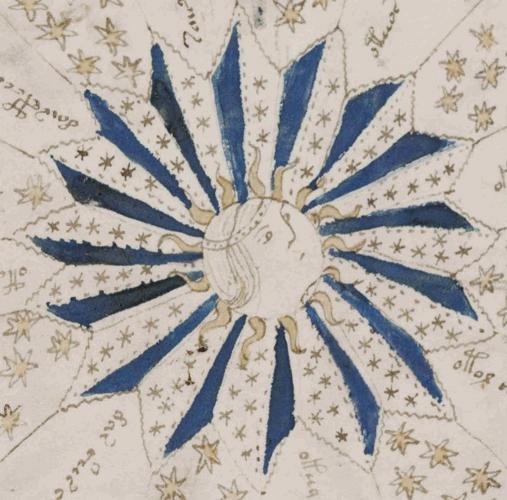
It's still unknown who wrote it and what it means, but a UA-led team has solved one mystery of the "Voynich manuscript" - its age.
Through radiocarbon dating, a team led by University of Arizona physicist Greg Hodgins determined the manuscript dates to the early 15th century, 100 years earlier than previously thought.
The manuscript - often referred to as "the book nobody can read" due to its indecipherable coding - has been a mystery since its rediscovery in Italy at the turn of the 19th century.
The manuscript has more than 150,000 distinct symbols, with 20 to 30 repeated in a way that suggests an alphabet.
The book has been much-studied, but no one has been able to crack its code for 300 years - even Wilfrid Michael Voynich, who devoted his life to the mystery.
The UA group used radiocarbon dating to determine the book's age. The process relies on carbon-14, a naturally occurring but unstable form of carbon that reaches Earth's surface in carbon dioxide from the upper atmosphere.
People are also reading…
Traces are found in living plants and animals because plants make their tissues from carbon dioxide. Animals eat plants or other plant-eating animals, making carbon-14 present in their tissues, too.
The carbon-14 remaining in plants and animals decreases predictably after death, allowing scientists to calculate how much time has passed.
The manuscript's pages are made of animal material, making them good subjects for the process.
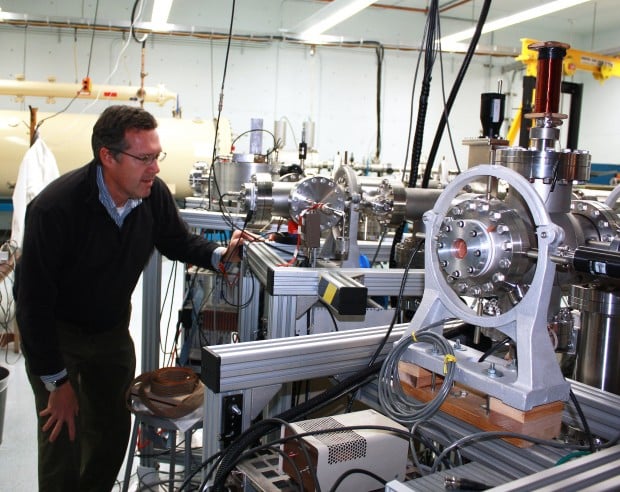
Hodgins and his team used a machine called a mass spectrometer to measure carbon-14 in four pages from the book.
The machine works by extracting solid carbon into a beam, like a beam of light.
It splits the beam into its components by passing it through a magnetic field, like white light splitting into colors when passed through a prism.
Carbon-14 is heavier than other isotopes, so the machine isolates it, allowing scientists to determine how much is left compared with the other isotopes. That measurement and the known decay rate of carbon-14 is used to calculate age.
The four pages all yielded similar answers about age.
Earlier work conducted by Joseph Barabe with the book's illustrations reinforced Hodgins' conclusion. Barabe, a senior research microscopist and director of scientific imaging at McCrone Associates Inc., analyzed the book's pigments.
Barabe said his findings are consistent with an early 15th-century book.
"Sometimes we find materials that will lead us to conclude something is not as old as people thought, but that wasn't the case here," he said. "Everything seems appropriate to (the 15th century), so from the point of view of authenticity, it was pleasing to see that things looked appropriately old."
The UA discovery helps rule out one hypothesis about the book: that it was a hoax, created soon before Voynich rediscovered it at a book sale in 1912.
Radiocarbon dating also helps rule out other theories about its author. With an early 15th-century date, researchers know it couldn't have been penned by Leonardo da Vinci or other late Renaissance authors, as some had speculated.
Dating aside, Hodgins said he finds the book fascinating, especially the research to decipher its unusual text.
"If you think it's a known language that's encoded, then the question is: What is the code?" he asked. "It then becomes an interesting question about codes and ciphers. Does it fall into what's known? Or is it something completely outside of that?"
The discovery has garnered international attention for the UA team, with news coverage from outlets such as Fox, Discovery and CBS, as well as European media.
Hodgins was surprised by all the attention, but he's enjoying being part of the long-sought answer. He was recently invited to speak at a cryptography conference.
"There's a huge range of explanations for what (the text) might mean," he said. "The many drawings it contains suggest portions of it deal with botany, medicine, possibly anatomy, and also astronomy and astrology.
"Attempts to solve its meaning have involved people from many disciplines, and I think that's part of the appeal of it. There are challenges to a whole range of disciplines - linguistics, cryptanalytics, obviously, and so far, its meaning has eluded everyone."
It's believed that the book had various owners in the past, but its rediscovery by Voynich, an antique dealer, gave it its name.
After Voynich's death in 1930, the book eventually fell into the possession of Beinecke Rare Book & Manuscript Library at Yale University, which continues to hold on to it.
The UA Accelerator Mass Spectrometry lab has hosted other high-profile projects, some controversial. The lab dated the Dead Sea Scrolls at 200 B.C. to A.D. 100, and the Shroud of Turin at A.D. 1260 to A.D. 1390.
THE VOYNICH TEXT
• The manuscript is a 240-page handwritten book with pages made of mammal skin.
• It's had several owners, but it was named after Wilfrid Michael Voynich, who rediscovered it at the turn of the 19th century.
• The book is now part of the Beinecke Rare Book and Manuscript Library at Yale University.
• Through radiocarbon dating, UA researchers determined the book is from the early 1400s.
• The book's author - as well as the meaning of its unreadable text - is still unknown.
Victoria Blute is a NASA Space Grant Intern. E-mail her at vblute@azstarnet.com


