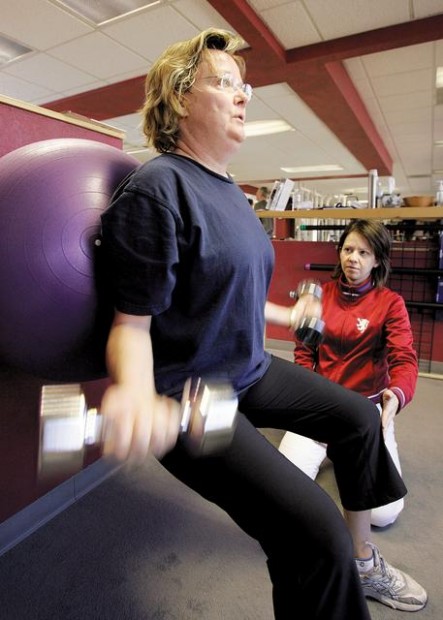
It's nearly four months before the official start of the shorts-and-swimsuits season.
You have a little disposable income in your pocket and want to hire a trainer to tone those abs and shape those thighs.
But where to start?
Jana Beutler Holland, with SWAT — Strength Wellness Athletic Training, with locations on the Northwest and East sides, and Rick Friedman of Foothills-based Select Fitness, have suggestions for choosing a qualified personal trainer.
First, say both, a qualified professional will perform a fitness assessment on a client and discuss the client's goals.
The purpose of the initial assessment, Holland said, is "to set the client up for greatest success. For some people just to get in the door to exercise is an accomplishment."
People are also reading…
Clients should know their limitations, Friedman said.
"People should walk in with realistic expectations and trainers should be realistic in what they can do," he said.
Cathy Whalen, a 43-year-old mother, trains twice a week at SWAT. Training sessions at SWAT run from $10 for small-group sessions to $75 for one-on-one training. At Select Fitness individual training sessions are $55.
With personal trainers, Whalen said, "You get their undivided attention. They're right there with you … for the whole hour. That way they can demonstrate how to do each exercise and each technique. You get the feedback right there and the education you get talking to someone as you go along."
Certification not everything
Education, certification and professional affiliations are important to ask trainers about because the field is not government-regulated. A college degree in a fitness field is good, said Holland and Friedman, as is certification by a national agency, such as the American Council on Exercise, the National Strength and Conditioning Association or the American College of Sports Medicine.
However, Friedman said, potential clients should consider more than certification when interviewing a trainer.
"What I tell everybody … is, certifications are really worth the paper they are written on," Friedman said. "Anybody can get certification."
Experience is as significant as education, both trainers said.
Professional affiliations are also important, Holland said.
"When you meet a personal trainer, I'd want to know, as a client, if they are … part of an organization that has professional affiliations — a standard they hold their trainers to that has a good reputation and has resources in terms of networking. They should be a part of a network of professional physicians, dietitians, physical therapists and other fitness and medical professionals," she said.
Measuring results
How a trainer measures results is important, too. Some trainers get paid based on how much weight the client loses, but a client's goal might be different. That is why communication between a trainer and client is so important, Holland and Freidman said.
"It's not so much what questions people ask me, it's what the trainer asks you," Freidman said. "How interested is the trainer in what your goals are?"
If a trainer "is doing more talking than listening, then I would really wonder if that was the right trainer for me," Holland said. "It should not be about what the trainer can do, what the trainer can accomplish, and what the trainer can offer. It's finding out what the client wants, getting to the root of the problem and what they can to do meet individual goals."
With a personal trainer, Friedman said, clients "get a program designed specifically for them — the proper amount of weights, the proper amount of repetitions, their form is checked, they get motivation, they get accountability … they get an ever-changing routine, they get constant feedback."
Choosing a personal trainer
Trainer Jana Beutler Holland, with SWAT — Strength Wellness Athletic Training — suggests people ask the following questions when interviewing trainers:
● Do they have certification?
● What is their education and fitness background?
● What is their experience with special-needs clients?
● What is their specialty?
● Why did they become a personal trainer?
● Do they have insurance?
● To which professional organizations do they belong?
● How do they measure progress?
● What industry magazines do they read?
Rick Friedman of Select Fitness also asks:
● What is their philosophy on health and fitness?
● What is their cancellation policy?
● What are their references?