

Let's continue our time travel journey through the history of the Catalina Foothills and the Tanque Verde Valley. Last week we covered formation and early history.
Ranches and homesteads A.D. 1868
In the late 1850s you watched people beginning to reach out from Tucson toward the north and east to make their living on the open lands of the foothills and valleys. You saw the Tanque Verde Valley (named for large water holes containing green algae) settled by Mexicans, Anglos and Chinese who started farms and cattle ranches.
At the same time you noted a ranch on Sabino Creek, just a mile south of Sabino Canyon. In 1868 well-known Tucson land holder and cattleman Emilio Carrillo founds the Tanque Verde Ranch, along Tanque Verde Creek at the far eastern end of the valley. Settlers establish Agua Caliente Ranch at the spring, along Agua Caliente Creek, in 1875.
People are also reading…
You can see that these major creeks flow year-round. Grasslands are plentiful. A large mesquite forest covers the southeastern Tanque Verde Valley. Cattle roam over expansive areas, even in the foothills. As you will see, these conditions will not last much longer.
In the early 1900s, you will note that William and Maria Watson start developing a 172-acre homestead in the foothills at Pima Canyon. At the same time you will observe a cattle ranch, the Flying V, established at Ventana Canyon.
Between 1890 and 1920 you will see the mesquite forest cut down to provide fuel for residents of the growing city of Tucson. In 1930 Jane Wentworth will build a 640-acre stock-raising homestead on that deforested property. Her only neighbors will be thousands of saguaro cacti.
Apache Wars A.D. 1873
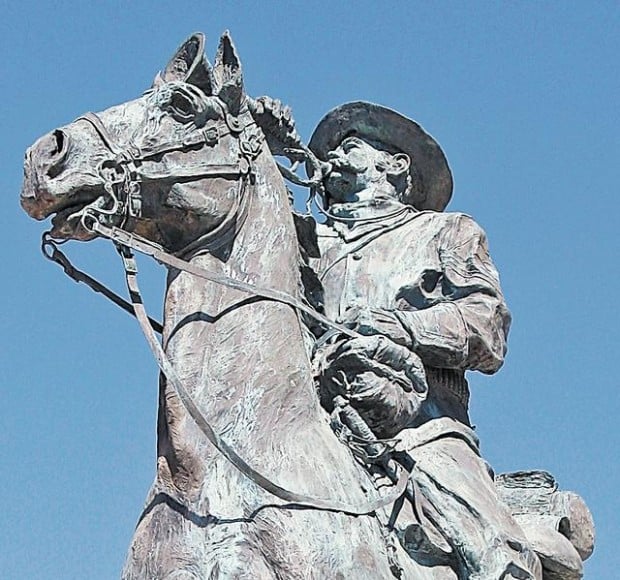
In the frontier period, Apaches continue to be a problem. The U.S. Army builds Fort Lowell east of Tucson. From 1873 to 1891, the Army escorts wagon trains, protects settlers and conducts offensive operations against the Apache.
Troopers use Soldier Camp in the Santa Catalinas for intermittent campaigns against the Apache. The Army also establishes a camp at Agua Caliente Spring, part of a protective barrier for Tucson.
The Arizona Indian war will end with the final surrender of Geronimo in 1886 and the deportation of remaining Apaches to Florida.
Transcontinental railroad A.D. 1880
In 1880 you notice a big hubbub in Tucson, the celebration of the completion of the transcontinental railroad through the Old Pueblo.
The railroad will help increase trade with the rest of the world and bring in heavier equipment for industry, construction and mining.
Trains also will bring in thousands of new permanent residents as well as tourists attracted by the fabulous winter weather and the prospect of a Western frontier experience.
By the way, if you have maps of Tucson in your time machine, you may note that around 1880, the Spanish-named Santa Catarina Mountains mysteriously become our familiar Santa Catalina Mountains. History does not provide a satisfactory explanation for this change.
Two of the first people to arrive in Tucson by train are botanist John Gill Lemmon and his wife Sara Allen Plummer Lemmon — on their honeymoon. In 1880 they climb the Catalinas' highest peak and name it Mount Lemmon in honor of the new bride, who is the first woman to climb the peak.
Mining A.D. 1880
You've noticed prospectors searching for gold and silver in the Santa Catalina Mountains. Starting in the late 1860s, gold seekers worked placer deposits on Cañada del Oro Creek, four to 10 miles southwest of the town of Oracle.
Prospectors will return to this site time and again for more than 100 years, but only small amounts of gold will be found.
Mineral seekers will locate a handful of claims on the Tucson side of the mountains, but none will make any money. Gold fever will even strike in Upper Sabino Canyon in 1892, but it lasts only briefly as prospectors find little of the precious metal.
Starting in the late 1870s, you've seen most of the mining action occur on the north slope of the Catalinas, on Oracle Ridge.
Here miners located and worked several gold and silver claims with some success, but these mines largely become inactive after the mid-1880s.
Until the completion of a dirt road from Oracle to the mines (continuing nearly to the top of Mount Lemmon) in 1920, this area will remain largely inaccessible.
Prospectors will make sporadic attempts to locate and work new claims over the years, but the only mildly successful activity is copper mining that will last intermittently until 1968.
Guest ranches and resorts A.D. 1881
Beginning in the early 1880s, you notice a new phenomenon — guest ranches and resorts. In 1881 Fuller's Hot Springs and Resort opens at Agua Caliente Spring. The next year Sunstone Guest Ranch opens just a few miles to the southwest.
Starting in 1908, the Tanque Verde Ranch will invite tourists to participate in roundups, a tradition that continues today.
"Dude" ranches are emerging in the Catalina Foothills. The Flying V Ranch will evolve from the working cattle ranch in the 1920s. By the 1940s, the large Watson homestead at Pima Canyon will become Westward Look Resort. In 1948 Hacienda del Sol guest ranch will be born from the previous property, a college preparatory school for young women.
You will see Tucson successfully change its marketing approach from a sanitarium for the sick — to recuperate from arthritis, bronchitis and tuberculosis — to a tourist attraction for the healthy.
Canyon Ranch spa will open in 1979. The ultimate expressions of these tourist attractions will be the Foothills' Loews Ventana Canyon resort opening in 1984 (with its Flying V Bar and Grill) and the Westin La Paloma Resort & Spa opening in 1986. Both of these fabulous resorts will offer championship golf courses to visitors.
Next week: Access to natural recreation areas
Sources: Odie B. Faulk, "Arizona, A Short History"; C.L. Sonnichsen: "Tucson, The Life and Times of an American City"; John P. Wilson: "Islands in the Desert, A History of the Uplands of Southeastern Arizona"; Arizona Historical Society.
About this series
This is the second in a five-part series on the history of the Catalina Foothills and the Tanque Verde Valley. Author Bob Ring has spent years collecting facts about the area. This series pulls together those tidbits along with information yielded from three months of intensive research.
Part 1: Formation and early history
Today, Part 2: Exploration and initial settlement
Part 3: Access to natural recreation areas
Part 4: Development of the Catalina Foothills
Part 5: Development of the Tanque Verde Valley


