

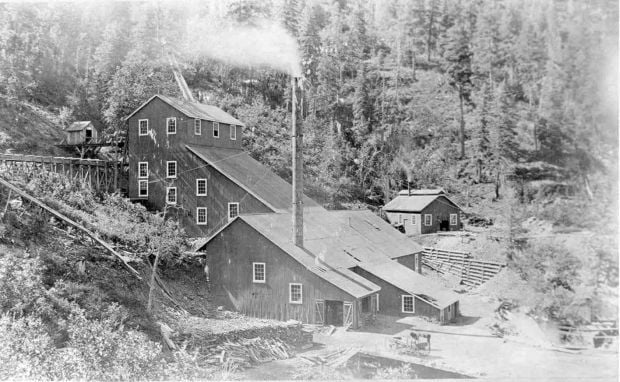
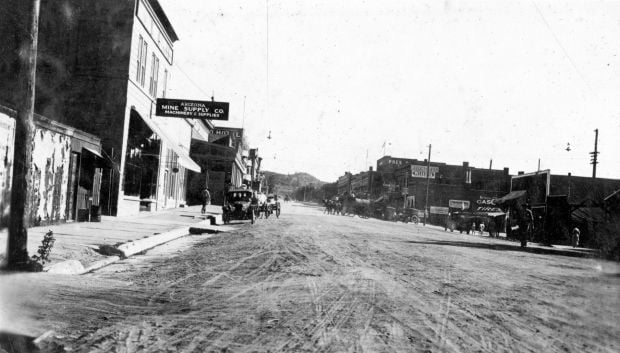
Multiple mining operations in and around the Bradshaw Mountains, combined with innovative methods of ore processing, made Central Arizona a top producer of gold and silver in the late 19th and early 20th centuries.
Prescott, the seat of Yavapai County and territorial capital of Arizona from 1864 to 1867 and from 1877 to 1889, financed and supplied the mines in the Bradshaw Mountains, which encompassed over 24,000 valid mining claims by 1893.
Established in 1875, the Tip Top Mine produced $2 million in silver by 1890. Until declining silver prices caused its closure, it was known for its gunfights and alcohol. One Tip Top resident miner, bitten by a centipede, overindulged his pain with a quart of whiskey and died, succumbing to either the venom or the pain killer. Named after Daniel B. Gillett, superintendent of the Tip Top Mine, the milling town of Gillett was on the left bank of the Agua Fria River.
People are also reading…
Vigilante justice was doled out on a jailed prisoner in Gillett in 1878 when an armed mob murdered the sheriff, then executed the prisoner by hanging him from a tree. The local blacksmith served a dual role as a stagecoach robber along the Black Canyon highway until apprehended by a Wells Fargo detective.
Transportation on the peripheral of the Bradshaw Mountains included a 110-mile wagon trial. Despite its narrow features, the trail was used extensively by freight companies transporting ore to the numerous mines in the area.
The Senator Highway, extending 41 miles, journeyed southward from Prescott to the top of the Bradshaw Mountains. Building began in 1866 with the Prescott & Lynx Creek toll road, whose fares included $1.50 per wagon and 25 cents per horse and rider. Further funding from Prescott merchants in 1878 extended the road to Alexandra, 32 miles south of Prescott.
The Senator Mine began with a claim made in 1864 by members of the Walker party. Apache raids hindered its development until 1872, when Samuel Fredericks added a 10-stamp mill along with steam hoists to his operation. Phelps Dodge improved the property in the 1890s with four mills, increasing production and size of the camp to several hundred. From 1883 to 1899, $500,000 in gold was extracted. James S. Douglas, son of metallurgist and Phelps Dodge President Dr. James Douglas, gained his early mining experience here prior to his discovery of the United Verde Extension Mine at Jerome.
Nine miles southeast of Prescott, the town of Poland, named for Davis R. Poland from Tennessee, saw its prime in 1902 with a population exceeding 800. A 1,100-foot tunnel was excavated through the mountain, connecting to the town of Walker and enabling mule-drawn ore cars from that community to connect to the railroad at Poland junction. Three quarters of a million dollars of silver was extracted from the Poland vein by 1912.
Innovative practices of ore processing in the Bradshaw Mountains included the Washoe process also known as pan amalgamation perfected on the Comstock Lode in Nevada in the 1860s. A popular process that dominated silver milling from the 1860s until the turn of the century, it involved the treating of silver ores with copper sulphate, mercury and salt in grinding pans or tubs for a silver recovery of 80 percent.
Another innovation, involving the cyanide process, was a discovery made by three inventors in Scotland, including chemist John S. MacArthur, along with medical doctors William Forrest and Robert W. Forrest. It involved a team of assayers, a chemist and a metallurgist who perfected the process of separating gold or silver from ores by using a weak solution of sodium cyanide. The practice proved invaluable to the Bradshaw Mountains mining operations.
Sources:
Waldemar Lindgren, “Ore Deposits of the Jerome and Bradshaw Mountains Quadrangles,” U.S. Geological Survey Bulletin 782
James E. Sherman and Barbara H. Sherman, “Ghost Towns of Arizona,” Norman, University of Oklahoma Press
Robert L. Spude and Stanley W. Paher, “Central Arizona Ghost Towns,” Nevada Publications
Bruce M. Wilson, “Crown King and the Southern Bradshaws: A Complete History,” Crown King Press
Otis E. Young, “Western Mining: an informal account of precious-metals prospecting, placering, lode mining, and milling on the American Frontier from Spanish Times to 1893,” University of Oklahoma Press.


