

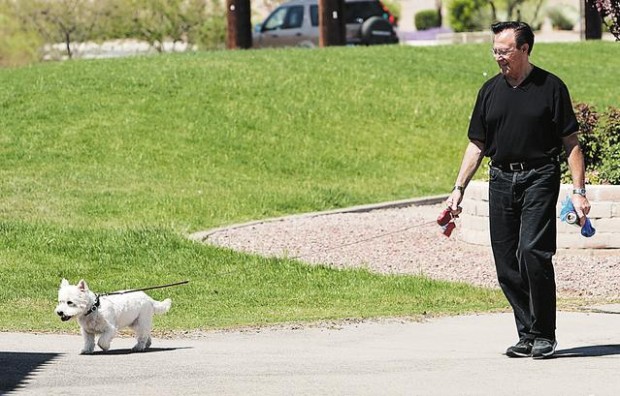
The town of Marana wants to tighten the leash on dog owners by closing loopholes in its animal-control provisions.
Town prosecutor Jane Fairall said the language in the town's leashing ordinance has made the law nearly impossible to enforce. If people challenged a citation they received for having dogs "at large" — neither confined by an enclosure nor restrained by a leash — she had no choice but to drop the charges against them.
The problem stemmed from the fact that Marana's town code listed the violation as a civil infraction, but Arizona law states that having a dog at large in certain situations is a criminal offense.
Arizona law prohibits vicious dogs, female dogs in their breeding season and dogs in rabies quarantine from being at large. It also requires dogs in public parks or on public school properties to be on leashes. A violation of those provisions is a Class 2 misdemeanor.
People are also reading…
"In my opinion, it was not enforceable because it was in violation of the state statute," Fairall said. "A municipality can have ordinances that are more restrictive, but it can't have one that's less restrictive."
She and Town Attorney Frank Cassidy modified the language of the ordinance so it would coincide with Arizona law. Cassidy said the Marana Town Council will discuss the ordinance in a study session June 13.
The minimum penalty for having a dog at large anywhere within the town limits will remain the same under the town's new provision — $25 for the first conviction within a 12-month period. But the maximum fine would more than double, from $300 under the existing provision to $750 under the new one.
Fairall said she could remember only a handful of cases that had to be dismissed because of the town's existing leash law.
"Although it's been something that I've wanted to get fixed, it hasn't been something that's been a constant problem," Fairall said.
Oro Valley also considers the violation a civil infraction, but Marana's neighbor has no intention of changing its town code, said Oro Valley's town prosecutor, Tobin Sidles.
Sidles said that Oro Valley has had no problems enforcing its leash law.
Marana also will add significant detail to its vaccination and licensing ordinances.
"Our existing ordinance is pretty vague," Cassidy said.
Cassidy and Fairall rewrote the vaccination and licensing ordinances to eliminate the ambiguity.
While the current town code states only that the town ordinance is in addition to any U.S., state or county provisions, the new town ordinance includes detailed information about what levels of vaccination and licensing are required.
"The ordinance that we have now, it doesn't really say anything," Fairall said. "It doesn't have prohibited conduct or any penalties."
The new provision states that it's unlawful to have a dog older than 3 months that hasn't been vaccinated for certain diseases such as rabies, or does not have a license.
The fine for violations would be $150, but that fee can be waived if the owner shows the court proof of vaccination or licensing within 15 workdays after the complaint has been issued.
At the request of the county, the town might add an ordinance that would prohibit the transfer or sale of animals on public property or rights of way, such as street corners and roadsides.
Kim Janes, the director of the Pima Animal Care Center, said the county is trying to get all jurisdictions in the area to adopt ordinances that would deter people from getting an animal on a whim and then abandoning it when they realize the scope of the responsibility.
"Animals aren't cheap," Janes said. "You've got to make sure they're vaccinated — especially with rabies, because that's the law."
When people pick up animals off the side of the road, they have no idea what sort of vaccinations or medical treatment the pets have had, Janes said.
Transferring animals on public lands also can increase the risk of spreading communicable diseases, Janes said.
"This is mostly a proactive thing on the account of the (Pima County) board," Janes said.
The ordinance would have no effect on the transfer of animals on private property, Janes said.
Current ordinance
● Leashing: Under Marana's current ordinance, it's a civil infraction for an individual to have a dog "at large" — one that's neither confined by an enclosure nor physically restrained by a leash. A conviction brings a minimum fine of $25 and a maximum of $300.
● Licensing and vaccination: Marana's current ordinance includes no specific information about the town's vaccination and licensing requirements other than to say they are in addition to any U.S. laws, state laws or county laws.
New ordinance
● Leashing: The new ordinance makes having a dog "at large" a Class 2 misdemeanor, which is a criminal offense. A conviction brings a minimum fine of $25 and a maximum of $750.
● Licensing and vaccination: The new ordinance requires a dog older than 3 months to be vaccinated for diseases such as rabies and to have a proper license. A conviction brings a fine of $150, but that fee would be waived if the owner shows the court proof of vaccination or licensing within 15 workdays after the complaint has been issued.


