

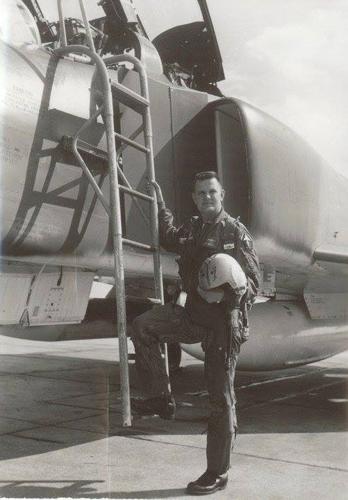
Maj. Thomas Storey roared off in his Air Force Phantom jet on a photo reconnaissance mission over North Vietnam. It was his 34th mission in the increasingly intense Vietnam War.
This time, fate was not on his side. Sometime after an hour in the air, “the whole world came unglued,” Storey recalled.
North Vietnamese enemy troops unleashed a barrage of anti-aircraft artillery toward Storey’s plane with such force and density that he likened it to “a waterfall in reverse.” Three shells struck and damaged the RF-4C’s underside. Flames penetrated the back of the two-seat aircraft, forcing Storey’s crewmate, 1st Lt. Ron Mastin, to eject. Minutes later, with the plane’s navigation controls inoperable, Storey also bailed out.
As his parachute drifted to earth, Storey looked down and saw his right leg dangling, seemingly out of place. Landing on a mountaintop, he immediately felt severe pain from back and leg injuries sustained while ejecting from the plane. Dazed and exhausted, he fell unconscious.
People are also reading…
When Storey awoke, he was able to hold out for several days before being captured by the North Vietnamese. He had no idea that he would have to endure 2,239 dark days — more than six years — of torture and misery as a prisoner of war. That he was able to survive and return home stands as a testament to his courage, resiliency and, most importantly, faith.
Not all of Storey’s buddies from his Air Force unit would make it home. Some were killed by enemy artillery over North Vietnam or perished as POWs. Over the years at ex-POW gatherings and on Memorial Day, Storey and other veterans have remembered and honored those Americans who died in Vietnam and in other wars.
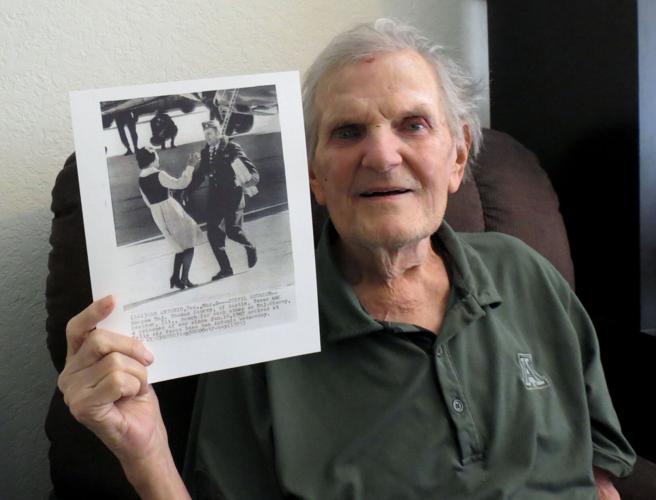
Now, the 93-year-old Storey, who has lived in Tucson for 25 years, resides in a local assisted-living home. He retired from the military in 1986 with the rank of lieutenant colonel. Many details about the past have been lost for Storey in the fog of time. But the day his plane was shot down, the day of his capture and the day of his release are seared in his memory.
Ambition to become a pilot
Thomas Gordon Storey knew he wanted to be a military pilot from an early age. He was raised by a farming family in Galesburg, Ill. His family worshipped in the Disciples of Christ church, and young Tom grew to be a man of deep faith. After graduating from Western Illinois University, he joined the Air Force and underwent pilot training in the mid-1950s. After that, Storey joined the Illinois Air National Guard and taught electrical engineering at Millikan University in Decatur, Ill.
Storey was called to active duty for the U.S. showdown with the Soviet Union during the 1962 Cuban missile crisis. After the crisis ended without warfare, he stayed on active duty. He was assigned to a base in England before his unit, the 432nd Tactical Reconnaissance Wing, was sent to Vietnam war duty in October 1966, operating from Udorn AFB in Thailand. Storey’s wife, Sylvia, daughter Pamela, then 9, and son Kurt, 3, stayed in England.
Controversy about the Vietnam War boiled in the United States from its beginning. President John F. Kennedy first sent advisers to aid the South Vietnam government from attacks from Communist-ruled North Vietnam. Advisers to Kennedy and President Lydon B. Johnson argued that South Vietnam was “a domino,” and if it fell into Communist hands, other nearby nations would go Communist with the military assistance of China and the Soviet Union. As the attacks from North Vietnam and from the South Vietnam-based Viet Cong escalated, Washington escalated its role with more troops and weapons. And debate and opposition to the war also shot up.
Flying into danger, unarmed
Storey was 34 when he took off at 4 p.m. on Jan. 16, 1967, to photograph a Vietnamese railyard north of Hanoi. Like his previous assignments, he and Mastin were tasked with bringing back high-quality photographs for commanders to study for potential bombing raids. Instead of weapons, the supersonic jet carried powerful cameras. Without defensive weapons, pilot Storey would have to fly exceptionally fast and low to avoid radar and enemy fire, said his son, retired Navy Capt. Kurt Storey, in an interview.
Air Force pilots were required to complete 100 missions over North Vietnam to be able to return to stateside duty. Storey was a third of the way there when he and “backseater” Mastin flew into enemy airspace. Unfortunately for Storey and Mastin, the Vietnamese had lined the Red River Valley with antiaircraft weapons and surface-to-air missiles supplied by China and the Soviet Union. In addition, Storey said a pause in bombing had enabled enemy troops to restock and relocate weapons.
Storey described his capture in a 2020 talk at Davis-Monthan to members of the 354th Fighter Squadron. Capt. Kurt Storey also provided details of his father’s days as a POW in interviews for this account.
Writhing in pain, shot in jaw
The North Vietnamese had spotted Storey’s landing spot and started climbing a mountain to go after him. Storey, meanwhile, writhed in pain from his injuries. He used his survival radio to call for a U.S. rescue search team, but he was told that would not be possible at his location.
A pack of dogs tracked Storey down, and an enemy soldier shot him as Storey destroyed his radio. The bullet entered and exited his jaw. He was captured and forced to crawl down the mountain, and he walked and was carried about 15 miles to the nearest road. Along the route, he was beaten when village elders encouraged young men to strike and berate the wounded American. Surprisingly, a female elder chased away would-be tormentors and tended to his wounds and provided something for him to eat.
When Storey’s capturers and the pilot arrived at a prison called Dogpatch by POWs, he was thrown into a tiny, filthy cell containing a bucket for a toilet. That began the harshest period of his long confinement. For about two years, he was held there in solitary confinement with small meals of rice and fish scraps. No treatment was provided for his injuries or bullet wound. Instead, he was regularly tortured when he refused to sign a letter that would criticize the U.S. war effort and speak glowingly about the “peace-loving” North Vietnamese. He only provided his name, rank and serial number in accordance with the U.S. military code of conduct.
Storey was blindfolded when he moved to another prison, and he still did not see another American for another year. Finally, he was put in a two-man cell with John W. Clark, a pilot who had been captured about two months after Storey. “What a glorious day,” Storey wrote in a book, “The Eagle Hunts,” authored by Clark. They talked endlessly about their prison and life experiences and everything that came to mind. “We went through the hell of torture, malnutrition, disease and depression, but we had each other,” Storey wrote.
Clark, who retired as an Air Force colonel, credits Storey, whom he affectionately calls “Uncle Tom,” for helping to restore his faith. He described Storey as a “man with deep faith and love for family and country.”
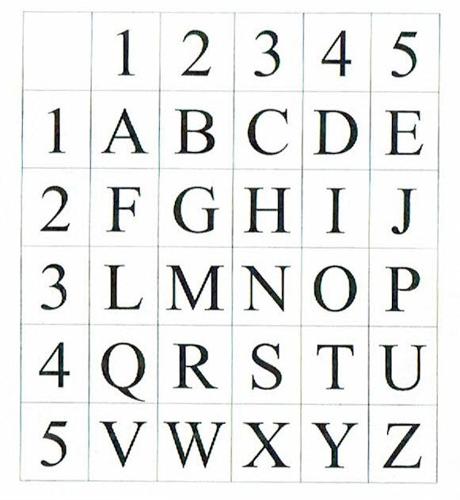
Clark wrote about an ingenious system of communication that lifted the Americans’ spirits. One day, alone in his cell, Clark heard tapping coming from his cement wall. Once he understood what the tapping meant – the number of taps designated a letter in the alphabet — he was able to communicate with his American “neighbor” in the next cell. The tapping was introduced to others across the prison and, in time, the system was widespread. The code helped tremendously in keeping the POWs mentally sharp and united, Storey recalled.
Was he dead or alive?
For three years, Storey’s wife and two children had no knowledge of whether their husband/father was dead or alive. The Air Force listed him as MIA — missing in action. Mrs. Storey kept an optimistic view. “Mom always kept us positive and upbeat about Dad,” daughter Pam recalled. “We understood he was gone, and what he was experiencing, and we leaned heavily on our church family during the darkest times.”
The Air Force moved the family from England to Austin, Tex., a few months after Storey was captured. Mrs. Storey wanted to be close to Randolph AFB in San Antonio. Personnel at the base passed along any new information to families about their MIA loved ones.
Finally, in 1970, “Mom was informed that Dad’s name had been reported on a ‘list’ from a source in North Vietnam” that he was a POW, Pam said.
U.S. raids an empty prison
In October of 1970, Storey and other prisoners at Son Tay prison were blindfolded and moved to a new Hanoi location known as the “Power Plant” due to its location near a large plant.
On the night of Nov. 21, 1970, the United States mounted a massive raid on Son Tay; Green Beret troops scrambled out of helicopters and killed scores of North Vietnamese guards. They called out for American POWs, but there was no response. With the POWs having been moved, the prison was empty.
The Hanoi government, shaken that the United States was capable of such surprise attacks, began to offer better conditions for the POWs, Storey said. Instead of small cells, the Americans were held in large cells that held 50 to 60 men in what the POWs sarcastically called “The Hanoi Hilton.” Hanoi considered the POWs “bargaining chips” in any negotiations and wanted their prisoners to be in better condition.
Storey was at the “Hilton” for the last two years of his internment. Among others in the same cell was John McCain, the late Arizona senator, whose plane had been shot down in October of 1966 and who endured severe torture.
During the later part of Storey’s confinement, the Hanoi leaders allowed the Americans to write postcards or short letters to families. Storey picked out a postcard with a picture of two roses. He wrote nine words to his wife:
Two roses.
Two hearts.
So close.
So far apart.
President Richard Nixon sent Secretary of State Henry Kissinger to conduct peace talks with North Vietnam. When the talks reached a deadlock in late 1972, Nixon ordered continuous B-52 bombing attacks starting Dec. 14, which became known as the “Christmas bombings.” Storey remembers he and other prisoners cheering the action, intended to bring the negotiations to an end. In fact, that strategy worked, and a peace agreement was initialed on Jan. 23, 1973. The Paris Peace Accords document was signed on Jan. 27. Storey and his fellow POWs soon were lined up in prison courtyards across North Vietnam and told they were going home.
Operation Homecoming
Six years, two months and several days after his capture, Storey boarded a C-130 on March 4, 1973, for what would be the happiest flight of his life. The now-former POWs burst into yelling and cheering as their plane flew out of North Vietnamese airspace. His flight was one of several that took 591 Americans to Clark AFB in the Philippines for hearty meals, real beds and pillows and medical exams. Storey was elated to learn that Ron Mastin, his crew member on that fateful flight, was among the returnees. The men next stopped in Hawaii and flew on to the mainland.
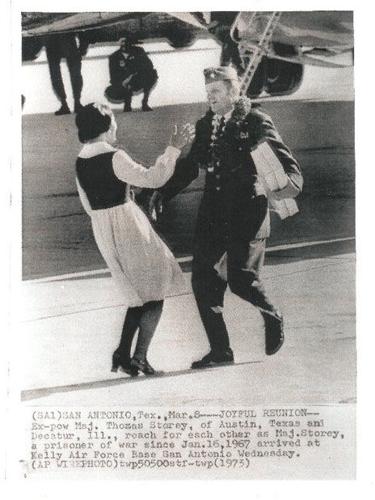
An overjoyed family awaited Thomas Storey’s return on May 8, 1973. His wife stood at the tarmac at Kelly AFB in San Antonio. She ran to greet her husband when he deplaned, carrying a bouquet of flowers in his arms. It was a glorious moment for them.
A reunion with Pam, now 16, and Kurt, 9, followed. The Air Force granted Storey’s request to be assigned to the Air Force Academy. Storey went on to serve as deputy commandant of cadets. Not only did he talk to cadets about flying in wartime but also about the most important lesson he could offer — the “Fabulous Five” of faith, family, friends, future and freedom. He spoke to audiences around the country on the same topic.
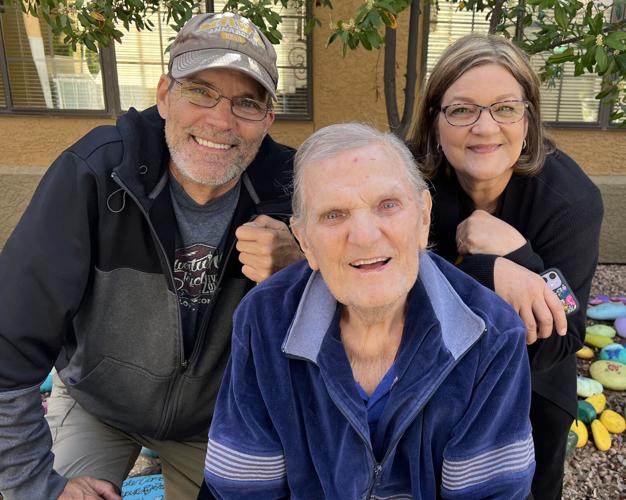
After two subsequent decades in Japan, Storey and Sylvia decided to settle in Tucson to enjoy the sunshine and to be close to daughter Pam Morrow, a librarian in the Flowing Wells School District, and her two children. They also visited regularly with son Kurt and his two daughters. Storey now has three great-grandchildren.
They landed on a house a block from Tucson National Golf Course and spent many mornings enjoying a round of golf. Sylvia died in 2019. Storey’s health has deteriorated slowly for the last three years since he turned 90. Yet, he keeps up with current events and greets family and guests with a wide smile and sparkling blue eyes.
Without his loving wife of 64 years at his side, Thomas G. Storey can again look and her photo and remember:
Two hearts.
So close.
So far apart.


