WASHINGTON — A year after being lauded for its plan to replace thousands of aging, gas-powered mail trucks with a mostly electric fleet, the U.S. Postal Service faces congressional attempts to strip billions in federal EV funding.
In June, the Senate parliamentarian blocked a Republican proposal in a major tax-and-spending bill to sell off the agency's new electric vehicles and infrastructure and revoke remaining federal money. Still, efforts to halt the fleet's shift to clean energy continue in the name of cost savings.
Donald Maston, president of the National Rural Letter Carriers' Association, said canceling the program now would have the opposite effect, squandering millions of dollars.
"I think it would be shortsighted for Congress to now suddenly decide they're going to try to go backwards and take the money away for the EVs or stop that process because that's just going to be a bunch of money on infrastructure that's been wasted," he said.
People are also reading…
Beyond that, many in the scientific community fear the government could pass on an opportunity to reduce carbon emissions that contribute to global warming when urgent action is needed.

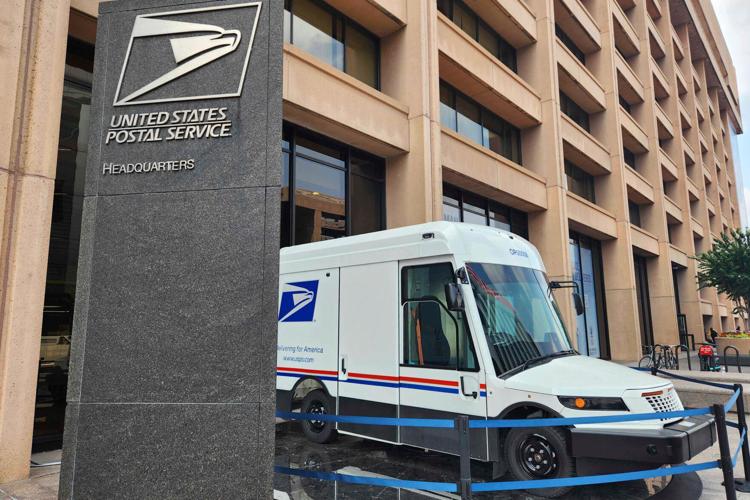
One of the U.S. Postal Service's new zero-emission electric Next Generation Delivery Vehicles is displayed Aug. 7 in front of the organization's headquarters in Washington.
Electrified vehicles reduce emissions
A 2022 University of Michigan study found the new electric postal vehicles could cut total greenhouse gas emissions by up to 20 million tons over the predicted, cumulative 20-year lifetime of the trucks.
That's a fraction of the more than 6,000 million metric tons emitted annually in the United States, said professor Gregory A. Keoleian, co-director of the university's Center for Sustainable Systems. Still, he said the push toward electric vehicles is critical and needs to accelerate, given the intensifying impacts of climate change.
"We're already falling short of goals for reducing emissions," he said.
Many GOP lawmakers share President Donald Trump's criticism of the Biden-era green energy push and say the Postal Service should stick to delivering mail.

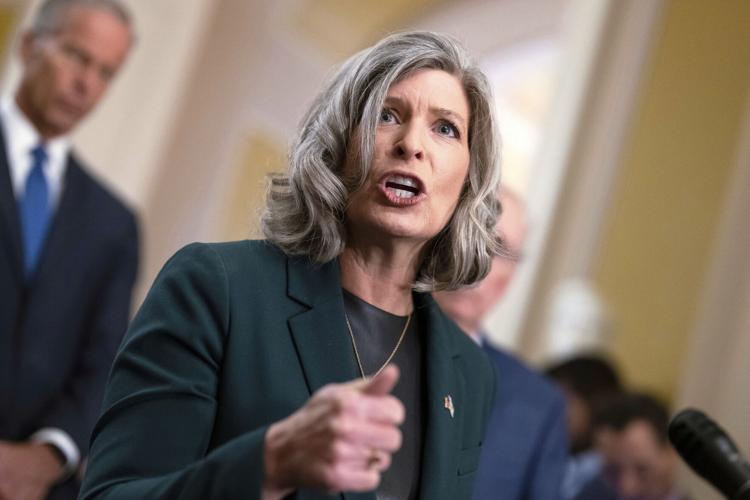
Sen. Joni Ernst, R-Iowa, speak to reporters Sept. 24 at the Capitol in Washington after a closed-door meeting with fellow Republicans.
Sen. Joni Ernst, R-Iowa, said "it didn't make sense for the Postal Service to invest so heavily in an all-electric force" — an initiative she called "a textbook example of waste," citing delays, high costs and concerns over cold-weather performance.
She said she will pursue legislation to rescind what is left of the $3 billion from the Inflation Reduction Act allocated to help cover the $10 billion cost of new postal vehicles.
During a recent appearance at the Iowa State Fair, she noted "the rate at which the company that's providing those vehicles is able to produce them, they are so far behind schedule, they will never be able to fulfill that contract," referring to Wisconsin-based Oshkosh Defense.
"For now," she added, "gas-powered vehicles — use some ethanol in them — I think is wonderful." Corn-based ethanol is a boon to Iowa's farmers.
Rep. Michael Cloud, R-Texas, a co-sponsor of the rollback effort, said the EV order should be canceled because the project "delivered nothing but delays, defective trucks, and skyrocketing costs."
The Postal Service maintains that the production delay of the Next Generation Delivery Vehicles, or NGDVs, was "very modest" and not unexpected.
"The production quantity ramp-up was planned for and intended to be very gradual in the early months to allow time for potential modest production or supplier issues to be successfully resolved," spokesperson Kim Frum said.

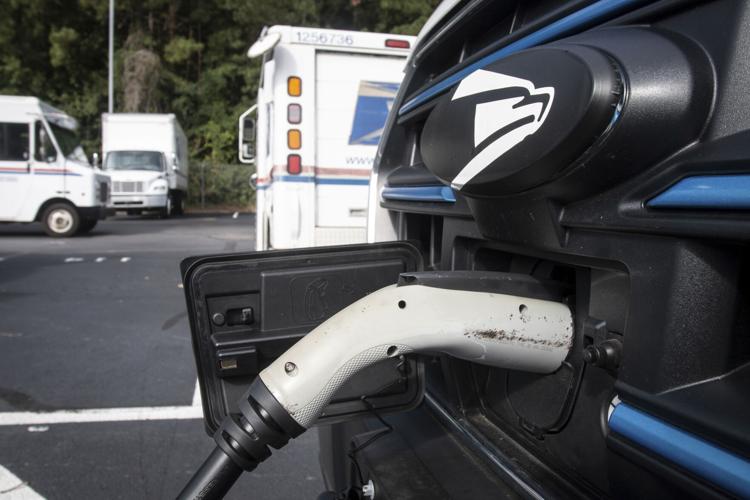
Mail delivery vehicles are charged Sept. 5 at a post office in Athens, Ga.
EVs help in modernization effort
The independent federal agency, which is paid for mostly by postage and product sales, is in the middle of a $40 billion, 10-year modernization and financial stabilization plan. The EV effort had the full backing of Democratic President Joe Biden, who pledged to move toward an all-electric federal fleet of car and trucks.
The "Deliver for America" plan calls for modernizing the ground fleet, notably the Grumman Long Life Vehicle, which dates back to 1987 and is fuel-inefficient at 9 mpg. The vehicles are well past their projected 24-year lifespan and are prone to breakdowns and even fires.
The Postal Service announced in 2022 it would deploy at least 66,000 electric vehicles by 2028, including commercial off-the-shelf models, after years of deliberation and criticism it was moving too slowly to reduce emissions. By 2024, the agency was awarded a Presidential Sustainability Award for its efforts to electrify the largest fleet in the federal government.
In 2021, Oshkosh Defense was awarded a contract for up to 165,000 battery electric and internal combustion engine Next Generation vehicles over 10 years.
The first of the odd-looking trucks, with hoods resembling a duck's bill, began service in Georgia last year. Designed for greater package capacity, the trucks are equipped with airbags, blind-spot monitoring, collision sensors, 360-degree cameras and antilock brakes.
There's also a new creature comfort: air conditioning.
The agency so far ordered 51,500 NGDVs, including 35,000 battery-powered vehicles. To date, it received 300 battery vehicles and 1,000 gas-powered ones.
Former Postmaster General Louis DeJoy said in 2022 the agency expected to purchase chiefly zero-emissions delivery vehicles by 2026. It still needs some internal combustion engine vehicles that travel longer distances.
Frum, the Postal Service spokesperson, said the planned NGDV purchases were "carefully considered from a business perspective" and will be deployed to routes and facilities where they will save money. The agency also received more than 8,200 of 9,250 Ford E-Transit electric vehicles it ordered, she said.
Ernst said it's fine for the Postal Service to use EVs already purchased.
The most and least hospitable states for electric vehicle ownership
The most and least hospitable states for electric vehicle ownership

The number of people purchasing and using electric vehicles in the United States reached record levels in 2024, thanks to a combination of federal, state, and local incentives and growing awareness about the impact of greenhouse gases on climate change. However, recent moves by the Trump administration to curb incentives to buy EVs, such as tax credits, pause federal fleets' adoption of EVs, and implement tariffs on EV parts is threatening continued growth.
EVs occupied approximately 8.6% of the new vehicle retail market in the country in 2023, according to consumer research firm J.D. Power. The firm projects that number to plateau at about 9.1% in 2025. While California continues to hold the top spot for EV adoption, the largest growth was recorded in New York, Florida, and Colorado.
Stacker analyzed data from the Department of Energy and the nonprofit Tax Foundation to determine which states are the most hospitable for EV owners.
Scores were determined by calculating the number of charging stations per EV, excluding plug-in hybrids (30% of the overall score), the number of laws and incentives for owning an EV (10%), and the annual in-state cost of owning an EV—including yearly registration fees minus the maximum tax credits offered.
Data on registration and charging stations is accurate as of April 2025.
Three types of EVs are available in the American market: battery EVs, powered solely by electricity from rechargeable battery packs; plug-in hybrid EVs, which, along with batteries, also have an internal combustion engine to supplement electric power for longer ranges; and fuel cell EVs, which convert compressed hydrogen gas into electricity.
Widespread EV adoption benefits the environment, the average consumer, and the nation's energy independence. EVs produce lower emissions, are more efficient, and have better fuel economy than their gas-powered counterparts. EVs can cost more off the lot, but consumers typically pay less for using them than they would for nonelectric vehicles.
Electricity in the U.S. is produced by a diversified mix of sources, including natural gas, wind energy, coal, nuclear energy, hydropower, and solar energy. Therefore, the widespread adoption of EVs will make the U.S. consumer automobile market less susceptible to shocks in the global fuel market.
However, the growing adoption of EVs has hurt states in unintended ways. It has decreased their revenues from gas taxes and caused lost money in tax credits. States have adopted or are considering policies to increase fees associated with using EVs to recover some of the lost revenue. Vermont, notably, is evaluating a miles-traveled fee to regain some of the lost funds.
You may also like: The outsourcing of housework is on the rise—and it's creating a shift both inside of the home and out

Urban areas with additional clean vehicle tax credits are the most friendly for EVs

Nebraska, Louisiana, Iowa, and Arkansas have regulations that make it difficult for car manufacturers to sell EVs directly to consumers. Electric vehicle manufacturers like Tesla rely on a direct-to-consumer sales model that excludes dealers as the go-between, saving consumers' and manufacturers' expenses. Prohibitions on direct sales make purchasing EVs difficult for consumers, especially by making the process more expensive than direct purchases.
By contrast, California, New Jersey, Connecticut, and Oregon score as some of the most EV-friendly states in the country. These states also have high urbanization rates, with California at 94.2% urbanization, New Jersey at 93.8%, Connecticut at 86.3%, and Oregon at 80.5%.
EVs tend to be popular in big cities and urban areas that tend to have denser charging networks, shorter commute times, and local EV adoption and use incentives.
However, rural areas' lower population density disincentivizes companies from building extensive charging networks as in urban areas. The insufficient EV infrastructure has been a critical barrier to EV adoption in the rural parts of the U.S.
States with large swaths of rural areas make up some of the least EV-friendly states. Some of the lowest EV-friendly scores in the nation belong to South Dakota with 57.2% urbanization, Nebraska with 73%, Louisiana with 71.5%, Iowa with 63.2%, and Arkansas with 55.5%.
Residents of rural areas also take on longer commutes and travel more often than their urban counterparts, contributing to consumer anxiety about vehicle range and the need to make stops for charging.
California, New Jersey, Oklahoma, Connecticut, and Oregon are the top five EV-friendly states in the U.S. In addition to the $7,500 tax credit available for EV buyers in all states, these states offer additional EV tax credits ranging from $4,000 to $7,500. They also have high numbers of registered EVs.
The top five least EV-friendly states, South Dakota, Nebraska, Louisiana, Iowa, and Arkansas, have no additional EV tax credits, few EV charging stations per vehicle, and few registered EVs.
Story editing by Shannon Luders-Manuel. Additional editing by Kelly Glass. Copy editing by Tim Bruns and Kristen Wegrzyn.