WASHINGTON — Long before the bobbleheads and the “Fauci ouchie,” Dr. Anthony Fauci was a straight-shooter about scary diseases — and “stick with the science” remains his mantra.
Fauci steps down from a five-decade career in public service at the end of the month, one shaped by the HIV pandemic early on and the COVID-19 pandemic at the end.
In an interview with The Associated Press, Fauci said he leaves excited by the prospect of advances such as next-generation coronavirus vaccines — but worried that misinformation and outright lies mark a “profoundly dangerous” time for public health and science.
“Untruths abound and we almost normalize untruths,” Fauci said. “I worry about my own field of health, but I also worry about the country.”
Fauci, who turns 82 on Christmas Eve, has been a physician-scientist at the National Institute of Allergy and Infectious Diseases for 54 years, and its director for 38 of them.
People are also reading…

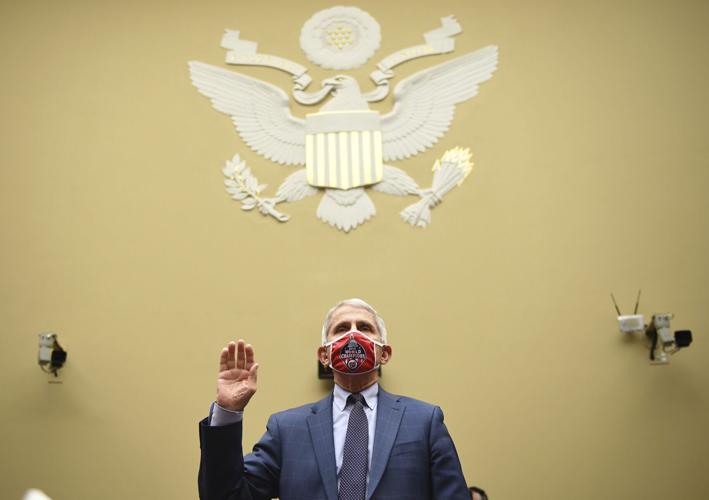
Dr. Anthony Fauci, director of the National Institute for Allergy and Infectious Diseases, is sworn in before a House Subcommittee on the Coronavirus crisis hearing on July 31, 2020, on Capitol Hill in Washington.
Because he candidly puts complex science into plain English, Fauci has advised seven presidents, from Ronald Reagan to Joe Biden, about a long list of outbreaks — HIV, Ebola, Zika, bird flu, pandemic flu, even the 2001 anthrax attacks.
“Stick with the science and never be afraid to tell somebody something that is the truth — but it’s an inconvenient truth in which there might be the possibility of the messenger getting shot,” Fauci said. “You don’t worry about that. You just keep telling the truth.”
He added, with characteristic understatement: “That’s served me really quite well with one exception that, you know, the truth generated a lot of hostility towards me in one administration.”
For all his prior influence on national and even global responses to infectious diseases, it wasn’t until COVID-19 paralyzed the world in early 2020 that Fauci became a household name — giving the latest updates at daily White House press conferences and in frequent media interviews.
But eventually, Fauci found himself having to contradict then-President Donald Trump’s attempts to downplay the severity of the viral threat and promote unproven treatments. Trump and his allies began attacking Fauci, who even received death threats that required a security detail for his protection.

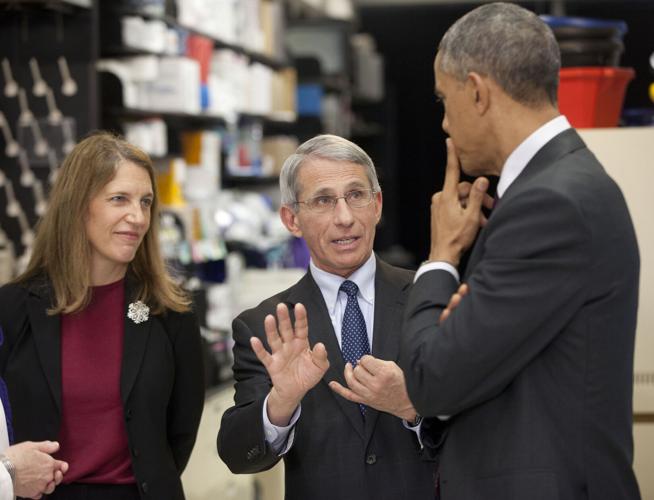
Dr. Anthony Fauci, center, director of NIH's National Institute of Allergy and Infectious Diseases, talks with President Barack Obama, right, as Sylvia Mathews Burwell, left, Secretary of Health & Human Services, looks on during a tour of the Vaccine Research Center at the National Institutes of Health, Dec. 2, 2014 in Bethesda, Md.
As the world enters another year of COVID-19, Fauci still is a frequent target of the far right — but also remains a trusted voice for millions of Americans.
Under his watch, researchers at the National Institutes of Health laid the scientific groundwork for the speedy development of powerful coronavirus vaccines. An analysis released by the Commonwealth Fund last week found the shots saved 3.2 million lives in the U.S. alone and prevented 18.5 million hospitalizations.
With another winter uptick underway, Fauci’s disappointed that just 14% of people eligible for the updated COVID-19 boosters — shots that add protection against omicron strains — have gotten one.
“That doesn’t make any sense at all, when you have a vaccine that you know is life-saving,” he said. But he's also looking forward to next-generation vaccines that do a better job of preventing infection, citing promising leads like nasal vaccines.
Fauci has had a hand in life-saving scientific advances for decades. As a young researcher at the National Institutes of Health, he helped develop highly effective therapies for rare but once-fatal blood vessel diseases known as vasculitis syndromes.

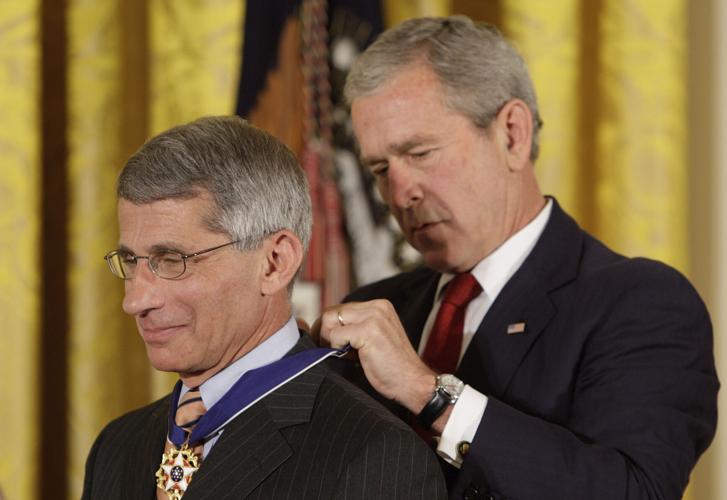
resident Bush places the Presidential Medal of Freedom on Dr. Anthony S. Fauci, director of the National Institute of Allergy and Infectious Diseases, as he takes part in a ceremony for the 2008 recipients of the Presidential Medal of Freedom on June 19, 2008, in the East Room of the White House.
Then came the AIDS crisis and days that Fauci, treating patients in NIH’s hospital, recalled as “very dark and very difficult.”
“As a physician you’re trained to heal people. And we weren’t healing anybody. Everybody was dying in front of us.”
Fauci created an AIDS division that, together with drug companies and universities, led research into drugs that eventually transformed HIV into a manageable chronic disease. Later, under President George W. Bush, Fauci helped develop PEPFAR, the President’s Emergency Plan for AIDS Relief, to bring those HIV medications to poor countries. The program is credited with saving more than 20 million lives over the past 20 years.
But it took years to get even the first anti-AIDS medications — and in the late 1980s and early ’90s, furious activists protested what they saw as government indifference. Fauci brought the activists to the table, making it standard practice for patient advocates to have a voice in government decisions about drug research.

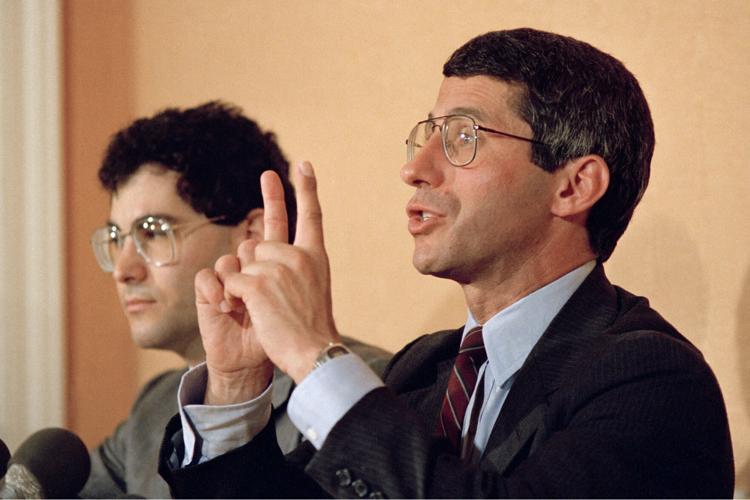
Dr. Anthony S. Fauci of the National Institute of Health, tells reporters that the first human trial in this country of an experimental vaccine to prevent AIDS, should begin in October, during an Aug. 18, 1987, news conference in Washington.
Unfortunately, he said, that experience can’t help bridge today’s political divisions that are hurting public health.
The AIDS activists “were theatrical. They were iconoclastic. They were provocative. They were confrontational, all of the above. But the fundamental core message that they had was a correct message,” Fauci said. “That is enormously different from what is going on right now with COVID, where untruths abound, conspiracy theories abound, distortions of reality abound.”
Despite that kind of rancor, Fauci is excited about recent scientific progress against a list of other scourges such as work toward vaccines for malaria, tuberculosis and maybe one day HIV. That’s why even though he’s leaving the government, Fauci says he’s not retiring.
“I’m going to continue to lecture and to write and to try and encourage and inspire people to go into science, medicine and public health,” he said. “There are a lot of things that are unfinished business and they will be finished sometime because science is going to do it.”
Photos: Dr. Fauci through the years

Dr. Anthony Fauci, director of the National Institute of Allergy and Infectious Diseases at the National Institute of Health, testifies during a hearing on Capitol Hill Iin Washington in this April 4, 2003, file photo. Weeks before President Bush announced a plan in June 2002 to protect African babies from AIDS, top U.S. health officials were warned that research on a key drug was flawed and may have underreported thousands of severe reactions including deaths, government documents show. (AP Photo/Gerald Herbert, File)

Dr. Anthony Fauci, a pioneering AIDS researcher and scientific leader, speaks at the 2003 Ellis Island Family Heritage Awards ceremony held on Ellis Island, N.J., Thursday, April 10, 2003. He was one of five recipients who can trace their family roots through Ellis Island were chosen for their contributions to the American experience. (AP Photo / Stuart Ramson)

Anthony Fauci, left, director of the U.S. National Institute of Allergy and Infectious Diseases, speaks near Swiss Giuseppe Pantaleo, right, chairman of the AIDS Vaccine 04 conference and professor at Lausanne University Hospital, CHUV, during a press conference after the opening of the AIDS Vaccine 04 conference in Lausanne, Switzerland, Monday, Aug. 30, 2004. (AP Photo/Keystone, Laurent Gillieron)

Actress Ashley Judd, who is also global ambassador for YouthAIDS, an organization dedicated to educating and protecting young people from HIV/AIDS, talks with Dr. Anthony Fauci, director of the National Institute of Allergy and Infectious Diseases at the National Institutes of Health, prior to giving their testimony before the Senate Foreign Relations Committee on Capitol Hill, Thursday, June 23, 2005. (AP Photo/Susan Walsh)

Dr. Anthony Fauci, director, National Institute of Allergy and Infectious Diseases, National Institute of Health, center, flanked by Dr. James LeDuc, director, Division of Viral and Rickettsial Diseases, National Center for Infectious Diseases, Centers for Disease Control and Prevention, left, and Dr. Bruce Gellin, director, National Vaccine Planning Office, Department of Health and Humans Services, testifies on Capitol Hill, Thursday, June 30, 2005, before the House Government Reform Committee hearing on "The Next Flu Pandemic: Evaluating U.S. Readiness." (AP Photo/Lauren Victoria Burke)

Dr. Anthony Fauci, director of The National Institute of Allergy and Infectious Diseases testifies on Capitol Hill in Washington, Thursday, Oct. 16, 2014, before the The House Energy and Commerce Committee's subcommittee on Oversight and Investigations hearing to examine the government's response to contain the disease and whether America's hospitals and health care workers are adequately prepared for Ebola patients. (AP Photo/Pablo Martinez Monsivais)

Patient Nina Pham is hugged by Dr. Anthony Fauci, director of the National Institute of Allergy and Infectious Diseases, outside of National Institutes of Health (NIH) in Bethesda, Md., Friday, Oct. 24, 2014. Pham, the first nurse diagnosed with Ebola after treating an infected man at a Dallas hospital is free of the virus. The 26-year-old Pham arrived last week at the NIH Clinical Center. She had been flown there from Texas Health Presbyterian Hospital Dallas. (AP Photo/Pablo Martinez Monsivais)

Dr. Anthony Fauci, Director, National Institute of Allergy and Infectious Diseases, National Institutes of Health, testifies before the House Energy and Commerce subcommittee hearing looking into the effectiveness of vaccines in the wake of a measles outbreak and the exceptionally severe flu season, on Capitol Hill in Washington, Tuesday, February 3, 2015. (AP Photo/Molly Riley)

Dr. Anthony Fauci, director of the National Institute of Allergy and Infectious Diseases, speaks at the Economic Club of Washington on various topics including the Zika virus, Friday, Jan. 29, 2016, in Washington. (AP Photo/Alex Brandon)

From left, CDC Director Tom Frieden, NIH National Institute of Allergy and Infectious Diseases Director Anthony Fauci, and USAID Assistant Administrator for Global Health Ariel Pablos-Mendez, take a break on Capitol Hill in Washington, Wednesday, Feb. 10, 2016, from giving their testimony before the House Foreign Affairs, Africa, Global Health, Global Human Rights, and International Organizations Subcommittee and Western Hemisphere subcommittee joint hearing on: 'The Global Zika Epidemic.' (AP Photo/Susan Walsh)

Dr. Anthony Fauci, director of NIH/NIAID, right, and Dr. Anne Schuchat, Principal Deputy Director of the CDC, participate in a briefing in the Brady Press Briefing Room of the White House in Washington, Monday, Feb. 8, 2016. (AP Photo/Pablo Martinez Monsivais)

President Barack Obama speaks during a briefing on the ongoing response to the Zika virus with members of his public health team, Friday, July 1, 2016, in the Oval Office of the White House in Washington. Joining Obama are Director of the Centers for Disease Control and Prevention Dr. Tom Frieden, center, and Director of NIH/NIAID Dr. Anthony Fauci, right. (AP Photo/Pablo Martinez Monsivais)

Dr. Anthony Fauci, director of the National Institute for Allergy and Infectious Diseases, works at his desk in his office at the National Institutes of Health, Tuesday, Dec. 19, 2017, in Bethesda, Md. (AP Photo/Carolyn Kaster)

Dr. Anthony Fauci, head of the National Institute of Allergy and Infectious Diseases, talks to reporters before the start of a closed all-senators briefing on the coronavirus on Capitol Hill in Washington, Friday, Jan. 24, 2020. (AP Photo/Susan Walsh)

National Institute for Allergy and Infectious Diseases Director Dr. Anthony Fauci arrives to testify before a House Commerce subcommittee on Capitol Hill in Washington, Wednesday, Feb. 26, 2020, during a hearing on the budget and coronavirus. (AP Photo/Susan Walsh)

Anthony Fauci, director of the National Institute of Allergy and Infectious Diseases, takes a phone call outside a room on Capitol Hill where he and others from the president's coronavirus task force briefed members of the House of Representatives on the outbreak of the new respiratory virus sweeping the globe, in Washington, Friday, Feb. 28, 2020. (AP Photo/J. Scott Applewhite)

National Institute for Allergy and Infectious Diseases Director Dr. Anthony Fauci, left, accompanied by President Donald Trump, speaks about the coronavirus during a news conference in the press briefing room at the White House, Saturday, Feb. 29, 2020, in Washington. (AP Photo/Andrew Harnik)

National Institute for Allergy and Infectious Diseases Director Dr. Anthony Fauci closes his eyes as he appears before a Senate Health, Education, Labor and Pensions Committee hearing on the coronavirus on Capitol Hill, Tuesday, March 3, 2020, in Washington. (AP Photo/Andrew Harnik)

National Institute for Allergy and Infectious Diseases director Dr. Anthony Fauci, left, speaks with President Donald Trump at the National Institutes of Health, Tuesday, March 3, 2020, in Bethesda, Md. (AP Photo/Evan Vucci)

Dr. Anthony Fauci, Director of the National Institute of Allergy and Infectious Diseases at the National Institutes of Health, speaks in the briefing room of the White House in Washington, Monday, March, 9, 2020, about the coronavirus outbreak as Health and Human Services Secretary Alex Azar, Dr. Robert Redfield, director of the Centers for Disease Control and Prevention, U.S. Surgeon General Jerome Adams, Vice President Mike Pence, and Dr. Deborah Birx, White House coronavirus response coordinator, listen. (AP Photo/Carolyn Kaster)

Dr. Anthony Fauci, director of the National Institute of Allergy and Infectious Diseases, arrives to testify before a House Oversight Committee hearing on preparedness for and response to the coronavirus outbreak on Capitol Hill in Washington, Wednesday, March 11, 2020. (AP Photo/Patrick Semansky)

Dr. Anthony Fauci, director of the National Institute of Allergy and Infectious Diseases, center, listens during a news conference about the coronavirus in the Rose Garden of the White House, Friday, March 13, 2020, in Washington. (AP Photo/Evan Vucci)

Dr. Anthony Fauci, director of the National Institute of Allergy and Infectious Diseases, speaks during a press briefing with the coronavirus task force, in the Brady press briefing room at the White House, Monday, March 16, 2020, in Washington, as President Donald Trump and U.S. Surgeon General Jerome Adams listen. (AP Photo/Evan Vucci)

Dr. Anthony Fauci, left, director of the National Institute of Allergy and Infectious Diseases, walks past President Donald Trump after answering a question during a coronavirus task force briefing in the Rose Garden of the White House, Sunday, March 29, 2020, in Washington. (AP Photo/Patrick Semansky)

Dr. Anthony Fauci, director of the National Institute of Allergy and Infectious Diseases, sits outside the White House, Sunday, April 5, 2020, in Washington. Fauci said Sunday that he hoped the pace of new infections would plateau soon, but that the virus is unlikely to be completely eradicated this year. That means the U.S. could see a resurgence during the next flu season, he said. (AP Photo/Patrick Semansky)

Dr. Anthony Fauci, director of the National Institute of Allergy and Infectious Diseases, speaks about the coronavirus in the James Brady Press Briefing Room of the White House, Tuesday, April 7, 2020, in Washington. (AP Photo/Alex Brandon)

In this April 9, 2020, file photo, Dr. Anthony Fauci, director of the National Institute of Allergy and Infectious Diseases, appears at a news conference about the coronavirus in the James Brady Press Briefing Room of the White House in Washington. (AP Photo/Andrew Harnik, File)

Dr. Anthony Fauci, director of the National Institute of Allergy and Infectious Diseases, stands before President Donald Trump arrives to speak about the coronavirus in the James Brady Press Briefing Room at the White House, Monday, April 13, 2020, in Washington. (AP Photo/Alex Brandon)

Dr. Anthony Fauci, director of the National Institute of Allergy and Infectious Diseases, speaks remotely during a virtual Senate Committee for Health, Education, Labor, and Pensions hearing, Tuesday, May 12, 2020 on Capitol Hill in Washington. (Win McNamee/Pool via AP)

Director of the National Institute of Allergy and Infectious Diseases Dr. Anthony Fauci wears a face mask as he waits to testify before a House Committee on Energy and Commerce on the Trump administration's response to the COVID-19 pandemic on Capitol Hill in Washington on Tuesday, June 23, 2020. (Kevin Dietsch/Pool via AP)

Ceremonial first pitch is thrown by Dr. Anthony Fauci, Director of the National Institute of Allergy and Infectious Diseases before the start of the during the first inning of an opening day baseball game between the New York Yankees and Washington Nationals at Nationals Park, Thursday, July 23, 2020, in Washington. (AP Photo/Alex Brandon)

Dr. Anthony Fauci, director of the National Institute for Allergy and Infectious Diseases, arrives to testify before a House Subcommittee hearing on the Coronavirus crisis, Friday, July 31, 2020 on Capitol Hill in Washington. (Kevin Dietsch/Pool via AP)

Dr. Anthony Fauci, director of the National Institute of Allergy and Infectious Diseases, gestures after receiving his first dose of the COVID-19 vaccine at the National Institutes of Health, Tuesday, Dec. 22, 2020, in Bethesda, Md. (AP Photo/Patrick Semansky, Pool)

Dr. Anthony Fauci, director of the National Institute of Allergy and Infectious Diseases, prepares to receive his first dose of the COVID-19 vaccine at the National Institutes of Health, Tuesday, Dec. 22, 2020, in Bethesda, Md. (AP Photo/Patrick Semansky, Pool)